
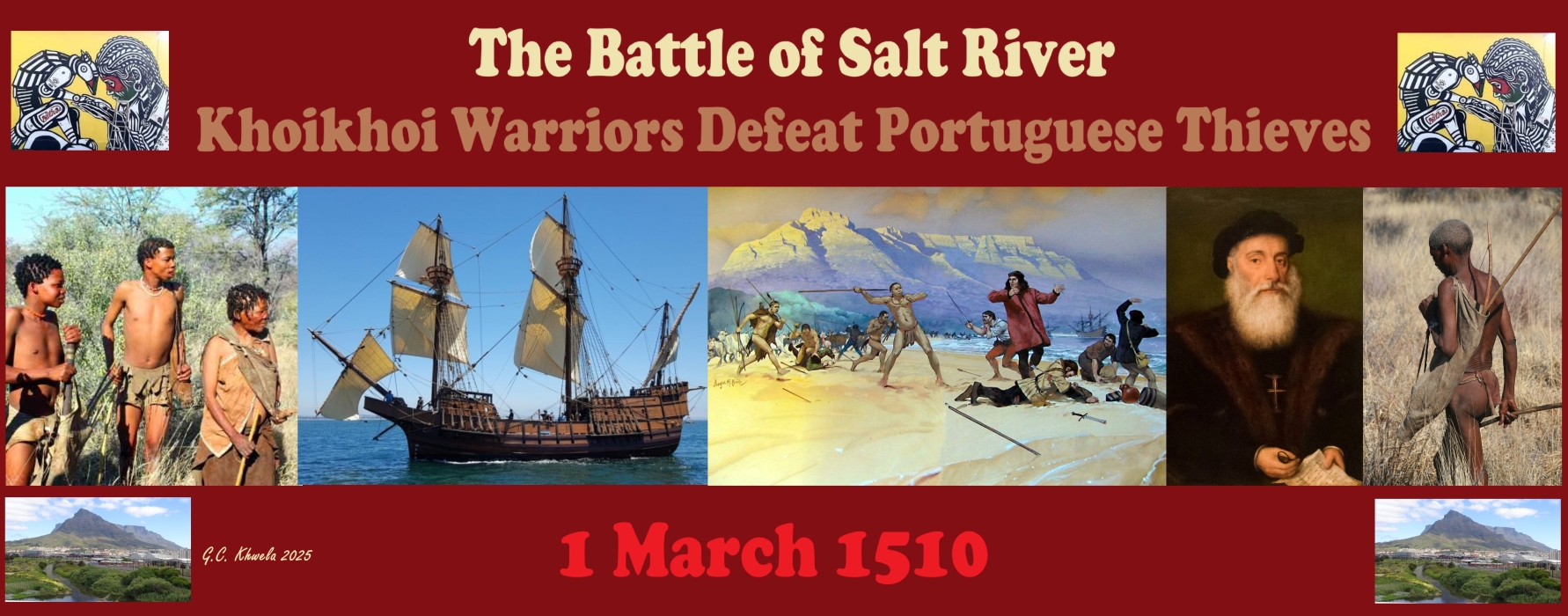
The Battle of Salt River: Khoikhoi Warriors Defeat Portuguese Thieves
On this day, 1 March 1510, at the mouth of Salt River, on the shore of Table Bay (in Cape Town), a momentous battle took place between Portuguese forces, under the command of Francisco de Almeida, and the local ǃUriǁʼaekua (recorded as “Goringhaiqua”) Khoikhoi people who were herding their cattle alongside the river to protect them from attack. In this conflict, which became known as the Battle of Salt River, the local ǃUriǁʼaekua Khoikhoi people humiliatingly defeated and achieved an eternal victory over the Portuguese.
Following his victory in the Battle of Diu in the Indian Ocean, which was a naval battle fought on 3 February 1509 in the Arabian Sea, in the Port of Diu, India, De Almeida began sailing for Portugal in December 1509. The Battle of Diu was between the Portuguese Empire and a joint fleet of the Sultan of Gujarat, the Mamlûk Burji Sultanate of Egypt and the Zamorin of Calicut, in order to control the spice trade. After this victory, on his way back to Portugal, with a fleet of three ships, the Garcia, Belém and Santa Cruz, De Almeida reached Table Bay, near the Cape of Good Hope, where the fleet dropped anchor in late February 1510, to replenish water.
At Table Bay they encountered the local indigenous people, the ǃUriǁʼaekua Khoikhoi abaThwa/Khwe nation. After a friendly trade with the ǃUriǁʼaekua, a group of 12 or 13 of the crew members visited their nearby village, which was situated in modern-day Observatory and Mowbray. In the ǃUriǁʼaekua village, an altercation took place as the Portuguese attempted to steal cattle from the ǃUriǁʼaekua. The Portuguese were chased from the village back to their ships, whereupon they begged De Almeida to take revenge against the ǃUriǁʼaekua Khoikhoi. After a long debate between the Portuguese officers on whether to take retaliatory action, De Almeida eventually agreed to conduct a castigatory raid the following morning.
On the morning of 1 March 1510, De Almeida commanded his captains Pedro and Jorge Barreto to return to the village with a force of around 150 men armed with swords, crossbows and spears and raided the village. The ǃUriǁʼaekua allowed the Portuguese to advance inland to be able to engage with them at close quarters when they entered the heavily bushed areas more inland. When the Portuguese reached the village, which they found deserted except for a few children and cattle, they began to loot what they found. To their surprise, a force of around 170 ǃUriǁʼaekua attacked them with stones, fire-hardened wood-tipped spears and poisoned arrows. Moreover, the ǃUriǁʼaekua also deployed specially trained cattle that responded to specific whistles and whoops.
When their weapons proved ineffective against the Portuguese, the ǃUriǁʼaekua hiding behind their cattle, employing them as moving shields, while they accurately threw their assegais and stones at the Portuguese. This tactic worked, as it forced the Portuguese to retreat to the beach, at what is today known as Salt River, in Cape Town. In hot pursuit, the ǃUriǁʼaekua’s forced the Portuguese into a close-quarters attack, resulting in a sudden defeat. The Portuguese were left without a retreat when they reached the beach, as the flagship’s master, Diogo d’Unhos, had moved the landing boats to a watering point farther up the beach.
Sensing an opportunity for an annihilation attack, the ǃUriǁʼaekua pounced on the Portuguese, during which De Almeida and 64 of his men perished, including 11 of his captains. A few of the Portuguese combatants that survived the attack managed to retreat farther up the beach to the landing-boats at the watering-points. Dom Francisco de Almeida’s body, a Portuguese nobleman, soldier and explorer, who had distinguished himself as a counsellor to King John II of Portugal and later in the wars against the Moors and in the conquest of Granada in 1492, as well as the first governor and viceroy of the Portuguese State of India, was recovered the same afternoon and buried on the shore close to where he had died.
The Battle of Salt River became a significant military embarrassment for the Portuguese and led to them enforcing stricter rules of not landing their ships in the region. The ǃUriǁʼaekua Khoikhoi warriors of the region also earned an outstanding status for ferocity amongst the European imperialists. This also affected Portuguese’s competitiveness for trade and influence in the Indian Ocean, as their directive not to land ships in the region put them at a long-term disadvantage with the Dutch, the English and the French, who as their competitors continued to land on the coast for replenishment.
Former South African President Thabo Mbeki referred to the Battle of Salt River as the “first moment of black anti-colonial struggle”. This momentous Battle also prevented the Western Cape, and perhaps the entire South Africa, becoming a Portuguese colony. This day should have been declared South Africa’s Heroes Day, as it was the first time indigenous South African Warriors encountered and defeated European invaders and thieves. Instead of 6 April 1652 being recognised as the first day of European invasion, the 1st of March must be celebrated as a day when our warriors showed Europe that we were not just a run over territory. This day, 1 March 1510, must be remembered and be recorded as an important date in our heritage, with movies, poems, music and other artefacts being created in its honour.
Sources:
Wikipedia.
South African History Online (SAHO).
Uzonna Anele, “The Battle of Salt River: The First Encounter Between Europeans and Indigenous People in South Africa”, Talk Africana, 2 August 2023.
Castro Khwela
Good evening fellow Compatriots!
Discover more from CASTRO KHWELA
Subscribe to get the latest posts sent to your email.


Thanks to Cde. Castro Khwela for feeding us with the correct records of our history.