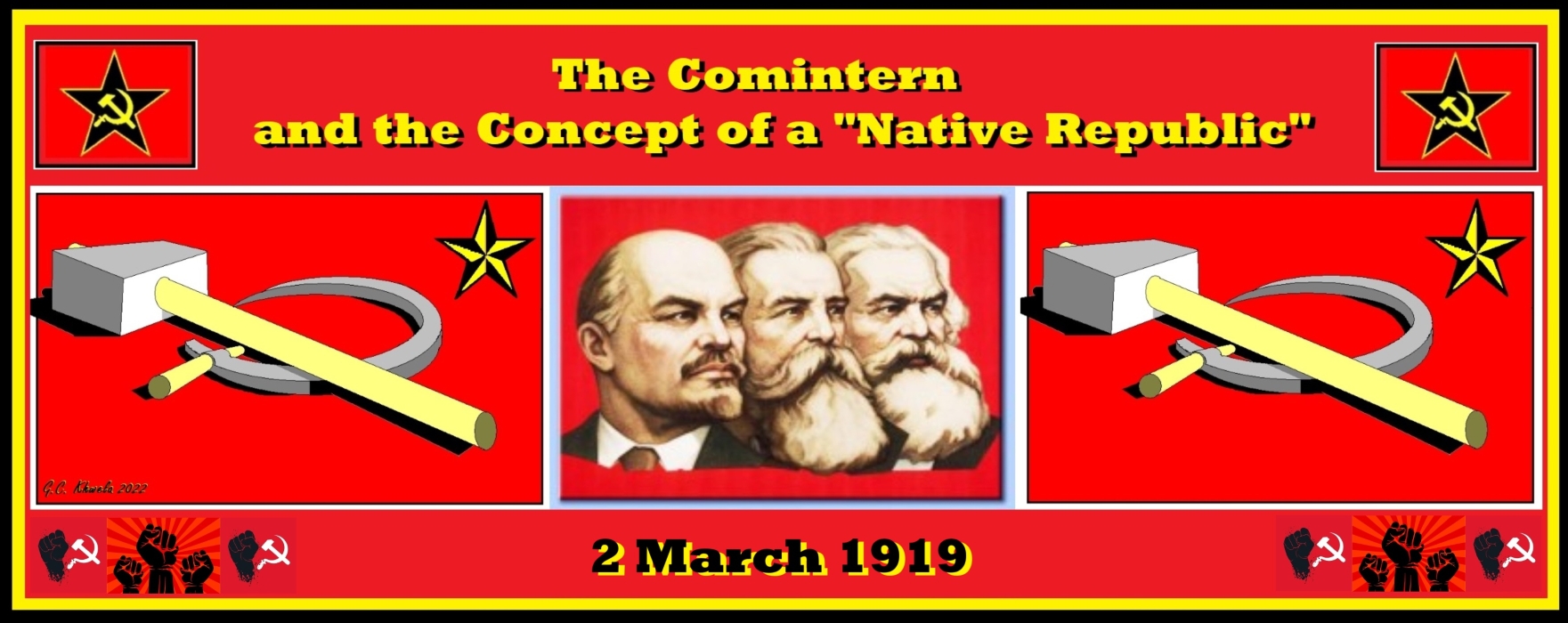
The Comintern and the Concept of a “Native Republic”
On 2 March 1919, the Communist International (Comintern) was formed. It was also known as the Third International, an international organisation that advocated for world socialism and ultimately communism. The Comintern was founded at a Congress held in Moscow on 2 – 6 March 1919, hosted by the Soviet Union, against the backdrop of the Russian Civil War.
It opened with a tribute to Karl Liebknecht and Rosa Luxemburg, who were murdered by the “Freikorps” during the “Spartakus Uprising”, which was a general strike (and the armed battles accompanying it) in Berlin from 5 – 12 January 1919. The main topic of discussion was “The Difference between Bourgeois Democracy and the Dictatorship of the Proletariat”.
The victory of the Russian Communist Party in the Bolshevik Revolution of November 1917 was felt throughout the world and an alternative path to power to parliamentary politics was demonstrated. With much of Europe on the verge of economic and political collapse in the aftermath of the carnage of World War I, revolutionary sentiments were widespread. The Russian Bolsheviks headed by Vladimir Lenin believed that unless socialist revolution swept Europe, they would be crushed by the military might of world capitalism just as the Paris Commune had been crushed by force of arms in 1871. The Bolsheviks believed that this required a New International to foment revolution in Europe and around the world.
Regarding the political situation in the colonised world, the Second Congress of the Communist International, held in July through August 1920, stipulated that a united front should be formed between the proletariat, peasantry and national bourgeoisie in the colonial countries: that all communist parties must support the bourgeois-democratic liberation movements in the colonies. Notably, some of the delegates opposed the idea of alliance with the bourgeoisie and preferred giving support to communist movements in these countries instead. The Congress removed the term “bourgeois-democratic” in what became the 8th condition.
At the Sixth World Congress on 17 July – 1 September 1928, the Comintern revised the policy of the United Front in the colonial world. The Congress even adopted a resolution for the Communist Party of South Africa (CPSA), which was founded in 1921, to adopt the “Native Republic” thesis, which stipulated that South Africa was a country belonging to the natives, that is, the Indigenous Black population. This decision, it is argued, caused consternation among many CPSA members, who regarded South Africa’s white proletariat as the focus of their action, rather than its black population.
The resolution was influenced by a delegation from South Africa led by James la Guma, then CPSA Chairperson, who had met with the leadership of the Comintern. The CPSA had reoriented itself at its 1924 Party Congress towards organising black workers and “Africanising the Party”. By 1928, 1,600 of the party’s 1,750 members were black. The party dismissed competing attempts at multiracial revolutionary organisations during this period, and used revisionist history to claim that the CPSA and its Native Republic policy was the only viable route to African liberation. Nevertheless, in 1935, the Seventh Comintern Congress withdrew the independent “Native Republic” slogan, with the CPSA also turning its attention less towards black political liberation and more on strengthening trade unionism.
Unfortunately, in 1943, Joseph Stalin, the leader of the Soviet Union, dissolved the Comintern for global diplomatic considerations and it was succeeded by the Cominform (the Communist Information Bureau) in 1947, which published the “World Marxist Review”, a joint periodical of the communist parties that played an important role in coordinating the International Communist Movement and the World Revolutionary Process, up to the break-up of the Eastern Bloc in 1989 – 1991.
Despite the dissolution of the Comintern in 1943, Terence Africanus argued that “Whatever shortcomings it may have from time to time developed, the Third International accomplished a great and indispensable mission, it helped to develop, to train and to purify scores of revolutionary Marxist-Leninist Parties in every continent; parties which have tirelessly and heroically defended the cause of the working class, of national liberation and socialism, in innumerable historic struggles everywhere; which have sacrificed innumerable martyrs on the battlefields and in the jails and torture-chambers of fascism and colonialism; which have raised high the red banner of Communism under the most dangerous conditions of illegality and terror; which have already led the workers to the conquest of state power in a dozen countries besides the Soviet Union, and tomorrow will liberate the whole world from capitalism. These Parties are the precious heritage bequeathed to mankind by the immortal Communist International” (The African Communist, No. 36, First Quarter 1969).
Currently, coordination is done through the International Meeting of Communist and Workers’ Parties (IMCWP), which is an annual conference attended by communist and workers’ parties from several nations. It originated in 1998 when the Communist Party of Greece (KKE) invited communist and workers’ parties to participate in an annual conference where parties could gather to share their experiences and issue joint declarations. The most recent and 21st meeting of the IMCWP was held in October 2019 in Turkey and hosted by the Communist Party of Turkey (TKP).
It is important to emphasise that “The history of the Communist International – in its firmness of discipline, its tradition of unyielding struggle against opportunism, nationalism and other departures from internationalist principles is a rich treasury of lessons which cannot be disregarded by the revolutionary movement of our times” (Terence Africanus).
Sources:
Wikipedia.
Stephen Ellis, “External Mission: The ANC in Exile”.
Vladimir Shubin, “ANC: A View from Moscow”.
Terence Africanus, “Comintern”, The African Communist, No. 36, First Quarter 1969).
Castro Khwela
Good evening fellow Compatriots!
Discover more from CASTRO KHWELA
Subscribe to get the latest posts sent to your email.