The Jacobs Car Bomb – 12 July 1984
On Friday, 13 July 1984, newspapers in and around Durban reported that a car bomb hurled shattered glass and shredded metal into a crowded street scene on Thursday, 12 July 1984, killing five people and injuring 27, at least one of them seriously. The blast, Durban’s second car bomb attack in three months, erupted outside warehouses in the Mobeni industrial area at the height of the afternoon rush hour.
The explosion shattered windows over a wide area and blew in the front of a nearby warehouse, reducing the unidentifiable vehicle to thousands of glass and steel projectiles. Cars parked nearby were pock-marked as though by machine-gun fire and glass littered the street. Durban residents said dark smoke still hung over the scene shortly before nightfall while police inspected the cordoned-off site with dogs.
The car bomb that exploded in Durban on 12 July 1984 became known as the “Jacobs” car bomb, according to an application for amnesty by Raymond Lalla. In his amnesty request from the Truth and Reconciliation Commission (TRC), Raymond Lalla, a member of the African National Congress (ANC) and a senior Commander in Umkhonto we Sizwe (MK), maintained that this bomb was intended to sabotage military targets in the Durban area, and he understood that these bombs could potentially harm or kill unsuspecting civilians.
With respect to the Jacobs car bomb on 12 July 1984, Lalla stated in an affidavit that he, with his Commander, the late Thami Zulu, met with the late Cyril Raymonds (aka “Fear”) and a person known as “Rabbit”, discussed car bombs and other operations to be launched against military targets in the Durban area, where “Fear” was the Chief of Operations.
Lalla was granted amnesty for his role in setting up this operation, as it was considered to be a part of broader political objectives which did not intend to take lives. It emerged from the evidence that Lalla not only discussed the planning of attacks on military targets, but he also provided or arranged for the provision of the explosives and detonators used in the construction of car bombs. Unfortunately, no evidence was led before the TRC as to what the intended targets were or how the explosions actually occurred.
The TRC was accordingly of the view that the Applicant was entitled to amnesty in respect of his participation in the two car bomb incidents which occurred on the Victoria Embankment on 3 April 1984 and at Jacobs on 12 July 1984, as well as to amnesty in respect of the role he played in the planning, facilitation and implementation of Operation Butterfly and all incidents carried out in furtherance of or arising from that operation and of all acts, offences or delicts arising therefrom.
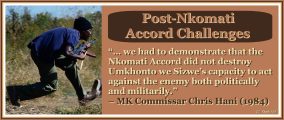
ANC President Oliver Tambo asserted that the bomb had been intended for a military convoy and condemned the bombers for being “inexcusably careless” by causing civilian casualties. Unfortunately, according to the ANC’s TRC submission, “civilian casualties were frequent and notorious consequences of irregular forms of military combat … In contrast with a conventional military force, in which virtually all planning takes place at Headquarters level by experienced officers, in guerrilla warfare most of the … detailed planning takes place at the lowest level.”
“Each cadre”, the ANC’s TRC submission continued, “has to be trusted to make decisions with regard to choice of target within ANC policy, whilst keeping a close eye on developments and feelings among the people in his/her community – a responsibility which no soldier in a conventional force ever has to face. At times, an operation would take place in support of campaigns or other struggles taking place within the community – such as strike action … a rent or bus boycott. An explosion at an office block, a railway line, factory or supermarket makes sense in this context. Civilians were never the targets in these cases –however, it did happen in some instances that the timing of a blast went wrong for a range of reasons and resulted in unintended civilian casualties.”
“Another bomb blast … e-Durban!” Sounded the Umkhonto slogan during the toyi-toyi high-stepping syncopated march in the Angolan bushes.
Sources:
South African History Online (SAHO).
Truth and Reconciliation Commission, “Amnesty Application: Rayman Lalla”, Truth and Reconciliation Commission Amnesty Committee, Cape Town, 17 May 2001.
African National Congress, “Further Submissions and Responses by the African National Congress to Questions Raised by the Commission for Truth and Reconciliation”, 12 May 1997.
UPI, “4 Dead in 2nd Durban Car Bombing in 3 Months”, United Press International, 12 July 1984.
UPI, “A Bomb Planted in a Car Exploded Thursday in…”, United Press International, 12 July 1984.
Thula Simpson, “Umkhonto we Sizwe: The ANC’s Armed Struggle”, Penguin, 2016.
Jocelyn Alexander and JoAnn McGregor, “The Travelling Toyi-Toyi: Soldiers and the Politics of Drill”, Journal of Southern African Studies, Vol. 46, No. 5, 2020.
Castro Khwela
Good day fellow Compatriots!
Discover more from CASTRO KHWELA
Subscribe to get the latest posts sent to your email.