The Pretoria Church Street Bombing: Apartheid Retaliation
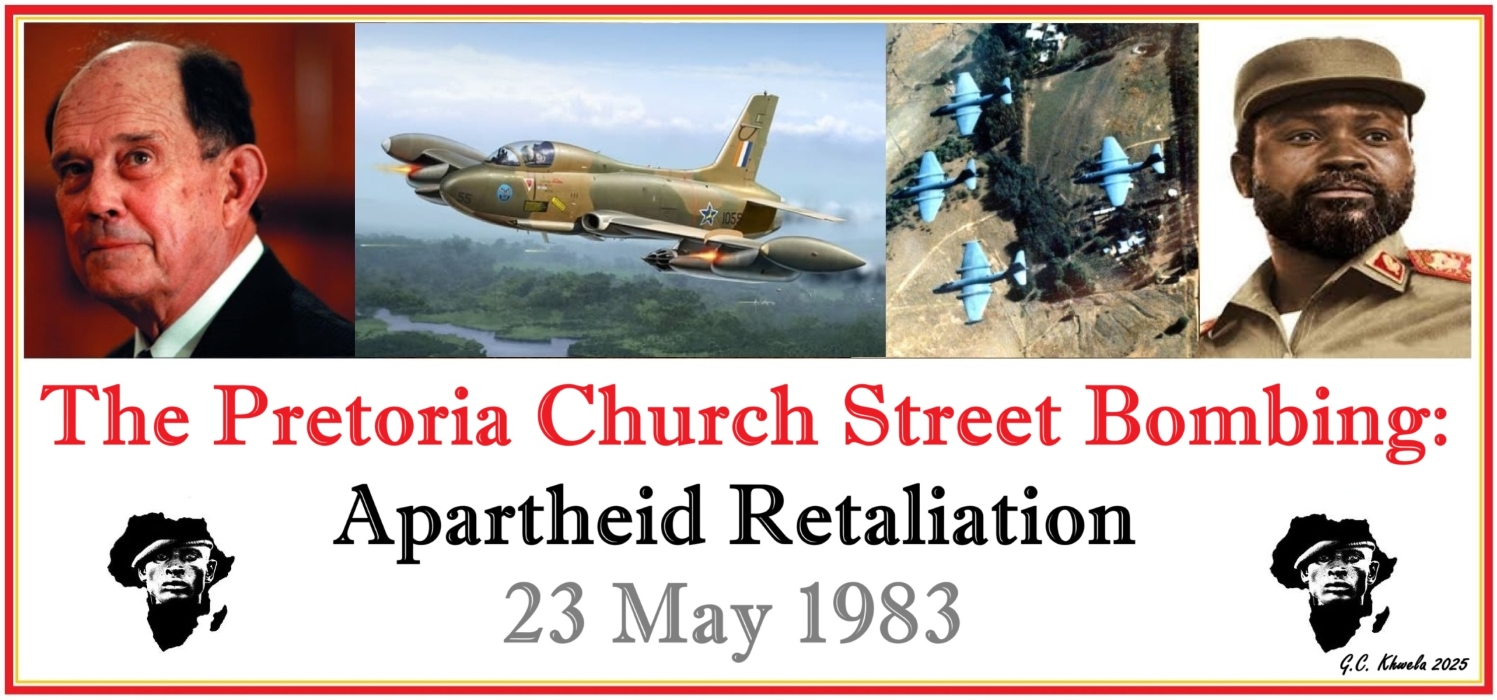
On 23 May 1983, just before 07:30, in the morning, apartheid South African Air Force (SAAF) Impala and Canberra planes were flying over the Bay of Maputo, where they ploughed rockets into an orange grove next to an old Portuguese Villa on Rua Ingineira Pinto Texeira. The SAAF carried out these aircraft bombardments as a revenge raid against the African National Congress (ANC) targets in Maputo, Mozambique, following the Church Street explosion in Pretoria on 20 May 1983.
The shrapnel from the explosions wounded a young girl at a crèche who had nothing to do with the 20 May 1983 attack. Just behind the building, was a state-run Somopal grapefruit and jam factory, where rockets bombarded the outer walls of the crèche and blew two holes out of the foot of the breeze-block walls surrounding the property’s grounds. Further on, a whitewashed Spanish-style house had its living room devastated by a rocket fired from the planes, as well as at a property just beyond the same house, two children who went to look when they heard the planes approaching were hit by shrapnel splinters.
At the Umkhonto we Sizwe (MK) Transvaal Urban Machinery’s former headquarters in Liberdad, rockets fell in a garden but did little damage to the building itself. Of the six houses that were attacked, some had been vacated by the ANC up to a year earlier. The apartheid South African Defence Force (SADF) claimed that 64 persons had been killed, including 41 “terrorists”. In fact, the ANC suffered only one casualty, a driver who was cleaning his vehicle in the street, but three Mozambicans, who were employees at the jam factory, were also killed, and approximately forty who were wounded. Pretoria’s officials boasted that they had destroyed an ANC arms depot, which turned out to be a jam factory.
Following the bombings of facilities in Maputo by the SAAF, a joint statement was issued by the European Community foreign ministers which condemned the raid as a violation of international law. Similarly, the Organisation of African Unity (OAU) deplored the raid, with Egypt saying that it was “treacherous aggression and a threat to peace in southern Africa”. In Eastern Europe, Hungary and the former Soviet Union condemned the raid, and China called it a “crime of barbarous aggression”. Sweden referred to the raid as “a violation of international law”, while North Korea condemned the act, and Japan expressing regret that it took place.
The United States and Australia condemned both the Pretoria bombing and the apartheid SAAF raid as “actions of an extreme kind”. A report in the New York Times on 6 June 1983 featured extracts from an interview conducted with General Constand Viljoen, Chief of the apartheid SADF. Viljoen explained that the rationale behind apartheid South Africa’s regional strategy was to focus on shutting MK out of neighbouring countries. General Viljoen maintained that the FRELIMO (Mozambique Liberation Front) government had steered away foreign correspondents from where “at least forty” MK cadres had been killed by rocket and machine gun fire.
Asked whether the ANC would be stopped dead in their tracks if that occurred, Viljoen said, “I think so. Oh yes. I wouldn’t say ‘dead in their tracks’ but they would just not be able to operate. If we deny them bases in all our neighbouring states, either through cooperation of the states themselves, which we hope will be possible, or by means of military action against their bases, then they have only two ways to come in, by air or by sea. It makes it almost impossible for them.”
General Constand Viljoen’s assertions were based on secret discussions held in Pretoria between the representatives of the Mozambican and the apartheid South Africa governments after the Pretoria, Church Street bombing, in which the apartheid government considered the Church Street bombing to be a gruesome incident, the largest “terrorist” act in the history of South Africa. The Mozambican government was accused of harbouring MK cadres that had undertaken acts of “terrorism” against the apartheid South African state.
The ANC was subsequently not informed of the content of the Mozambican negotiations with Pretoria. As a consequence, the Mozambican government acted negatively on the ANC, for example, the issuing of visas to ANC cadres wishing to enter Mozambique was stopped, and the registration of all ANC members was required, as was the confiscation of weapons. The Mozambicans regarded the 31 flats and houses where ANC members lived in Maputo as a threat to their security. The use of the “corridors” on the Mozambican border with Swaziland was restricted, and ANC activists were evicted from some houses.
Following these worrying actions by the Mozambican government, in August 1983, in an interview with The Guardian newspaper, Oliver Tambo stated: “The Machels, Dos Santoses, Kaundas, Mugabes – they are all creations of liberations struggle. If they did what South Africa wanted them to do, to destroy the liberation struggle, they would be destroying their own independence … There may be limitations as to what they can do in practice, but they cannot be our enemies” (Simpson).
Sources:
Wikipedia.
South African History Online (SAHO).
Peter Stiff, “The Silent War: South African Recce Operations, 1969 – 1994”, Galago, 1999.
Thula Simpson, “Umkhonto we Sizwe: The ANC’s Armed Struggle”, Penguin, 2016.
Hugh Macmillan, “The Lusaka Years: The ANC in Exile in Zambia, 1963 to 1994”, Jacana, 2013.
Stephen Ellis, “External Mission: The ANC in Exile”, Jonathan Ball, 2012.
Vladimir Shubin, “ANC: A View from Moscow”, Jacana, 2008.
Castro Khwela
Good evening fellow Compatriots!
Discover more from CASTRO KHWELA
Subscribe to get the latest posts sent to your email.