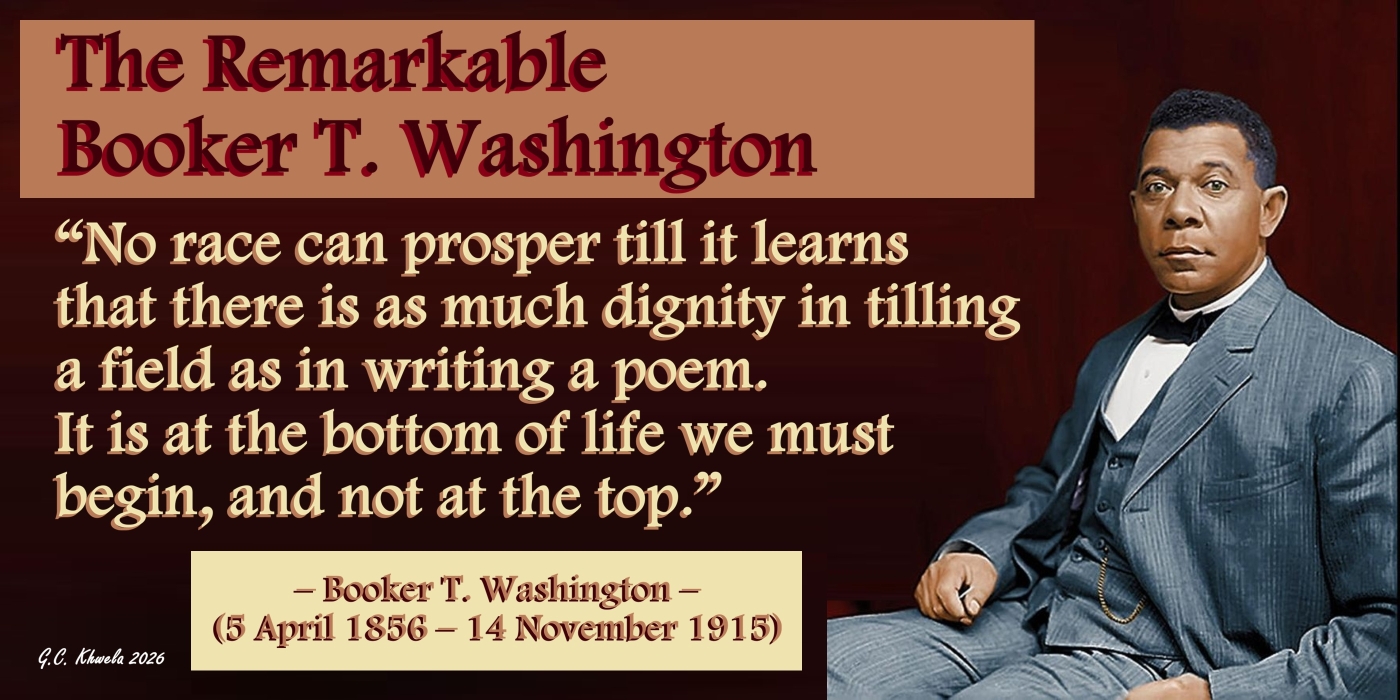
The Remarkable Booker T. Washington
170 years ago, on 5 April 1856, Booker Taliaferro Washington was born in a hut in Franklin County, Virginia. His mother was a cook for the plantation’s owner. His father, who was a white man, was unknown to Washington. He was born into slavery and rose to become a leading African American intellectual of the 19th century, founding Tuskegee Normal and Industrial Institute (now called Tuskegee University) in 1881 and the National Negro Business League two decades later. Washington advised Presidents Theodore Roosevelt and William Howard Taft and his infamous conflicts with Black leaders like W. E. B. Du Bois over segregation caused a stir. However, nowadays, he is remembered as the most influential African American speaker of his time.
At the close of the American Civil War, all the enslaved people owned by James and Elizabeth Burroughs, including 9-year-old Booker, his siblings, and his mother, Jane, were freed. Jane moved her family to Malden, West Virginia, where she soon thereafter, she married Washington Ferguson, a free Black man. In Malden, Washington was only allowed to go to school after working from 04:00 to 09:00 each morning in a local salt works before going to class. It was at a second job in a local coalmine where he first heard two fellow workers discuss the Hampton Institute, a school for formerly enslaved people in southeastern Virginia founded in 1868 by Brigadier General Samuel Chapman. Chapman had been a leader of Black troops for the Union during the Civil War and was dedicated to improving educational opportunities for African Americans.
In 1872, Booker T. Washington walked 800 kilometres to Hampton, where he enlisted at the Hampton Institute and became an excellent student, receiving high grades. Subsequently, he went on to study at Wayland Seminary in Washington, D.C., and had so impressed Chapman that he was invited to return to Hampton as a teacher in 1879. Consequently, Chapman referred Washington for a role as principal of a new school for African Americans in Tuskegee, Alabama, which was called The Tuskegee Normal and Industrial Institute. Washington assumed the role in 1881 at age of 25 and would work at The Tuskegee Institute until his death in 1915.
Washington went on to hire George Washington Carver to teach agriculture at Tuskegee in 1896. Carver evolved to become a celebrated figure in Black history in his own right, making huge advances in botany and farming technology. For Black people life in the post-Reconstruction era South was challenging, as discrimination was rife in the age of Jim Crow Laws and exercising the right to vote under the 15 Amendment became dangerous. During this period, access to jobs and education was severely limited, and with the dawn of the Ku Klux Klan, the threat of retaliatory violence for advocating for civil rights was real.
On 18 September 1895, Washington told a majority white audiences in Atlanta, in what was his most famous speech, that given that the way forward for African Americans was self-improvement through an attempt to “dignify and glorify common labour.” For Washington, it was better to remain separate from whites than to attempt desegregation as long as whites granted their Black countrymen and women access to economic progress, education, and justice under the United States court system.
In his speech, Washington maintained that “The wisest of my race understand that the agitation of questions of social equality is the extremist folly and that progress in the enjoyment of all the privileges that will come to us must be the result of severe and constant struggle rather than artificial forcing. The opportunity to earn a dollar in a factory just now is worth infinitely more than to spend a dollar in an opera house.”
His speech was sharply criticized by W.E.B. Du Bois, an African American sociologist, writer, historian, and Pan-Africanist civil rights activist, who repudiated what he called “The Atlanta Compromise” in a chapter of his famous book, “The Souls of Black Folk”, which was published in 1903. Opposition to Washington’s views on race inspired the Niagara Movement, a civil rights organisation led by W.E.B. Du Bois and William Monroe Trotter, demanding full political, civil, and social rights for African Americans, which was founded in 1905.
Du Bois went on to find the National Association for the Advancement of Colored People (NAACP), which was a premier United States civil rights organisation founded in 1909, to advance justice, equality, and rights for African Americans. It operated through advocacy, legal action, and grassroots organising, with initiatives including voting rights, criminal justice reform, and economic empowerment. Because of Booker T. Washington’s outsized stature in the Black community, dissenting views were strongly squashed. Du Bois and others criticised Washington’s harsh treatment of rival Black newspapers and Black thinkers who dared to challenge his opinions and authority.
Booker T. Washington became the first African American to be invited to the White House in 1901, when President Theodore Roosevelt invited him to dine with him. It caused a huge uproar among white Americans – especially in the Jim Crow South – and in the press, and came on the heels of the publication of his autobiography, “Up From Slavery”. However, Roosevelt saw Washington as a brilliant advisor on racial matters, a practice that his successor, President William Howard Taft, continued.
By 1913, at the dawn of the administration of Woodrow Wilson, Washington had largely fallen out of favour in the African American community. He remained at the Tuskegee Institute until congestive heart failure ended his life on 14 November 1915, at a relatively young age of 59. While he lived through an epic sea change in the lives of African Americans, his public views supporting segregation appear to be outdated today. His emphasis on economic self-determination over political and civil rights fell out of favour as the views of his largest critic, W.E.B. Du Bois, took root and inspired the civil rights movement.
Nonetheless, despite the political controversies, Washington secretly financed court cases that challenged segregation and wrote letters in code to defend against lynch mobs. Additionally, his work in the field of education helped give access to new hope for thousands of African Americans. The Tuskegee Institute, which he led, for instance, inspired the first President of the South African Natives National Congress (SANNC) that later became the African National Congress (ANC), John Langalibalele Dube, to establish a school near Durban, the Ohlange Zulu Christian Industrial School which is now the Ohlange High School at Inanda, near Phoenix and EkuPhakameni.
Sources:
Wikipedia.
History.com Editors, “Booker T. Washington”, HISTORY.com, https://www.history.com/articles/booker-t-washington (accessed 04.04.2026).
Nana Lawson Bush, “Booker T. Washington (1856-1915)”, BlackPast.org, 18 January 2007.
Biography.com, “Booker T. Washington (Biography)”, https://www.biography.com/scholars-educators/booker-t-washington (accessed 04.04.2026).
Tuskegee University, “Dr Booker Taliaferro Washington”, Tuskegee University, https://www.tuskegee.edu/legacy/booker-t-washington.html (accessed 04.04.2026).
Castro Khwela
Good evening fellow Compatriots!
Discover more from CASTRO KHWELA
Subscribe to get the latest posts sent to your email.