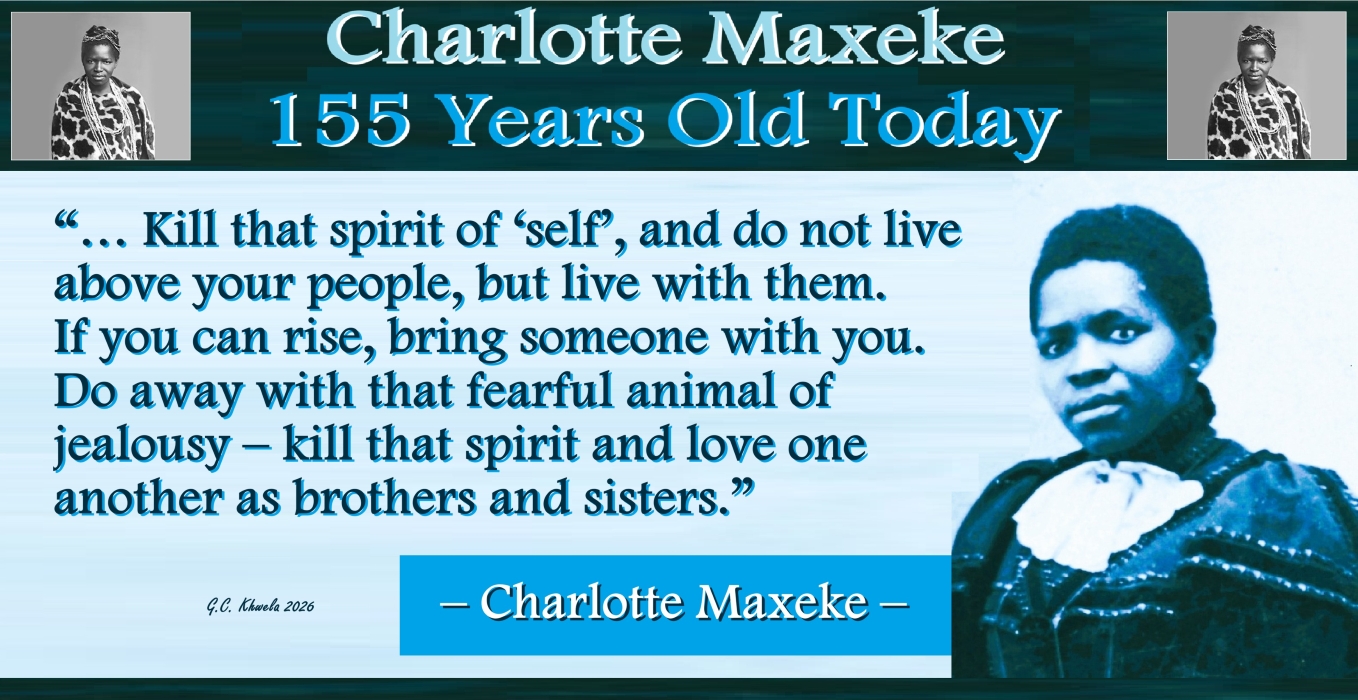
Charlotte Maxeke 155 Years Old Today
On this day, 7 April 1871, 155 years ago, Charlotte Makgomo (née Mannya) Maxeke was born. Charlotte Maxeke was a social and political activist, religious leader, the first black woman to graduate with a university degree in South Africa and to graduate from an American university, a B.Sc. from Wilberforce University, Ohio, in 1903. She became a founder of the Bantu Women’s League, which later was rechristened the African National Congress (ANC) Women’s League.
Charlotte Makgomo (née Mannya) Maxeke was born in Ramokgopa, in the Pietersburg district, the daughter of John Kgope Mannya, who was the son of headman Modidima Mannya from Batlokwa people, under Chief Mamafa Ramokgopa, and Anna Manci, a Xhosa woman from Fort Beaufort. Charlotte’s father was a roads foreman and Presbyterian lay preacher, and her mother was a teacher. Her grandfather served as a key adviser to the King of the Basotho. Soon after her birth, Charlotte’s family moved to Fort Beaufort, where her father was employed at a road construction company.
At age 8, she began her primary school classes at a missionary school in Uitenhage. She excelled in Dutch and English, mathematics and music. Charlotte’s musical prowess was visible at a young age. From Uitenhage, she moved to Port Elizabeth to study at the Edward Memorial School. She excelled and completed her secondary school education in record time, achieving the highest possible grades. In 1885, after the discovery of diamonds, Charlotte moved to Kimberley with her family.
After arriving in Kimberley in 1885, Charlotte began teaching fundamentals of indigenous languages to expatriates and basic English to African “bossboys” – an offensive word for foremen in charge of a team of mineworkers or other labourers. Charlotte joined the African Jubilee Choir in 1891, and her talent attracted the attention of a local choir master who was organising an African choir to tour Europe. The rousing success after her first solo performance in Kimberley Town Hall immediately resulted in her appointment to the Europe-bound choir operation. The group left Kimberley in early 1896 and sang to numerous audiences in major cities of Europe, Canada and the United States.
During the choir’s tour of the United States, the group was abandoned by their escort, Mr Bam, in Cleveland. Fortunately, Bishop Daniel A. Payne of the African Methodist Church (AME) in Ohio, a former missionary in the Cape, organised the churchgoers to provide for the abandoned troupe’s continued stay in America. The choir were made to settle for a church scholarship at Wilberforce University, the AME Church University in Xenia, Ohio. At the university, Charlotte was taught by W.E.B Du Bois, a major African American sociologist, writer, historian, and Pan-Africanist civil rights activist. After obtaining her B.Sc. degree from the Wilberforce University in 1903, she became known as the first black South African woman to earn a degree.
It was at Wilberforce that Charlotte met her future husband, Reverend Dr Marshall Maxeke, and the couple got married in 1903. Charlotte became politically active while serving in the African Methodist Episcopal Church, advocating the cause of education for Africans in South Africa. The church later elected her president of the Women’s Missionary Society. Shortly after her return to South Africa, she and her husband established a Wilberforce Institute, which later became one of the leading Transvaal higher schools of learning for Africans.
Charlotte began her involvement in anti-colonial politics, when she, along with two other individuals from the Transvaal, attended an early Native National Congress meeting, and she was one of the few women present. She also attended the formal launch of the South African Native National Congress (SANNC) in Bloemfontein in 1912. Charlotte also became active in the movements against pass laws through her political activities.
During the Bloemfontein anti-pass campaigns, Charlotte served as an impetus towards eventual protest by organising women against the pass laws. It should be remembered that the question of passes in the Free State forced women as early as 1913 to go beyond petitions and deputations by refusing to carry passes and backed their action with mass demonstrations. This led Charlotte to the founding of the Bantu Women’s League (BWL), which was also referred to as the “African Women’s League”, and later, in 1948, became the foundation of the African National Congress (ANC) Women’s League. As President of the African Women’s League, she led a delegation to the Prime Minister to discuss the question of the passes for women in the Free State.
Charlotte also participated in protests related to low wages at Witwatersrand and eventually joined the Industrial and Commercial Workers Union (ICU) in 1920. She extended her support to the early efforts of Clements Kadalie and Selby Msimang to launch a national trade union movement for Africans. Her main contributions were not only as an activist, but also as a writer of note, as she always sought to combine her actions with reflection, blending theory with practice. She made use of her journalistic skills as she and her husband were also editors of local African newspapers.
One of her greatest contributions related to the analysis of the women’s question in South Africa, particularly the address she made on “Social Conditions Among Bantu Women and Girls” at a conference of “European and Bantu Christian Student Associations” at the University of Fort Hare, which was held from 27 June to 3 July 1930. In this address she discussed questions connected with the African home and family, the role of women in the family and the problems of the peaceful working of the homes. According to Charlotte, these problems emanated from the adverse effects of the migratory system – “the stream of Native life into the towns” – and the laws and regulations that prevented African wives from living with their husbands.
“Many of the Bantu feel and rightly too that the laws of the land are not made for Black and White alike. Take the question of permits for the right to look for work. To look for work, mark you! The poor unfortunate Native, fresh from the country does not know of these rules and regulations, naturally breaks them and is thrown into prison; or if he does happen to know the regulations and obtains a pass for six days, and is obliged to renew it several times, as is of course very often the case, he will find that when he turns up for the third or fourth time for the renewal of his permit, he is put into prison, because he has been unsuccessful in obtaining work.” – Charlotte Maxeke, “Social Conditions Among Bantu Women and Girls”, 27 June to 3 July 1930.
Charlotte was very articulate in presenting the effects of racial discrimination, the problems of domestic servants, religious aspects, work permits, the social effects of racism on the wife and children, and the land question. She referred to the land question as a “very acute question”, since according to her, South Africa in terms of the land available to the Africans was “shrinking daily” and cattle diseases were ruining African wealth which was “gradually decaying”. She viewed these issues from a Pan-Africanist perspective, as one of Charlotte’s favourite topics was the question of African unity on a continental scale.
Charlotte Maxeke remained active in politics until her death on 16 October 1939, in Johannesburg, at the age of 68, showing outstanding qualities as a leader of the ANC, a social worker, a teacher, journalist, a thinker and pioneer of the AME church. In December 1935, at a meeting of the All-African Convention, Dr A.B. Xuma, who later became the President-General of the ANC, characterised Charlotte Maxeke as “the mother of African freedom in this country”. Her activities indirectly led some women, such as Mama Albertina Sisulu, to join the ANC Youth League in the 1940s and to form the ANC Women’s League, which in turn led to the formation of the Federation of South African Women (FEDSAW).
Sources:
Wikipedia.
South African History Online (SAHO).
Charlotte Maxeke, “Social Conditions Among Bantu Women and Girls”, Address at the Conference of European and Bantu Christian Student Associations at the University of Fort Hare, 27 June to 3 July 1930.
Sechaba Columnist, “Charlotte Maxeke: A Fabulous Woman”, Sechaba, August 1980.
Castro Khwela
Good day fellow Compatriots!
Discover more from CASTRO KHWELA
Subscribe to get the latest posts sent to your email.