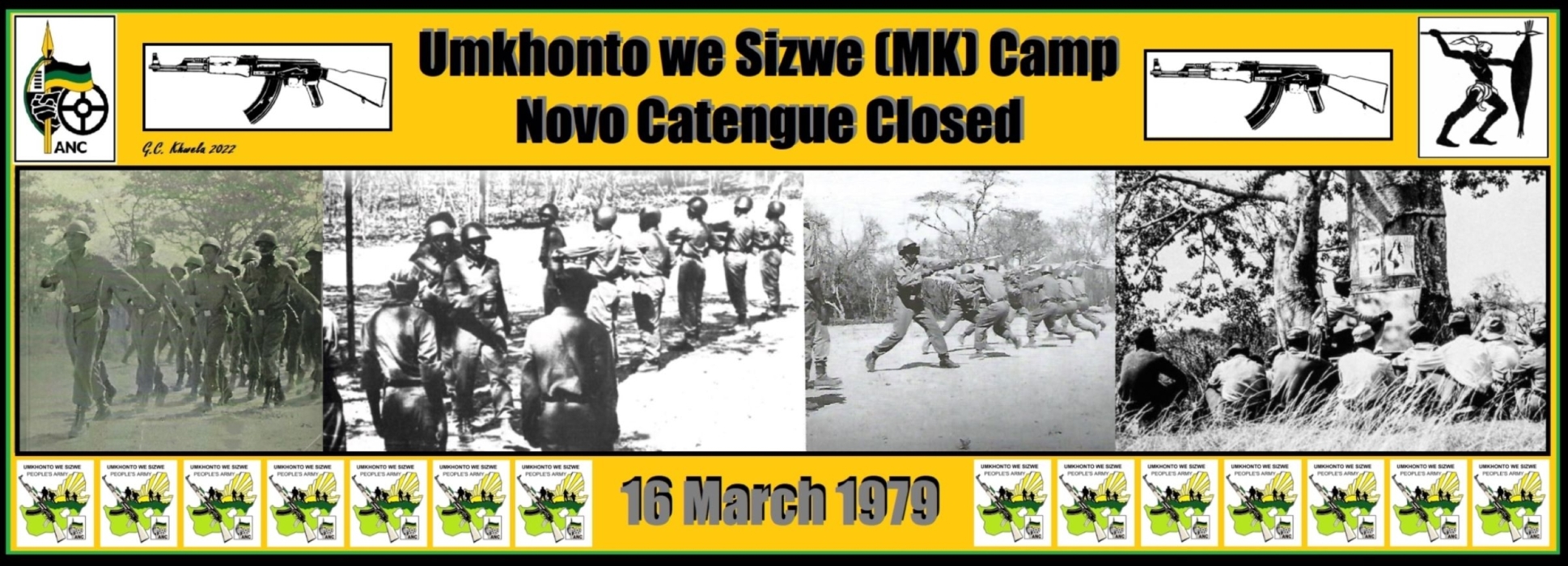
Umkhonto we Sizwe (MK) Novo Catengue Camp is Closed
On 16 March 1979, a huge number of Umkhonto we Sizwe (MK) combatants arrived in Pango Camp, as well as others in Quibaxe Camp, about 200km northeast of Luanda, Angola, following the bombing and closure of the Novo Catengue base camp, on 14 March 1979, approximately 430km south of Luanda, affectionately known as the “University of the South”.
They were taken in military trucks to the port of Benguela, where they found a huge naval vessel waiting for them. The vessel took off into the night and having been drilled during their military training in topography, these MK cadres could tell that they were sailing north. They took the whole night to reach their destination and were taken to a bushy patch of land with a few old, dilapidated, white housing structures and told to do their best to turn the place into a new camp. They had arrived in Quibaxe and some were dispatched to Pango, both camps in Angola’s Cuanza Norte province.
What had happened on the morning of 14 March 1979, was that there was a unit guarding the approaches to the camp, at Novo Catengue. There was also a platoon living outside the camp, which was in possession of anti-tank guns. At about 07:00, Commander Mshengu (aka “Uncle”), the commander of the anti-tank platoon, was among approximately 600 cadres on their way back to the camp for breakfast after spending the night in the bush as part of the on-going safety precautions against an attack following apartheid South African Prime Minister B.J. Vorster’s speech threatening to attack Novo Catengue.
On their way back to the camp, they saw two SA Air Force Canberra jets approaching. There were only about eleven people in the camp at the time, who were preparing breakfast. Among them were a Cuban Commander and Commissar. More than 500 bombs of different types were dropped on the camp, two MK cadres, one of which was a female, and one Cuban, were killed in the attack, which lasted a mere three minutes. When the Canberras left, the camp had been razed to the ground. One of the Canberras was hit by one of anti-aircraft units in the camp and had crashed in the south of Angola.
The bombing happened at exactly 07:15 in the morning and the relatively low number of casualties was because camp personnel had taken precautions of sleeping outside the perimeter because MK had received advance intelligence about a possible enemy attack. There had been previous air attacks on PLAN (People’s Liberation Army of Namibia – armed wing of the South West African People’s Organisation – SWAPO) and ZIPRA (Zimbabwean People’s Revolutionary Army – the armed wing of the Zimbabwean African People’s Union – ZAPU) installations in southern Angola.
The air raid was immediately considered to be a result of information passed to the apartheid Security Forces, although it was also argued that since the camp was located in view of Angola’s main railway line, it could quite easily have been reconnoitred from the air or on the ground without inside help. Nevertheless, “it became pretty obvious to us that the apartheid regime had accurate knowledge of the routine in the camp. The punctuality of the raid, exactly at morning assembly time, was no coincidence” (Vusi Mavimbela).
According to Mavimbela, “We can also assume that they knew the camp routine from MK guerrillas they had captured and tortured. In hindsight, it was short-sighted of our senior commanders to maintain the same camp assembly routine for almost two years. One can only assume that they were lulled into a false sense of security by Novo Catengue’s distance from South Africa. They might have thought that the camp was not within striking distance of military aircraft based there and in South West Africa.”
Although life was austere at Novo Catengue, the high quality of political and military instruction in the camp’s heyday, combined with the excitement of taking part in a collective revolutionary enterprise, generated real enthusiasm amongst the MK cadres. Following the 1977 Black September poisonings as well as the 1979 air raid at the camp, the African National Congress (ANC) was completely convinced that the organisation had been heavily infiltrated. According to analysis, the arrival of the 1976 generation was the main cause of this situation, when many students came into the ranks of the liberation movement. Some were obviously recruited, trained and sent to infiltrate the ANC as “sleepers”, ordered to lie low for many months before becoming active, by trying to strive to get to the top leadership, up to the point of effective decision-making.
Most of the 1976 recruits, most of whom were former Black Consciousness Movement (BCM) members, were groomed in BCM politics, and had to adjust to ANC’s understanding of the South African revolution when they went to exile. According to Luli Callinicos, “Tambo suggested that the camp request Jack Simons, the brilliant retired Professor of Sociology at the University of Zambia and formerly a popular radical lecturer in African Government and Law at the University of Cape Town, to run a course on the history and theory of the National Democratic Revolution for MK recruits at Novo Catengue.”
For cadres of the June 16 Detachment of MK, Novo Catengue became the “University of the South”, as it was “the cradle of a new cadre of the ANC, where cadres were educated not only in the art of war, but in politics and philosophy” (James Ngculu). Luli Callinicos confirms that “Oliver Tambo was concerned not only to use education as a weapon in the struggle, but also to build an intelligentsia within the army itself, as well as throughout the movement. History and political theory were particularly important in developing political cadres. Their key task on their return was to wage a disciplined and informed guerrilla operation, which would recruit and guide the community in which they found themselves. A grasp of the strategy of liberation as a whole was crucial to the success of this process.”
The instructors in Novo Catengue camp were mainly Cubans but were assisted by members of the Mgwenya (MK’s first Luthuli Detachment) group and the mid-1970s group, who had left South Africa before the June 16 Soweto Uprising. Political instruction was given by leading members of the ANC and the South African Communist Party (SACP), such as Ronnie Kasrils, Mark Shope, Jack Simons and Albert Dhlomo, amongst others.
With regards to Novo Catengue, ANC President Oliver Tambo maintained, “In building up our own popular army”, he explained to the troops “we aim … not only at the overthrow of the fascist regime, we aim also at building up a politically conscious and revolutionary army, conscious of its popular origin, unwavering in its democratic functions and guided by our revolutionary orientation” (Luli Callinicos).
Greeting the soldiers every day, Commissar Mark Shope, a South African Congress of Trade Unions (SACTU) leader, who was keen on political education, would say “Sons and daughters of the working class, good morning!” (James Ngculu).
Sources:
South African History Archives (SAHA).
Luli Callinicos, “Oliver Tambo and the Dilemma of the Camp Mutinies in Angola in the Eighties”, South African Historical Journal, Vol. 64 No. 3, 2012.
Luli Callinicos, “Oliver Tambo: Beyond the Engeli Mountains”, David Philip Publishers, 2004.
James Ngculu, “The Honour to Serve: Recollections of an Umkhonto Soldier”, David Philip Publishers, 2009.
Stephen Ellis, “External Mission: The ANC in Exile”, Jonathan Ball, 2012.
Vusi Mavimbela, “Time is Not the Measure: A Memoir”, Real African Publishers, 2018.
Lynda K. von den Steinen, “Soldiers in the struggle: Aspects of the Experiences of Umkhonto we Siswe’s Rank and File soldiers – The Soweto Generation and After”, Thesis (M.A. History) – University of Cape Town, 1999.
Castro Khwela
Good day fellow Compatriots!
Discover more from CASTRO KHWELA
Subscribe to get the latest posts sent to your email.