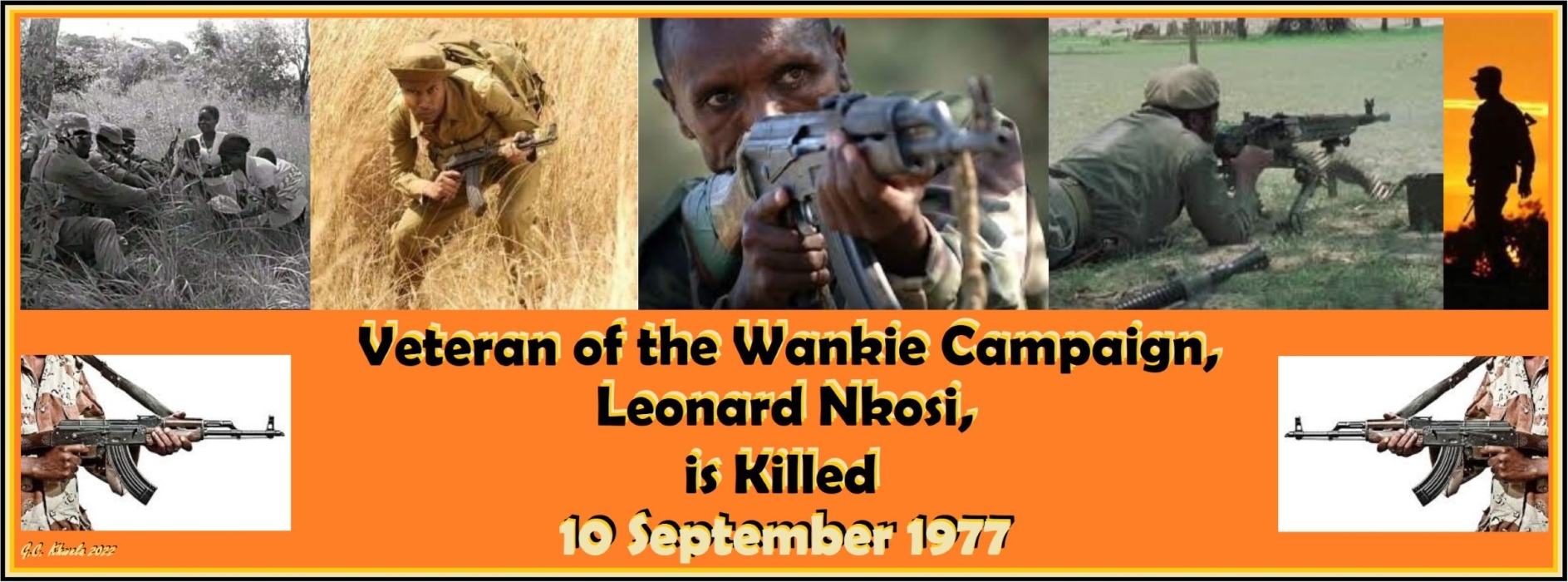
Veteran of the Wankie Campaign, Leonard Nkosi, is Killed
On the evening of Saturday, 10 September 1977, Leonard Mandla Nkosi (aka “Derek”), who was one of the Commanders of the joint Umkhonto we Sizwe-Zimbabwe People’s Revolutionary Army (MK-ZIPRA) Wankie Campaign, was in bed with his wife, Doris, at their home in KwaMashu, listening to a radio broadcast of a boxing match.
After turning off the lights, Nkosi heard a loud bang, which was part of a salvo of bullets that had been fired through their bedroom window. When Nkosi leant over his injured wife, he felt a warm fluid. And when he got out of bed to check on his brother-in-law, who was sleeping in another room, he collapsed in that room with blood spurting from his mouth, nose and chest, and died shortly afterwards, as another bullet was fired at his back.
During the Wankie Campaign in Rhodesia, difficulties that the Tsholotsho Group and the Luthuli Detachment encountered close to the Botswana border, Nkosi deserted the Group and after some few months sneaking and hiding in Rhodesia, he ultimately entered South Africa by train in December 1967. He surreptitiously managed to get to his place in KwaMashu, Durban, but was later betrayed to the authorities by one of his family members and arrested by two policemen in May 1968. He then decided to join the apartheid police and rose to the rank of Sergeant.
Another version of how Leonard Nkosi managed to get home in Durban was that he ostensibly handed himself over to the apartheid South African security forces soon after arriving home to learn that his father had been sentenced to imprisonment on Robben Island, and that his mother was living in abject poverty. He became a state informer and testified against former comrades in a number of court cases. Nkosi also testified for the state against other members of the Luthuli Detachment, including Mr James April who was tried in the Pietermaritzburg Supreme Court
Leonard Nkosi left South Africa in 1963 to undergo military and political training with MK. He became a leader and allegedly a renowned sniper in the Wankie Campaign. After deserting the Wankie Campaign, he became part of the Security Branch in 1967, and it is believed that he worked as an askari and later joined the Security Branch. In his application for amnesty, Jan Daniel Potgieter, a member of the Security Branch intelligence unit, revealed that Nkosi had been compelled to turn state witness against his former colleagues during the “Pietermaritzburg Ten Treason Trial”, which is sometimes referred to as the “Gwala Treason Trial” that ended on 15 July 1977.
On 10 September 1977, shortly after testifying against Gwala and the nine others, Nkosi was assassinated. Security Branch amnesty applicants told the Commission that Nkosi was shot dead with a single shot from a Tokarev pistol, following a number of shots from an AK-47 automatic rifle, which resulted in his wife being injured. ANC member Reverend Stanley Msibi (aka “Blackman”) was implicated in Nkosi’s death.
At this trial, the state had knitted together various strands of evidence drawn from documents that were obtained during the raids conducted at Gwala’s house and at those of the other accused. The state presented a list of over 80 witnesses it intended calling to testify. The coercive and punitive capacity of the state became evident as its list of state witnesses comprised of well-known collaborators, askaris and persons who had been detained in solitary confinement for over three months, and who had been severely tortured, and turned into state witnesses. Among these were Leonard Nkosi, Bruno Mtolo, Sipho Kubheka and Frans Kunene.
Nkosi along with Daluxolo Luthuli and Thula Bophela, had become separated from the main contingent, the joint MK-ZIPRA Tsholotsho Group, during the Wankie campaign, and went underground in Rhodesia for about eight months. Their intention was to head east and return to South Africa by signing on with Wanela, the Witwatersrand Native Labour Association (WNLA), an agency that recruited workers for the mines, the predecessor to The Employment Bureau of Africa (TEBA). But as the trio moved further east, their inability to speak Shona became a problem. When asked by local inhabitants what they were doing in the area, they claimed to be conducting research for a university.
Eventually they unwittingly accepted a lift from a security policeman, who tried to arrest them, but managed only to apprehend Bophela, as he was wearing the wristwatch that had belonged to Lieutenant Smith, one of the white casualties of the Wankie campaign. Thula Bophela was later sentenced to death in Rhodesia for Smith’s murder, which was commuted to life afterwards. Ultimately, Bophela was released by the ZANU-PF (Zimbabwe African National Union-Patriotic Front) government after the liberation of Zimbabwe in 1980.
Meanwhile, Daluxolo Luthuli was arrested by the apartheid Security Branch in December 1967 and was detained at the Pretoria Central Prison in 1968. Daluxolo Luthuli claimed that it was Nkosi who assisted in his December 1967 arrest in a sting operation in Messina. Nkosi subsequently testified against him and Luthuli was sent to Robben Island. After his trial, Luthuli was sentenced to 10 years imprisonment in Robben Island.
Following his release from Robben Island in 1979, he joined the Inkatha Cultural Movement led by Chief Gatsha Mangosuthu Buthelezi. He was later promoted to be a member of the National Executive Committee of Inkatha and the Commander-in-Chief of the Inkatha Caprivi-trained armed group, which committed a number of massacres, murders and other atrocities in the then Natal and the PWV (Pretoria, Witwatersrand and Vaal) areas.
Earlier on, prior to the Wankie Campaign, on 21 May 1963, a year and some odd months after the formation of MK, Leonard Nkosi, Thula Bophela and Daluxolo Luthuli were part of the eighteen-strong group of young men that crossed the Zambezi River into Kazungula in Northern Rhodesia. The group also included Chris Hani, and were later driven to Livingstone to catch a train to Lusaka, to join the ranks of MK.
In the second week of August 1963, Leonard Nkosi and Lawrence Phokanoka (aka Peter Tladi) were part of a group of thirty, including Archie Sibeko, Chris Hani, Justice Mpanza and Mark Shope, who were flown on a British Overseas Airways Corporation plane from Dar es Salaam to Khartoum. From the Sudan they were flown on a Russian aeroplane to Moscow; and were taken to a double-storey building surrounded by bushes about eight kilometres outside Moscow, in the Soviet Union, known as Ivanov, to undergo specialised military training.
The emphasis of their training in Moscow was underground work, primarily conspiracy and how to work the underground. They were being prepared to go and re-organise the underground structures inside the country and then they were being taught to be completely self-sufficient in handling weapons and explosive chemicals. They stayed in Moscow for 11 months and 3 weeks, from August 1963 to August 1964.
On 19 June 1967, Leonard Nkosi was part of a large group of MK cadres that were gathered in Kaluwe’s Farm, approximately 40 kilometres east of Lusaka in preparation for the Wankie Campaign. The group was taken from Kongwa Camp, in Dodoma, to a camp in Morogoro. In the final week of July 1967, at Dube’s Farm in Zambia, Leonard Nkosi was taken aside by Chris Hani, who informed him that he had been appointed Chief of Staff of the Luthuli Detachment, and was earmarked to remain in Rhodesia during the Wankie Campaign.
Nkosi was one of the highly trained and trusted members of the People’s Army, Umkhonto we Sizwe (MK), who had become part of the commanding team in the joint MK-ZIPRA (Zimbabwe People’s Revolutionary Army) Wankie Campaign. Following his separation from the Main Group, the Tsholotsho Guerrilla Unit, together with Thula Bophela and Daluxulo Luthuli, he ultimately went back to South Africa and turned to serve the apartheid security forces. Prosecutors relied heavily on Nkosi’s testimony in most of the cases, as a Wankie Campaign veteran turned askari.
For instance, seven days following Shadrack Maphumulo’s arrest, towards the end of July 1977, the Security Branch came to pick him up at his cell again. There were three of them, Bhengu, along with Leonard Nkosi and a white, Sergeant De Wit. Maphumulo noticed that the special branch preferred a black policeman to begin the beating, and Bhengu was always willing and able. Leonard wasn’t that bad of a fellow, though he became vicious when his white masters were around. He wanted to impress them. Nkosi did get involved in torturing Maphumulo, but he did not give his name to the Criminal Investigation Department (C.I.D.) because he felt that there was no point in doing so.
During his arrest, Maphumulo mentioned that “… another policeman came in and told me that Nkosi had been gunned down by Mkhonto militants. It was surprising that even the black uniformed police were happy that Leonard Nkosi had been killed. It seemed to me that the ordinary black uniformed policeman did not get along with the special branch. Whereas the black uniformed policemen served to oppress us, in that they helped to enforce the harsh racist laws of the country, they also assisted in keeping down crime. This was not the case with the special branch. They were out and out collaborators who did their dirty work solely to keep entrenched the evil apartheid system.”
According to the ANC, Nkosi became a huge liability to the revolutionary struggle by identifying and testifying against Cadres of the Liberation Movement, as an effective apartheid Security Branch official. Nkosi was even reported to have taken part in police raids, acquiring a reputation as a particularly dangerous askari. In its second submission to the Truth and Reconciliation Commission (TRC), the ANC admitted that former MK cadre turned Security Branch policeman, Leonard Nkosi, was killed in September 1977.
This was an operation mastered by Commissar Mduduzi Guma and Mandla Abednigo “Blackman” Msibi, with shots being fired by a young MK recruit. As he jumped and faced the window where the bullets came from, the young MK Cadre shot his stomach with his AK-47. When he turned to run to the small bedroom where his brother-in-law was sleeping, another Comrade fired the last shot with a Tokarev pistol on his back. He fell just outside the bedroom where his brother-in-law was sleeping. His last words were: “Sakhalisa okwesakithi lesisibhamu” (meaning: “This gun sounds like our – Umkhonto we Sizwe’s – own”).
“Asiwafun’ amaVeletshona kuloMbutho!”
Sources:
South African History Online (SAHO).
Rebecca S. Ward, “Daluxolo Luthuli”, South African History Online, 17 December 2013
Mxolisi Dlamuka, “Harry Gwala, Political Militancy and State Trials, 1960-1977”, South African History Online (SAHO), 9 January 2019.
Sapa, “ANC Says It Assassinated Top Impimpi and Other Informers”, South African Press Association, 12 May 1997.
Truth and Reconciliation Commission (TRC), “Truth and Reconciliation Commission of South Africa Report,” Vol. 2, 29 October 1998.
Truth and Reconciliation Commission (TRC), “Truth and Reconciliation Commission of South Africa Report,” Vol. 3, 29 October 1998.
African National Congress, “Statement to the Truth and Reconciliation Commission”, August 1996.
Diane Flaherty, “Regional Inequality in South Africa: Issues, Measurements and Policy Implications”, Development Bank of Southern Africa, Centre for Policy, Information and Evaluation Development Paper 70 Occasional Paper, O’Malley Archives, February 1995.
Learn and Teach, “Free Harry Gwala”, Learn and Teach Magazine, No. 3, 1988.
Rendani Moses Ralinala et.al., “Chapter 12: The Wankie and Sipolilo Campaigns”, The Road to Democracy in South Africa, Volume 1, 1960-1970, South African Democracy Education Trust (SADET), 2015.
Gregory Houston, “Chapter 15: The Post-Rivonia ANC/SACP Underground”, The Road to Democracy in South Africa, Volume 1, 1960-1970, South African Democracy Education Trust (SADET), 2015.
Janet Smith and Beauregard Tromp, “Hani: A Life Too Short”, Jonathan Ball, 2009.
Stephen Ellis, “External Mission: The ANC in Exile, 1960–1990”, Oxford University, 2013.
Thula Simpson, “Umkhonto we Sizwe: The ANC’s Armed Struggle”, Penguin, 2016.
Stephen Davis, “The ANC’s War Against Apartheid: Umkhonto we Sizwe and the Liberation of South Africa”, Indiana University, 2018.
Joe Pillay, “Taking Up the Spear: Shadrack Maphumulo’s Struggle Against Apartheid”, South African History Online Lives of Courage Series, South African History Online, 2024.
Castro Khwela
Good evening fellow Compatriots!
Discover more from CASTRO KHWELA
Subscribe to get the latest posts sent to your email.