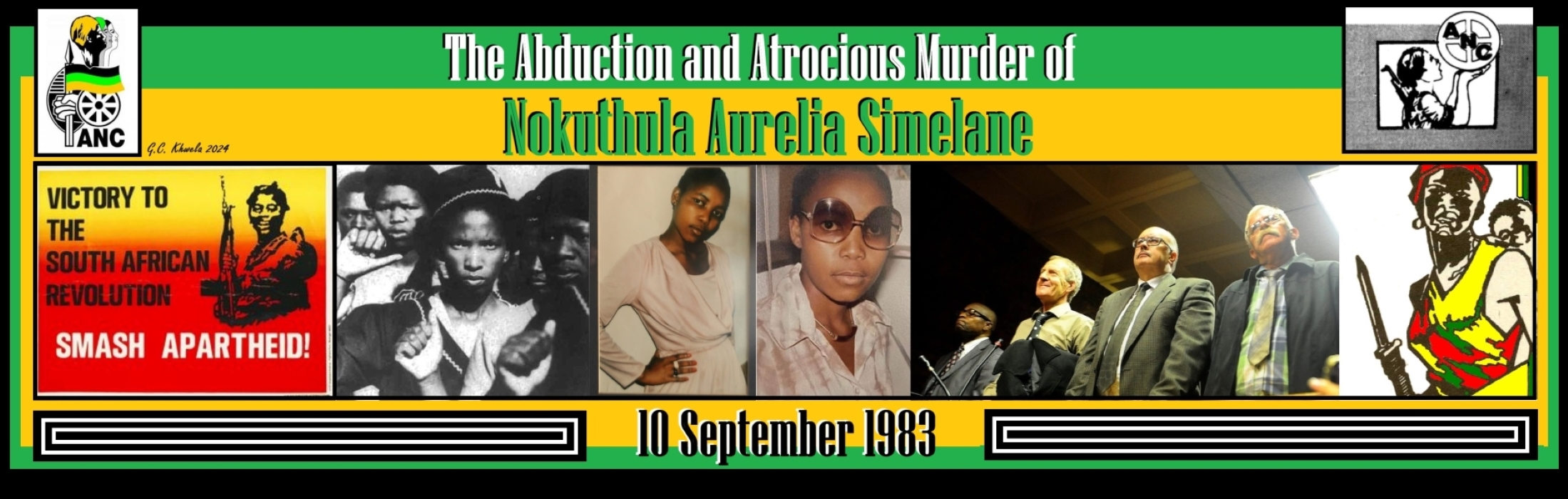
The Abduction and Atrocious Murder of Nokuthula Aurelia Simelane
On the evening of 11 September 1983, commanding personnel of the Transvaal Urban Machinery of Umkhonto we Sizwe (MK), the armed wing of the African National Congress (ANC), were concerned about the whereabouts of Nokuthula Simelane (aka “Sibongile”), as she had disappeared the previous day and could not be located. Simelane had gone on a mission to South Africa on the pretext of obtaining attire for her upcoming Bachelor of Administration (B. Admin) degree graduation at the University of Swaziland.
On 10 September 1983, during an underground operation of MK, Norman L. “Terror” Mkhonza (aka “Scotch”) arranged to meet Nokuthula in the underground parking lot of the Carlton Centre in Johannesburg. Scotch then alerted the Commander of the apartheid Soweto Intelligence Unit (SIU), Willem Hellem Coetzee, of this meeting. The information was also relayed to the overall commander of the Soweto Security Branch, H. Muller, who ordered Nokuthula’s abduction, with the hope of turning her into a police informant.
Nokuthula believed Scotch to be a fellow MK member, as she did not know that he was in fact an “Askari” – a former MK member turned apartheid state operative – with connections to the Soweto Intelligence Unit (SIU) of the apartheid South African Police Force (SAP). The Amnesty Committee heard evidence that, in the early 1980s, two deep cover agents of the SIU, Sergeant Langa (aka “Frank” or “Big”) and Sergeant “Terror” Mkhonza (aka “Scotch”) infiltrated MK’s Transvaal machinery with the help of an informer, Nompumelelo Zakade.
Nompumelelo Zakade was said to have provided information for the killings of Viva Dlodlo, Cassius Maake and Paul Dikeledi and others, as well as on the house in Dalraich where Pantsu Smith and others were killed in June 1986 by a Vlakplaas Team led by Colonel Eugene de Kock. For this latter operation another agent, Chris Hlongwane, was paid R7 000. For the Viva and Dikeledi-Maake killings, Zakade was said to have been paid R8 500.
Nokuthula was arrested by a group of police officers including Coetzee, Anton Pretorius, J.F. Williams, J.E. Ross, Moleke Peter Lengene, Frederick Barnard Mong, M.L. Selamolela, Msebenzi Timothy Radebe and Scotch Mkhonza. She was transported in the boot of a car to “Custodum” Flats in Norwood, Johannesburg, where she was tortured and forced to reveal the nature of her relationship with the ANC, including the work she was doing for both the ANC and MK, as well as the identification of key figures of the Movement in Swaziland.
She was later removed to a farm, in Northam, in the current North West province, where she was tortured by numerous police operatives until she died. Other reports maintain that she was held in illegal, forceful and violent custody on a remote farm in the Thabazimbi area for a period of about five weeks from September to November 1983, until she died. Her whereabout were nowhere to be found.
Nokuthula Aurelia Simelane was born in 1960 in Mzinoni Township, near Bethal, in the Eastern Transvaal, which is now Mpumalanga province, being the first of two daughters (Nokuthula and Thembisile) of Ernestina and Matthew Simelane. She was expecting to graduate on 15 October 1983 from the University of Swaziland with a Bachelor of Administration (B. Admin) degree. While she was studying at the University of Swaziland, she joined the ANC and became a courier server for MK. Her parents suspected that she was working on underground work for the ANC when correspondence was delivered at her uncle’s place in Swaziland.
Nokuthula was also the cousin of Barney Molokoane, who was an ANC operative and Commander of the MK Special Operations Unit responsible for the artillery attacks at the apartheid South African Defence Force’s (SADF) Voortrekkerhoogte Military Base, as well as the SASOL 1 and 2 bombings. Molokoane died after the 1985 Sasolburg attack in a shoot-out with the apartheid security forces near the border with Swaziland. Nokuthula was instrumental in arranging accommodation for Barney to stay with her family in Mzinoni, when his unit was in South Africa to fulfil their underground missions.
After the fall of Apartheid, the Simelane family filed her case with the Truth and Reconciliation Commission (TRC) in the hope of resolving her disappearance. Six white men applied for amnesty relating to Nokuthula’s abduction, torture and disappearance, Wellem Hellem “Timol” Johannes Coetzee, Anton Pretorius, Frederik Barnard “Frikkie” Mong, Willem Schoon, J.F. Williams and J.E. Ross, as well as three Black Security Branch police officers, Msebenzi Timothy Radebe, Moleke Peter Lengene and M.L. Selamolela.
During the TRC hearings, a former commander of the Soweto Intelligence Unit (SIU), Wellem “Timol” Coetzee, the man responsible for the disappearance and death of Nokuthula, stated that Nokuthula was alive when he last saw her, the unit had turned her into a spy and redeployed her back to Swaziland. Coetzee and Pretorius were unyielding in their assertions that they successfully attained Simelane’s co-operation, turned her into a double agent, treated her with relative leniency – providing her with clothing and toiletries – and also released her.
Coetzee’s argument was countered by his colleague, M.M. Veyi, who had joined the group at “Custodum” Flats, in Norwood, who confessed that she was tortured and brutally murdered by Coetzee and Pretorius and was buried around the Rustenburg area. Veyi and Selamolela maintained that Coetzee and Pretorius killed Simelane. The TRC ruled against Coetzee’s amnesty, as well as that of Pretorius and Mong, with regards to torture but were granted amnesty for Nokuthula’s abduction.
In refusing amnesty to applicants Coetzee, Pretorius and Mong, the Amnesty Committee said that during her detention for a period of approximately five weeks, Simelane “was continuously and very seriously assaulted by the group of Security Police, under the command of Coetzee, who held her captive. All attempts to extract information concerning MK or its operations as well as attempts to recruit her to become a Security Police informer, were fruitless. Due to the prolonged and sustained assaults, Ms Simelane’s physical condition deteriorated to the extent that she was hardly recognisable and could barely walk. Ms Simelane was last seen where she was lying with her hands and feet cuffed in the boot of Coetzee’s vehicle. She never returned to her familiar environment in Swaziland … and has disappeared since. It is not necessary for the purpose of this matter to make a definitive finding on the eventual fate of Ms Simelane.
The TRC did not award amnesty to the three men for torturing Nokuthula on the basis that they had failed to make a “full disclosure of all relevant facts”; and Radebe and Schoon were also not awarded amnesty since they did not apply for it. Radebe died in 2019 and Mong in 2021 without facing justice for their atrocities. In May 2003 then National Director of Public Prosecutions (NDPP), Bulelani Ngcuka, had determined that all cases emerging from the TRC, where there had been no amnesty applied for or where amnesty had been refused, were “priority crimes”.
Thus, a Task Team was established to look into the approximately 500 cases from the TRC. The National Prosecuting Authority (NPA) reported that the Priority Crimes Litigation Unit (PCLU) conducted an audit of around 300 cases that had been submitted in 1999, and that 167 were finalised, because it was found that no prosecutions could be brought. It identified 150 cases, including the Simelane case, as requiring investigation. For that reason, a Missing Persons Task Team (MPTT) was established. The TRC Unit was transformed into the Priority Crimes Litigation Unit (PCLU).
A senior prosecutor, Advocate Anton Ackerman, was appointed to head the PCLU, which in 2006 was working on 16 cases, of which five were deemed high priority, and were at an advanced stage of investigation. However, Ackerman was removed from this unit and posted elsewhere because of his supposed commitment to prosecute certain cases, including, so it was believed, a number of ANC leaders. In his 2015 affidavit in the Simelane case, Ackerman stated that: “I believe that it can safely be assumed that the NDPP was instructed at a political level to suspend these cases.” Advocate Vusi Pikoli, the then NDPP, was suspended because of suspicions that he was targeting ANC leaders for prosecution, because of their roles in committing human rights violations during the apartheid era.
In the 2015 Nkadimeng application filed before the High Court, Pikoli noted that he was suspended because of his possible prosecution of apartheid cases. He stated in his affidavit that: “In this affidavit I set out evidence that reflects such political interference, I also set out the serious impact that such interference had on the pursuit of the TRC cases by the National Prosecuting Authority.” “I confirm that there was political interference that effectively barred or delayed the investigation and possible prosecution of the cases recommended for prosecution by the TRC, including the kidnapping, assault and murder of Nokuthula Aurelia Simelane in the case: Priority Investigation: JV Plein 1469/02/1996.”
Thembi Nkadimeng, Nokuthula Simelane’s sister, wrote in 2013 that many obstacles had been placed in the path of the family in their quest to get answers and find out the truth about what happened to Nokuthula Simelane. In her writings Thembi Nkadimeng mentioned that they had “lost all faith in the prosecutors and the police. They have betrayed our trust. They now claim that they are occupied with inquiries, which could conceivably drag on indefinitely while witnesses and suspects grow old and die. We do not know why the authorities in the new South Africa would turn their backs on one of their own.”
Keith “Kid” Sogovu, who was a member of the MK Transvaal Urban Machinery, led by Siphiwe Nyanda (aka “Gebhuza”), at that time, wanted to know what had happened to Nokuthula Simelane, whom he remembered well from when they had lived together in Maputo. Early in 2017, Kid Sogovu was sitting in Soweto listening to the radio. He heard that Siphiwe Nyanda was calling for the removal of Zuma and that he would be addressing MK soldiers at Luthuli House. So, Kid jumped into a taxi and found a full auditorium at Luthuli House. Every journalist in the country was there to hear Siphiwe Nyanda denouncing Jacob Zuma and calling for him to step down or be removed.
Overcome with emotion, Kid Sogovu could not help himself. The anger and outrage were bubbling over in him, and he marched to the front to confront his old Commander in full view of the world’s video cameras and recorders to ask him the same question he had asked so many years before: “What happened to Nokuthula Simelane? Before you can talk about removing Zuma, give us those answers. … This conference must answer a lot of questions … Nokuthula Simelane disappeared when you commanded us to come and fight inside the country. You never gave any press conference. You never told us about the disappearance of Nokuthula Simelane.”
Nkadimeng, who was planning to launch a foundation in honour of Nokuthula, said she knew that her sister was beaten to death. She said: “But I am yearning to know what they did with her body. Where are her remains? She died in a very undignified manner. They beat her up to an extent that she will soil herself, she had no toiletries to clean herself. Nokuthula disappeared when I was nine years old. I got to fully understand her story when I accompanied my father in 1996 to the then John Vorster Square Police Station, now Johannesburg Central Police Station, to open a case.”
According to Jeremy Sarkin, “States need to promptly investigate cases of enforced disappearances. People accused of having committed these violations ought to be arrested and prosecuted. States also need to ensure that every person having knowledge of, or a legitimate interest in, an enforced disappearance, has the right to complain to a competent and independent authority, and have their complaint promptly, thoroughly and impartially investigated. … This is because enforced disappearances, by their very nature, are shrouded in secrecy.”
The truth will come out one day. Nokuthula Aurelia Simelane’s death was not in vain.
Sources:
Wikipedia.
South African History Online (SAHO).
South African History Archives (SAHA).
Truth and Reconciliation Commission (TRC), “Truth and Reconciliation Commission of South Africa Report,” Vol. 2, 29 October 1998.
Truth and Reconciliation Commission (TRC), “Truth and Reconciliation Commission of South Africa Report,” Vol. 3, 29 October 1998.
Truth and Reconciliation Commission (TRC), “Truth and Reconciliation Commission of South Africa Report,” Vol. 6, 21 March 2003.
SAHA, “Latest Developments in Nokuthula Simelane Matter”, South African History Archives (SAHA), 17 February 2017.
Baldwin Ndaba, “Nokuthula Simelane Declared Dead After 36 Years”, Independent Online, 22 August 2019.
Norman Masungwini, “Justice Still Far for Anti-Apartheid Activist Nokuthula Simelane”, City Press, 10 April 2024.
Bernadette Wicks, “Nokuthula Simelane Murder Court Holds Fitness to Stand Trial Hearing”, Eye Witness News – EWN, 23 January 2024.
Eric Mthobeli Naki, “Nokuthula Simelane’s Family Left Devastated by Delays in Case”, The Citizen, 20 May 2025.
Ahmed Timol Truth Prevails, “Nokuthula Simelane (1960 – 1983)”, Ahmed Timol Truth Prevails, 1971 – 2021: 50 Years: Cover-ups, Lies and Secrets, 07 April 2020.
Jeremy Sarkin, “Dealing with Enforced Disappearances in South Africa (With a Focus on the Nokuthula Simelane Case) and Around the World: The Need to Ensure Progress on the Rights to Truth, Justice and Reparations in Practice”, Speculum Juris, SPECJU Vol 1, No. 5, 2015.
Press Statement, “The trial of the former Security Branch officers accused of Nokuthula Simelane’s murder will start on Monday, 6 June 2022”, Foundation for Human Rights and Webber Wentzel, 06 June 2022.
Press Statement, “Repeated Delays in the Nokuthula Simelane’s Matter Means No Justice for the Family”, Foundation for Human Rights and Webber Wentzel, 06 June 2023.
Sibongile Masuku, “Opinion: Celebrating the Lives of Fallen Heroes and Heroines – The Story of Nokuthula Simelane”, University of Mpumalanaga, Newsletter, 03 October 2024.
Dumisa B Ntsebeza and Sha’ista Kazee, “Opinion for National Prosecuting Authority Concerning the TRC Component and TRC Prosecutions”, Office of the State Attorney, Pretoria, 1 July 2024.
Brent Nicholas Abrahams, “Unfinished Lives: The Biographies of Nokuthula Simelane”, Magister Artium in the Department of History, University of the Western Cape, May 2018.
Gayton McKenzie, “Kill Zuma by Any Means Necessary”, ZAR Empire, 2017.
Castro Khwela
Good evening fellow Compatriots!
Discover more from CASTRO KHWELA
Subscribe to get the latest posts sent to your email.