Apartheid SADF Defeat ‘Linked’ to Ceasefire in the Angola War
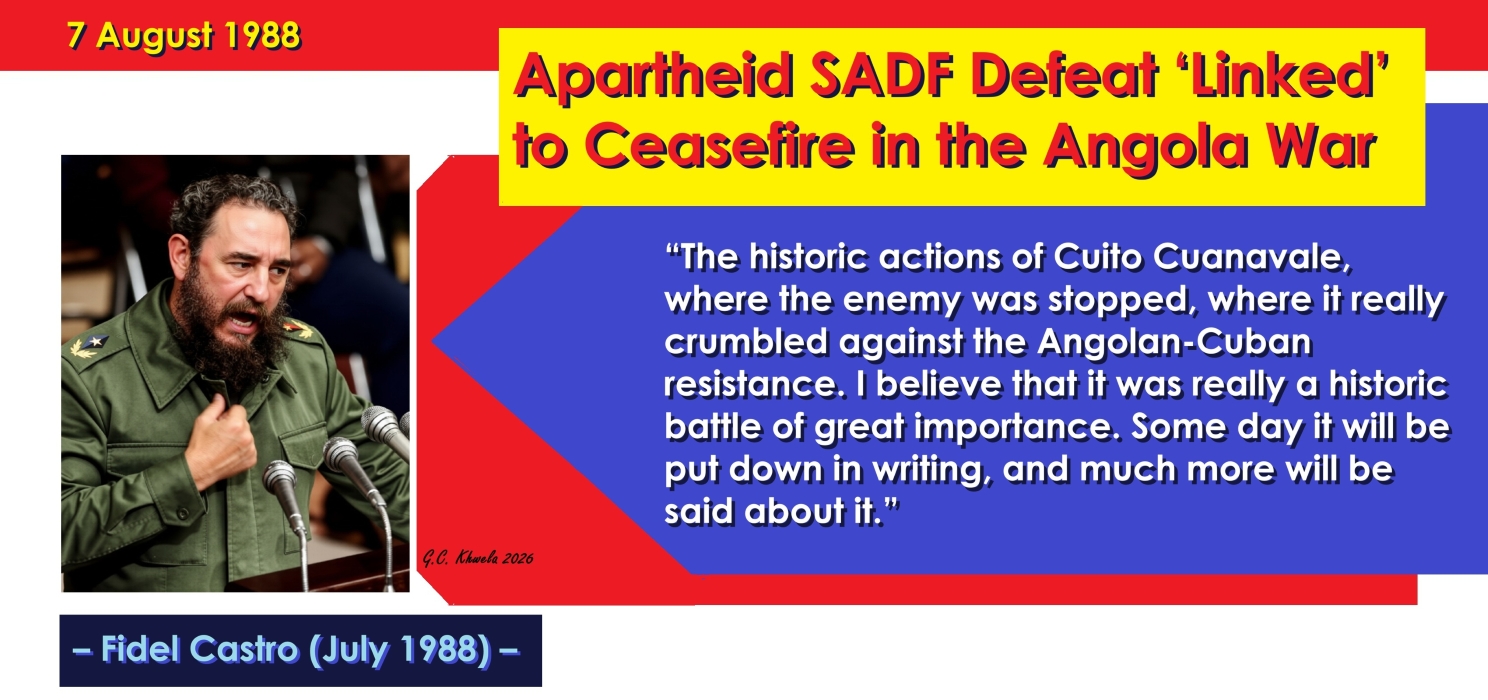
On 7 August 1988, the People’s Republic of Angola, the Republic of Cuba and apartheid South Africa agreed to a formal ceasefire. Under the terms of the ceasefire and later treaty, Cuba was to withdraw its forces from Angola, and South Africa was to grant Namibia independence and withdraw its forces and elections were to be held in Namibia. The ceasefire was reached through a combination of military stalemate on the ground, shifting Cold War geopolitics and intensive United States-led diplomatic mediation.
The immediate catalyst for the ceasefire was the Battle of Cuito Cuanavale (1987–1988) in southern Angola. The apartheid South African Defence Force (SADF) and UNITA (the National Union for the Total Independence of Angola) rebels failed to capture the strategic town of Cuito Cuanavale from Angolan (FAPLA) forces. Cuba heavily reinforced the area, deploying advanced MiG-23 fighter jets, creating integrated air defences, and establishing air superiority over northern Namibia and southern Angola. Facing the threat of an allied advance on the Namibian border and unsustainable white conscript casualties, South Africa realised a total military victory was unachievable.
The late 1980s marked the beginning of the end of the Cold War. The United States and the Soviet Union shifted from proxy warfare to a desire for regional de-escalation. South Africa was facing immense international isolation and economic sanctions due to apartheid. Simultaneously, the Soviet Union cut back financial backing for its foreign allies, prompting Cuba and Angola to seek a negotiated settlement. Negotiations accelerated in early 1988, mediated by Chester Crocker, the US Assistant Secretary of State for African Affairs. He utilised his strategy called “constructive engagement” and championed the concept of “linkage”.
Within the concept of “linkage”, apartheid South Africa refused to leave Namibia as long as Cuban troops were stationed in Angola. Subsequently, Crocker successfully “linked” the enforcement of UN Security Council Resolution 435 (Namibian independence) to the phased withdrawal of Cuban troops from Angola. A series of intense, direct quadrilateral diplomatic meetings took place throughout 1988 in London, Cairo, New York and Geneva. Ultimately, the parties agreed to a framework of basic principles for a peaceful settlement. Meeting in Geneva, Switzerland, the military and diplomatic delegations hammered out the exact terms of immediate troop separations. This directly resulted in the 7 August 1988 formal ceasefire agreement.
The apartheid South African government agreed to a ceasefire and withdrew from Angola and Namibia due to an accumulation of shattered military dominance, unsustainable domestic vulnerabilities, and shifting global politics that made their war aims impossible to achieve. The South African Defence Force (SADF) had long relied on complete air and technological superiority to control southern Angola. However, during the Battle of Cuito Cuanavale, Cuba deployed advanced MiG-23 fighter jets and high-tech anti-aircraft systems. For the first time, South Africa lost control of the skies, rendering its conventional ground forces highly vulnerable.
Following reversals at Cuito Cuanavale, heavily armed Cuban and Angolan forces advanced rapidly toward the Namibian border, threatening to trap thousands of South African troops inside Angola. Signing the ceasefire was the only way Pretoria could rescue its forces without a devastating military catastrophe. The war had become an unmanageable drain on the apartheid regime. Due to international arms embargoes, South Africa could not easily replace lost heavy equipment, such as fighter jets. More critically, the growing death toll of white conscript soldiers caused severe political backlash and anti-war sentiment among the white South African electorate.
Maintaining a massive military occupation in Namibia (South West Africa) and funding continuous cross-border operations in Angola, cost South Africa billions of rands at a time when its domestic economy was buckling under international banking sanctions and disinvestment. The apartheid regime had long justified its intervention to its Western allies and citizens as a “Total Onslaught” – a defensive shield protecting Southern Africa from so-called “Soviet expansionism”. By 1988, Soviet leader Mikhail Gorbachev was actively reducing Moscow’s foreign military commitments and cooperating with the United States to wind down proxy conflicts.
With the “Communist threat” rapidly evaporating, the United States and other Western nations stopped turning a blind eye to South Africa’s regional aggression, leaving the apartheid government geopolitically isolated. The United States’ “linkage” strategy offered South Africa a way to exit the conflict without admitting complete defeat. Through the Tripartite Accord, apartheid South Africa agreed to grant Namibia independence, but only in exchange for the total, phased withdrawal of all 50,000 Cuban troops from Angola.
The agreement also mandated that Angola could no longer be used as a springboard for militant actions, forcing the African National Congress (ANC) to dismantle its Umkhonto we Sizwe (MK) military training bases inside Angola. This allowed Pretoria to frame the retreat as a strategic compromise rather than an outright surrender. By accepting the ceasefire, Pretoria abandoned its goal of using UNITA to violently overthrow the Angolan government, opting instead to preserve its own domestic survival in a rapidly changing world.
An assessment that the United States’ “linkage” strategy offered South Africa a way to exit the conflict without admitting complete defeat, when in reality it was defeated in Angola, captures exactly how many historians, as well as the Cuban and Angolan leadership at the time, view the conclusion of the conflict. For the apartheid government, Chester Crocker’s “linkage” strategy served as a vital diplomatic lifeline. It allowed them to frame a forced strategic retreat as a balanced, mutual compromise on the international stage. However, whether this exit constitutes an outright military defeat or a strategic stalemate remains one of the most hotly contested debates in modern African military history, with deeply conflicting narratives.
Historians who argue that South Africa was fundamentally defeated point to the ultimate collapse of its core strategic objectives. The primary military goal of the apartheid SADF in late 1987 was to shatter the Angolan army’s offensive and permanently secure the region. They failed to capture the vital logistical hub of Cuito Cuanavale. By mid-1988, Cuba had seized complete control of the skies. Armed with air superiority, Cuban and Angolan forces advanced aggressively to the Namibian border, trapping SADF units and forcing Pretoria’s hand. Critics note that before the 1987–1988 campaign, Pretoria fiercely resisted Namibian independence and refused to leave Angola. They only conceded to UN Resolution 435 and evacuated their forces because their position on the ground had become militarily untenable.
Conversely, the former SADF leadership and various Western military analysts reject the label of defeat, pointing to tactical metrics on the battlefield. South Africa’s immediate operational mandate was to prevent FAPLA from destroying Jonas Savimbi’s UNITA movement. The SADF successfully halted the massive Angolan advance at the Lomba River, inflicting catastrophic casualties and equipment losses on FAPLA. From a strictly operational standpoint, a relatively small South African expeditionary force of a few thousand men held off vastly larger conventional armed forces while suffering minimal casualties relative to their opponents. Pretoria maintained that it never intended to occupy Cuito Cuanavale permanently due to the unacceptable political cost of white conscript casualties.
They argued that “linkage” successfully achieved their long-term foreign policy goal of removing 50,000 Cuban troops from their immediate border. Ultimately, however, while the SADF was not comprehensively destroyed on the battlefield, it was strategically outmanoeuvred. The military balance shifted drastically enough that South Africa could no longer dictate terms through brute force. The United States “linkage” strategy provided the perfect “face-saving” mechanism – allowing Pretoria to heads-up walk away from a war it could no longer afford to fight, while claiming they had traded Namibia to successfully “halt the spread of communism”.
Nevertheless, despite the US “linkage” strategy, a conclusion can be reached which aligns with the historical reality that, for the people of Angola, Namibia and the wider Southern African region, the 1988 ceasefire was a monumental turning point that dismantled decades of destructive conflict and foreign occupation. Regardless of the diplomatic framing or the “face-saving” mechanisms used by the apartheid regime, the tangible, long-term outcomes on the ground directly benefited the liberation and stability of the region in several profound ways.
The most direct and historic consequence of the agreement was the dismantling of South Africa’s illegal occupation of Namibia. For over 70 years, Namibians had lived under oppressive South African administration and the brutal enforcement of apartheid laws. The ceasefire finally forced Pretoria to implement UN Security Council Resolution 435, leading to free and fair elections in 1989 and Namibia’s official independence on 21 March 1990 under SWAPO leadership.
During the 1970s and 1980s, the apartheid government pursued a policy of violent destabilisation across Southern Africa to protect its minority rule. The withdrawal from Angola and Namibia brought an immediate end to the devastating SADF conventional invasions, cross-border bombings, and commando raids that had ravaged Angolan infrastructure and terrorised civilian populations. It effectively neutralised the primary source of state-sponsored military aggression in the subcontinent, allowing neighbouring Frontline States to begin breathing easier. By forcing the apartheid SADF to withdraw, the agreement successfully extracted Southern Africa from the crossfires of the global Cold War. The region stopped being a violent playground for imperialist aggression, shifting the focus from racist induced warfare back to local liberation, sovereignty and development.
The strategic retreat from Angola and Namibia had a profound psychological and political impact within South Africa itself, acting as a catalyst for internal liberation. The failure to achieve a total military victory in Angola shattered the myth of the apartheid military’s absolute invincibility. It was also stripped of its “Total Onslaught” pretext and facing immense economic isolation, the Pretoria regime could no longer justify massive military spending abroad while its domestic system was collapsing.
Within less than two years of the ceasefire, the ANC was unbanned, Nelson Mandela and other political prisoners were released, and negotiations to end apartheid began in earnest. While the “linkage” strategy was a calculated product of superpower diplomacy, its ultimate utility was that it successfully served as the crowbar that pried loose apartheid South Africa’s grip on its neighbours, paving the way for a free Namibia and a fundamentally transformed Southern Africa.
Sources:
Wikipedia.
South African History Online (SAHO).
Directorate of Intelligence, “Angola-Cuba-South Africa: Negotiations at a Critical Point”, Central Intelligence Agency, 15 August 1988.
Editorial, “The Solution of the Regional Conflict in Southern Africa”, Sechabа, Vol. 22, No. 9, September 1988.
Fidel Castro, “The Battle for Angola”, Sechabа, Vol. 22, No. 11, November 1988.
Editorial, “Angola and South Africa Sign Peace Accord: Date Set for Namibia Independence Plan”, Dateline: Namibia, ELCA News, January 1989.
Zachary Kagan-Guthrie, “Chester Crocker and the South African Border War, 1981–1989: A Reappraisal of Linkage”, Journal of Southern African Studies, Vol. 35, Issue 1, 31 March 2009.
Horace Cambell, “The Military Defeat of the South Africans in Angola”, Monthly Review, Vol. 64, No. 11, April 2013.
ADST, “The Search for Peace in Southern Africa – Oil, Angola, and the Proxy Wars”, Association for Diplomatic Studies and Training, August 2014.
Castro Khwela
Good morning fellow Compatriots!🙏🏾✊🏾👊🏾
Discover more from CASTRO KHWELA
Subscribe to get the latest posts sent to your email.