
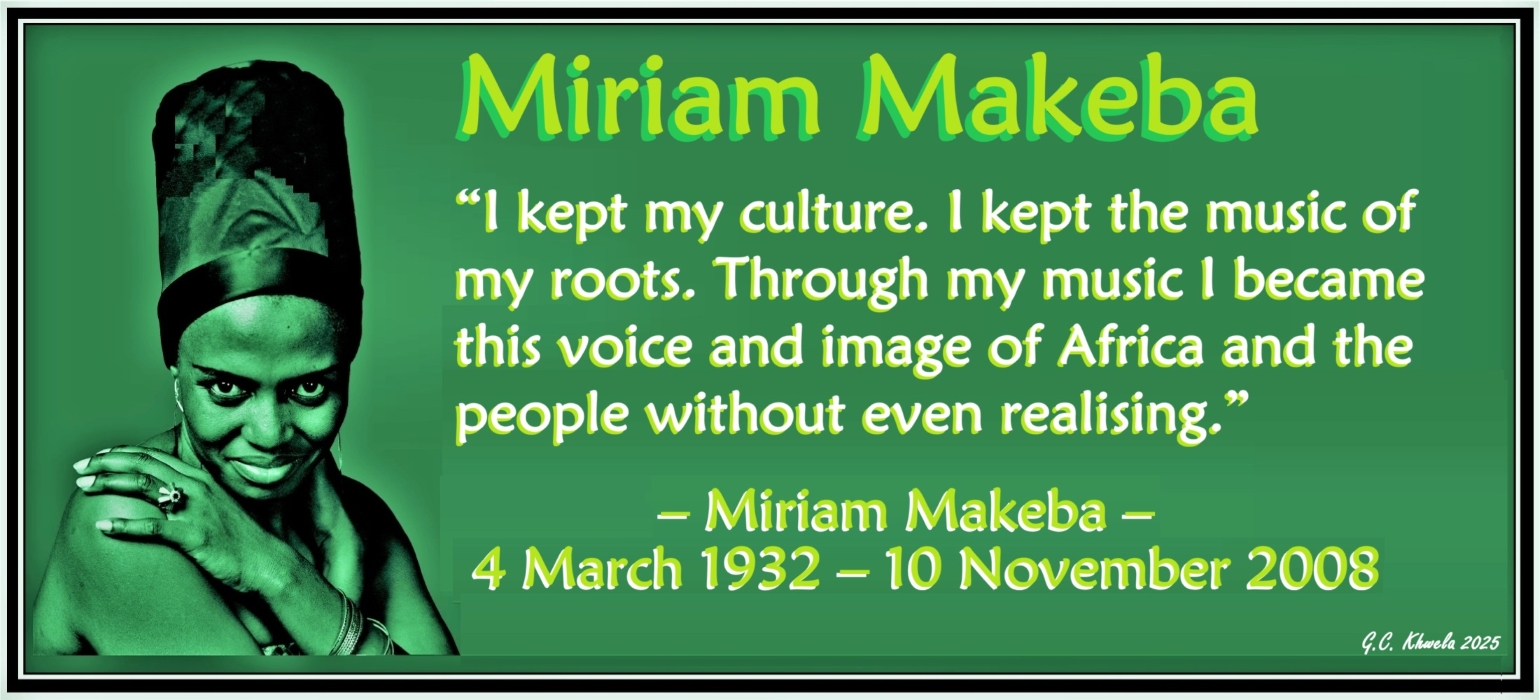
Zenzile Miriam Makeba: Mama Afrika
“Honestly, I’m just a little old singer, I am not a politician, I’m not an economist or anything of the sort. I just wish that people could be soldiers. We can all be soldiers not to fight against each other but to fight against poverty, illnesses, disease, greed and all the ills of the world, you know just be an army for all goodness.”
Throughout her career Makeba insisted that her music was not consciously political in an interview with the British Times she said: “I’m not a political singer. I don’t know what the word means. People think I consciously decided to tell the world what was happening in South Africa. No! I was singing about my life, and in South Africa we always sang about what was happening to us – especially the things that hurt us.”
“I kept my culture. I kept the music of my roots. Through my music I became this voice and image of Africa and the people without even realising.”
On July 16, 1963, Makeba addressed the United Nations (UN) Special Committee on the Policies of Apartheid. In a quiet voice and taking frequent nervous pauses, the usually consummate performer said: “Some 5,000 people have in recent months been put behind prison bars. Among those who have been jailed and detained… are many of our prominent leaders which include Chief AJ Luthuli, Robert Sobukwe, Nelson Mandela, Mrs Lillian Ngoyi and only last week, Mr Walter Sisulu… These people must be released at once. I am certain nobody can liberate his people when he is in a prison cell or concentration camp…”
“My country has been turned by the [Hendrik] Verwoerd government into a huge prison. I feel certain that the time has come for the whole of humanity to shout, ‘Halt!’ and to act with firmness to stop these crazy rulers from dragging our country into a horrifying disaster.” South Africa’s apartheid government responded by cancelling Makeba’s citizenship and banning her music. But Makeba would not be deterred. She spoke to the UN about the horrors of apartheid again the following year.
This time she asked: “You and all the leaders of the world, would you act differently, would you keep silent and do nothing if you were in our place? Would you not resist if you were allowed no rights in your own country because the colour of your skin is different from that of the rulers, and if you were punished for even asking for equality? I appeal to you, and to all the countries of the world to do everything you can to stop the coming tragedy. I appeal to you to save the lives of our leaders, to empty the prisons of all those who should never have been there.”
Nelson Mandela described Makeba as “South Africa’s first lady of song. … She was a mother to our struggle and to the young nation of ours. … Her haunting melodies gave voice to the pain of exile and dislocation which she felt for 31 long years. At the same time, her music inspired a powerful sense of hope in all of us.” (The Guardian, 10 November 2008).
Sources:
South African History Online (SAHO).
Xan Rice, “Miriam Makeba: ‘I will sing until the last day of my life’”, The Guardian, 10 November 2008.
Nick Dall, “‘Why shouldn’t power be Black’? How Miriam Makeba won and lost the US”, Al Jazeera, 20 October 2024.
Castro Khwela
Good morning fellow Compatriots!🙏🏾✊🏾👊🏾
Discover more from CASTRO KHWELA
Subscribe to get the latest posts sent to your email.


