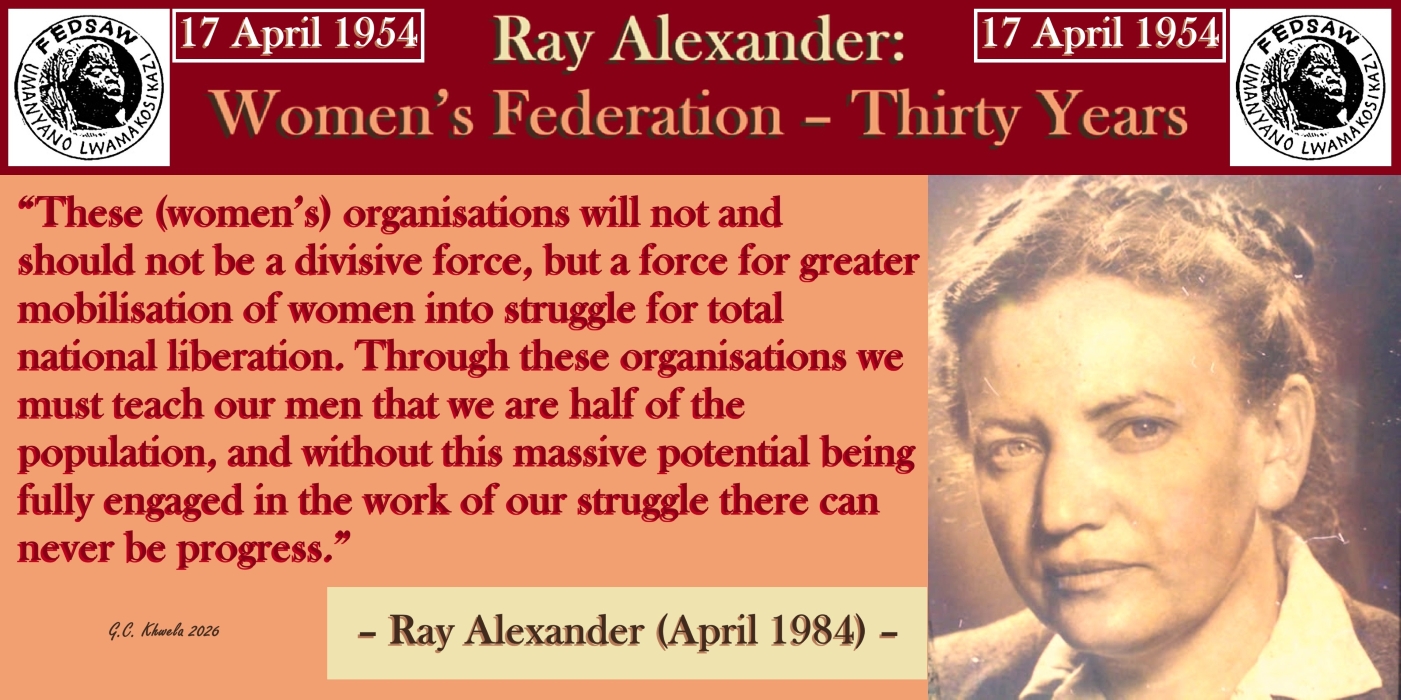
Ray Alexander: Women’s Federation – Thirty Years
(Sechaba Interview with Ray Alexander on the 30 th Anniversary of the Federation of South African Women, Sechaba, April 1984).
On the 17th of April 1954, the Federation of South African Women (FEDSAW) was born at a conference attended by more than 150 delegates representing over 230 000 women. Representatives of women’s organisations came from different areas of South Africa, including many towns in the Cape, as well as Durban, Port Elizabeth, East London and Johannesburg itself, where the conference was held.
The conference was opened by Ray Alexander, a veteran of our women’s and people’s struggle, who spoke of the important role women played in the past, and must play in the present and future of our country. Conference elected Ray general secretary of the Federation, but the government imposed a severe banning order on her – banning her from holding office and participating in more than forty organisations, among which was the Federation.
On the occasion of the thirtieth anniversary of the Federation, ‘Sechaba’ interviewed Comrade Ray Alexander on the Federation and its work.
Question: Could you give us a brief account of the events that led to the formation of the Federation of South African Women?
Answer: The Federation came about as a result of the development of our women’s struggles. It’s birth must therefore be seen not merely in terms of the conference of 17 April 1954. As far back as the days of the Second World War our women had begun getting organised for the struggle against food shortages and high prices of food. Food Committees were formed, and these fought for the fair distribution of food, particularly to the areas outlying the big cities.
The Food Committees concerned themselves with other issues affecting the lives of women. For example, we would meet on certain occasions like the 8th of March – International Women’s Day – to discuss issues affecting women. Such meetings were further inspired by the activities of organisations like the Women’s International Democratic Federation, which had begun organising women in the struggle against war and for the restoration of lasting peace.
Thus on the 1 st of April 1953, a meeting was organised in Port Elizabeth, which was attend by leading women in the African National Congress and Trade Union movement. I recall a few names: Florence Matomela, Frances Baard, Marya Williams, Gus Coe, Mary Moodley and others. We had a representative meeting of African, Indian, Coloured and White women. We also had a special guest, Mr Pemba (an artist).
We were all excited by the role women had played in the Defiance of Unjust Laws Campaign, but felt that there was a need to bring together women of all racial groups in one national organisation that could effectively ensure the fuller participation of women in our national liberation struggle. We then took a decision to work towards the creation of such an organisation.
Question: Would you say that the ground was laid for the creation of a federal organisation of women?
Answer: Yes. Our women had shown in actual field of struggle that they could be organised into such a body, although we knew that it was not going to be an easy task. We immediately set about getting in contact with women in other provinces. We contacted Dora Tamana, Gladys Smith, Katie White and other women in Cape Town; Hilda Bernstein and other women in Johannesburg; Hendrietta Khuzwayo, Bertha Mkhize, Fatima Meer, Mrs Singh, Fatima Seedat and other women in Natal. In Port Elizabeth we already had militant organisers like Florence Matomela and Frances Baard, who helped organise women all over the Cape.
Question: Since you did not operate under any established organisation, didn’t you find problems in your work of organising, particularly as there already existed a national organisation of the people, the African National Congress (ANC), which had its own Women’s League?
Answer: We encountered no problems at all. Actually, we received a lot of encouragement from Comrade Walter Sisulu, then Secretary General of the ANC. Comrade Walter had before then undertaken a trip to some socialist countries, and was very impressed with the level of women’s organisations there. Of course, there was some scepticism about the wisdom of another women’s organisation from some comrades, who thought that the Federation would be in competition with the ANC Women’s League. But these fears were soon dispelled by the representation at the conference, where all ANC Women’s League branches were represented. As to the invitation to attend, this was a letter to all interested individuals and organisations, signed by a number of women who acted as convenors.
Question: What questions did the conference address itself to?
Answer: A wide range of issues was discussed. Delegate after delegate spoke passionately against the white racist regime that keeps the majority of our people in poverty, ignorance, ill-health and slave labour conditions. The subjects covered showed the real political awareness of the delegates, who linked the question of women’s rights with their own struggles and problems, the Bills that were then before parliament, and the political issues of the day.
Women spoke of the conditions under which children were brought up, lack of proper family life, amenities and education opportunities, the need for schools, creches, maternity homes, the high rents and poor houses. Over and above everything, delegates emphasised the fight against unjust laws, the Bantu Education Act, the Industrial Conciliation Amendment Act, the Population Registration Act and the pass laws – all ow which greatly affected the lives of women and their families.
Question: The impression one gets when looking through conference records is that in addition to the bitterness prevalent against the regime, there was another degree of bitterness – against men. For instance, one delegate was loudly applauded when she said that if it were not for the husbands, many more women would have attend the conference. Another delegate angrily lashed out ‘If the men stand in our way, we shall sweep them aside for our rights’.
Answer: It is true that we were and still are primarily subjugated and oppressed by the system of apartheid, which is the main cause for the misery of millions of our women. But we are still aware that because of the laws of apartheid, because of tradition and custom, women are further victims of oppression in their own homes. Women more often than not fail to attend meetings and contribute fully towards the work of our struggle because they have to be home to cook, feed and look after their families, and have to do a lot of other chores without the help of their husbands.
We thus resolved to ‘teach the men that they cannot hope to liberate themselves from the evils of discrimination and prejudice as long as they fail to extend to women complete and unqualified equality in law and practice’.
This position is sometimes misinterpreted to mean an attack on the menfolk, but we in the Federation, like all democratic women in our country, have always strived to maintain the link between the inferior status of women under apartheid and the inferior status to which our people are subjugated by discriminatory laws and colour prejudice. Thus, the need for women’s organisations is to enable women to mobilise others to win specific demand for them and their children.
These organisations will not and should not be a divisive force, but a force for greater mobilisation of women into struggle for total national liberation. Through these organisations we must teach our men that we are half of the population, and without this massive potential being fully engaged in the work of our struggle there can never be progress.
Question: What documents guided the activities of the Federation?
Answer: We adopted a Charter of Women’s Rights, which summarises the demands of women in South Africa for themselves, their children and families. The Charter called for the right to vote, the right to full employment opportunities, equal rights with men in relation to property, marriage and children and for the removal of all laws and customs that deny women such equal rights. It calls for compulsory and free education for all children, the removal of laws that restrict movement and all oppressive laws. Through the Charter the Federation pledged to build and strengthen women’s sections in the national liberation movements and to organise women in trade unions and through the people’s varied organisations. It further committed the Federation to strive for permanent peace throughout the world.
Question: Considering that the Federation was never banned by the regime, do you think that after 30 years of its existence, it managed to achieve the goals which it had set itself?
Answer: Although it is correct that the Federation was never legally banned, it cannot be said that it continued to operate as it should have. The leadership of the Federation was subjected to severe bannings, detentions and arrests. Lilian Ngoyi, who later became our president, was continuously served with banning orders; until her death, Dora Tamana, who had been elected acting secretary general after I was banned, was harassed and victimised by the regime; Helen Joseph, who also served a term as secretary general of the Federation, was the first person in South Africa to be house arrested; she was further continuously banned and silenced.
However, we continued to participate in all major campaigns: against the Bantu Education Act; the Cape Provincial Segregation Ordinance; we campaigned for equal opportunities for our young African, Coloured and Indian women to work in shops and offices.
The most important of our campaigns was the anti-pass campaign, carried out jointly with the ANC Women’s League. This campaign led to the August 9th, 1956 demonstration by over 20 000 women of all races. We joined the international democratic women’s movement, sent our leaders like Dora Tamana, Lilian Ngoyi, Asha Darwood and others to conferences abroad, and in this way participated in the struggle to protect the children and peoples of the world from another war, for peace and social progress.
Yes, we were and still are a force. That is why so many of our women were and still are under constant harassment by the regime. Today they are trying to silence Albertina Sisulu, they have kept Dorothy Nyembe in their dungeons for the past fifteen years, they have tried to stifle our veterans like Helen Joseph, but our women are marching forward to victory.
Our women have created strong organisations throughout the country – the United Women’s Organisation, the South African Women’s Federation, the East London Women’s Organisation, the Port Elizabeth Women’s Organisation, the Durban Women’s Organisation as well as many other self-help and other clubs.
It is in recognition of the militancy of our women and as a means of consolidating the ranks of the democratic women’s movement that the African National Congress has declared this year (1984) as the Year of the Women. It is indeed a fitting tribute to the 30th anniversary of the founding of the Federation of South African Women.
Source:
Sechaba, “Interview with Ray Alexander: Women’s Federation – Thirty Years”, Sechaba, April Issue 1984.
Castro Khwela
Good morning fellow Compatriots!
Discover more from CASTRO KHWELA
Subscribe to get the latest posts sent to your email.