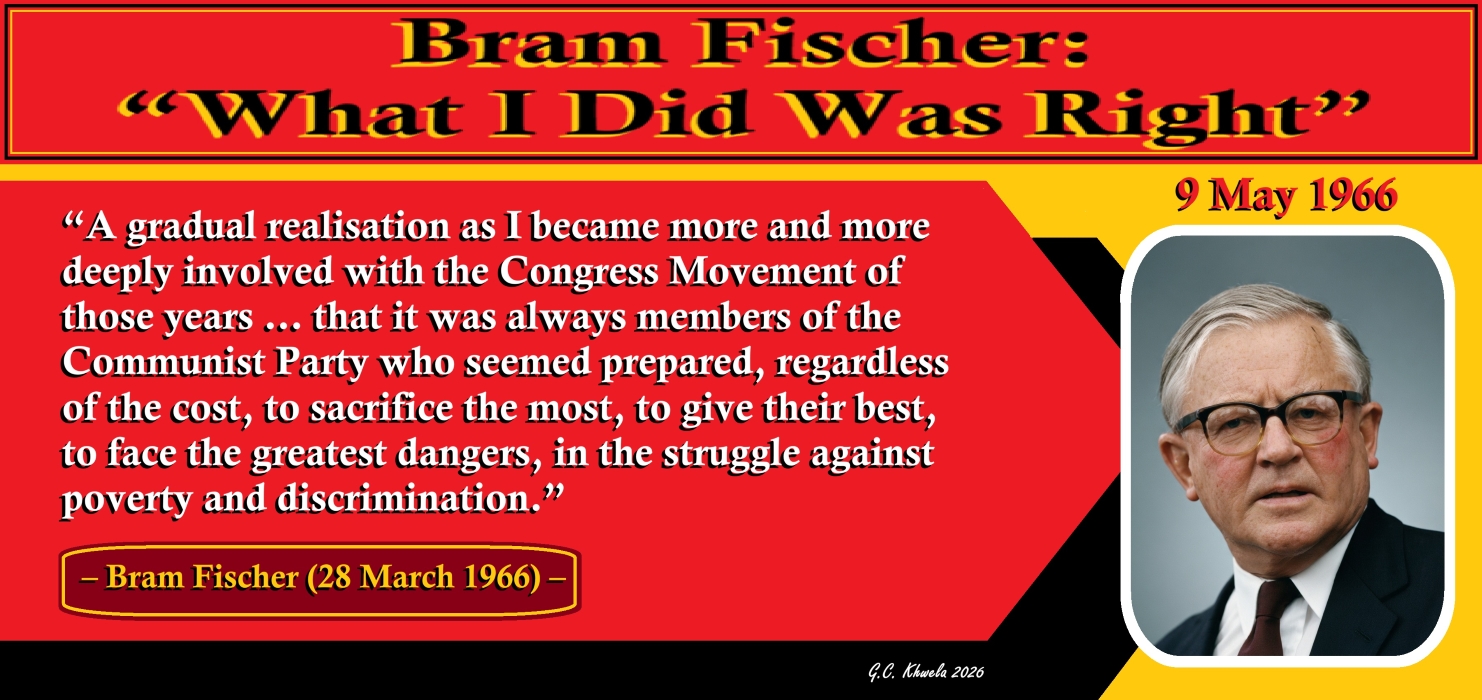
Bram Fischer: “What I Did Was Right”
Exactly sixty years ago, on 9 May 1966, Abram “Bram” Fischer was sentenced to life imprisonment for his political activities against apartheid and twenty-four years for being a member of the South African Communist Party (SACP). Bram had been arrested in 1964 for being a member of the illegal organisation, the Communist Party of South Africa (CPSA). He was later released on bail and in January 1965 he went into hiding. He remained underground until he was re-captured in Johannesburg on 11 November 1965. On 23 March 1966 his trial began in Pretoria.
On 28 March, the prosecution, after two days of presenting evidence, formally closed its case. Sydney Kentridge announced that the defence will not call any witnesses but that the accused will make a statement from the dock. Bram presented his “What I did was right” statement, whose extracts we publish below. After Bram’s five hours in the dock, the court was adjourned for 6 weeks, and 4 May, Bram was convicted of conspiring with the African National Congress (ANC) and Umkhonto we Sizwe (MK) to commit sabotage and for violating the Suppression of Communism Act.
On 9 May, Bram was sentenced to life in prison on the count of sabotage; to twenty-four years on the six charges under the Suppression of Communism Act; to fines totalling R120 (or six months in prison) for six contraventions of the Aliens Act; and to three months on the two counts of forgery. All the terms were to run concurrently, and Bram decided not to appeal.
Bram decided not to testify in his own defence because he feared being forced to implicate others. Instead, he chose to read a statement from the dock, which became one of the most important documents in South African history. The moving and historically significant statement was converted into a pamphlet by the SACP, which reflected a rational explanation of the choices, the willingness to accept the consequences and a plea for a society that is based on justice and dignity by the Afrikaner-born advocate who defended the Rivonia defendants and opposed apartheid. Presenting his statement on 28 March 1966, Bram said the following:
“I am on trial for my political beliefs and for the conduct to which those beliefs drove me. Whatever labels may be attached to the fifteen charges brought against me, they all arise from my having been a member of Communist Party and from my activities as a member. I engaged upon those activities because I believe that, in the dangerous circumstances, which have been created in South Africa, it was my duty to my fellow citizens to do so. Political belief and conduct cannot be separated. I believe that to hold a belief and to fail to set upon it constitutes cowardice.
“When a man is on trial for his political beliefs and actions, two courses are open to him. He can both confess to his transgressions and plead for mercy or he can justify his beliefs and explain why he acted as he did. Were I to ask forgiveness today, I would betray my comrades. That course is not open to me. I believe that what I did was right. I must therefore explain to this Court what my motives were: why I hold the beliefs that I do (certain beliefs) and why I was compelled to act in accordance with them.
“My belief, moreover, is one reason why I have pleaded not guilty to all the charges brought against me. Though I shall deny a number of important allegations made, this Court is aware of the fact that there is much in the State case that has not been contested. Yet if I am to explain my motives and my actions as clearly as I am able, then this Court was entitled to have had before it the witnesses who testified in chief and under cross-examination against me. Some of these I believe were fine and loyal persons who have now turned traitors to their cause and their country because of the methods used against them by the State, vicious and inhuman methods. Their evidence may therefore in important respects be unreliable.
“There is another and more compelling reason for my plea and why I persist in it. I accept the general rule that for the protection of a society laws should be obeyed. But when laws themselves become immoral and require the citizen to take part in an organised system of oppression – if only by his silence or apathy – then I believe that a higher duty arises. This compels one to refuse to recognize such laws. The laws under which I am being prosecuted are enacted by a wholly unrepresentative body, a body in which three-quarters of the people of this country have no voice whatever.
“These laws were enacted, not to prevent the spread of communism, but for the purpose of silencing the opposition of the large majority of our citizens to a Government intent upon depriving them, solely on account of their colour, of the most elementary human rights, of the right to freedom and happiness, the right to live together with their families wherever they might choose, to earn their livelihoods to the best of their abilities, to rear and educate their children in a civilized fashion, to take part in the administration of their country and obtain a fair share of the wealth they produce; in short, to live as human beings. My conscience does not permit me to afford these laws such recognition, as even a plea of guilty would involve. Hence, though I shall be convicted by this Court, I cannot plead guilty. I believe the future may say that I acted correctly.
“My first duty then is to explain to the court that I hold and have for many years held the view that politics can only be properly understood and that our immediate political problems can only be satisfactorily solved without violence and civil and by the application of the scientific system of political knowledge known as Marxism. I shall also have to explain why this view compelled me to act as I have.
“And I wish to emphasize that I do this from the dock and not from the witness box, not because I fear cross-examination on these matters, I would in fact welcome nothing more than to discuss this subject. But I know that cross-examination must go further and involve others who may or may not have been associated with me in my work. In the long series of political trials that this country has experienced in recent years, brave men and women have refused to testify against their friends and accepted long prison sentences rather than do so. In this very case, Mrs. Lesley Schermbrucker, whose husband is already serving a five-year sentence for his political ideals, provides an outstanding example of that courage. She was prepared to sacrifice herself and the happiness of two young children rather than give evidence.
“I ask the Court to consider my position in the light of such conduct. I will not go into the witness box and prevaricate or lie. I will not go into the witness box and answer questions that might implicate others. There is only one alternative therefore which is open to me. That is to make my statement from the dock. I know that it is possible for this Court to draw adverse inferences from my failure to go into the witness box. In the circumstances I cannot avoid that possible consequence. In no circumstances, whatever the consequences to me personally may be, would (will) I myself be State witness. I cannot even allow myself to be put in the position of informing on others whether directly or indirectly, whether by answering or my refusing to answer questions.
“When I consider what it was that moved me to join the Communist Party, I have to cast my mind back for more than a quarter of a century to try and ascertain what precisely my motives at that time were.
“Marxism is a system of philosophy which covers and seeks to explain the whole range of human activity, but looking back, I cannot say that it was Marxism as a social science that drew me originally to the Communist Party, just as little, presumably as a doctor would say that he was originally drawn to his own field of science by its scientifically demonstrable truths. These only become apparent later.
“In my mind there remain two clear reasons for my approach to the Communist Party. One was the glaring injustice which exists and has existed for a long time in South African society; the other, a gradual realisation as I became more and more deeply involved with the Congress Movement of those years, that is, the movement for freedom and equal human rights for all, that it was always members of the Communist Party who seemed prepared, regardless of the cost, to sacrifice the most, to give their best, to face the greatest dangers, in the struggle against poverty and discrimination.
“The glaring injuries is there for all who are not blinded by prejudice to see. This is not even a question of the degree of humiliation or poverty or misery imposed by discrimination on one section of the community. Hence it cannot be justified by comparing non-White standards of living or education in South Africa with those on other parts of the continent. It is simply and plainly that discrimination should be imposed as a matter of deliberate policy because of the colour which a man’s skin happens to be, irrespective of his merits as a man, a worker, a thinker, a father or a friend.
“Yet the injustice of the system does not in itself (suffice to) explain my conduct. All White South Africans can see it. The vast majority of them remain unmoved and unaffected. They are either oblivious to it or, despite all its cruelty, condone it on the assumption, whether admitted or not, that the non-White of this country is an inferior being with ideals, hopes, loves and passions which are different from ours. Hence the further tacit or open assumption that he need not be treated as a complete human being, i.e. that it is not “unfair” to make him carry a pass, to prevent him from owning lands, deprivations which if applied to Whites, would horrify all and cause a revolution overnight.
“Though nearly forty years have passed, I can remember vividly the experience which brought home to me exactly what this “White” attitude is and also how artificial and unreal it is. Like many young Afrikaners I grew up on a farm. Between the ages of eight and twelve my daily companions were two young Africans of my own age. I can still remember their names. For four years we were, when I was not at school, always in each other’s company. We roamed the farm together, we hunted and played together, we modelled clay oxen and swam. And never can I remember that the colour of our skins affected our fun, or our quarrels or our close friendship in any way.
“Then my family moved to town and I moved back to the normal White South African mode of life where the only relationship with Africans was that of master and servant. I finished my schooling and went to University. There one of my first interests became the study of the theory of segregation, then beginning to blossom. This seemed to me to provide the solution to South Africa’s problems and I became an earnest believer in it.
“Because I do not believe that theory and practice can or should be separated a year later to help in a small way to put this theory into practice, I joined the Bloemfontein Joint Council of Europeans and Africans, a body devoted largely to trying to induce various authorities to provide proper (and separate) amenities for Africans. I arrived for my first meeting with other newcomers. I found myself being introduced to leading members of the African community. I found that I had to shake hands with them. This, I found, required an enormous effort of will on my part. Could I really, as a White adult touch the hand of a black in friendship?
“That night I spent many hours in thought trying to account for my strange revulsion when I remembered I had never had any such feelings towards my boyhood friends. What became abundantly clear was that it was I and not the Black man who had changed; that despite my growing interest in him, I had developed an antagonism for which I could find no rational basis whatsoever.
“I cannot burden the Court with personal reminiscences. The result of all this was that and in succeeding years, when some of us ran literacy classes in the old Waaihoek location in Bloemfontein, I came to understand that colour prejudice was a wholly irrational phenomenon and that true human friendship could extend across the colour bar once the initial prejudice was overcome. And that I think was lesson No. 1 on my way to the Communist Party which has always refused to accept any colour bar and has always stood firm on the belief, itself two thousand years old, of the eventual brotherhood of all men.
“The other reason for my attraction to the Communist Party, the willingness to sacrifice, was a matter of personal observation. But there could be no doubt of its existence. By that time the Communist Party had already for two decades stood avowedly and unconditionally for political rights for non-Whites and its White members were, save for a handful of courageous individuals, the only Whites who showed complete disregard for the hatred which this attitude attracted from their fellow White South Africans. These members, I found, were Whites who could have taken full advantage of all the privileges open to them and their families because of their colour, who could have obtained lucrative employment and social position, but who, instead, were prepared for the sake of their conscience, to perform the most menial and unpopular work at little or sometimes no remuneration. These were a body of Whites who were not prepared to flourish on the deprivation suffered by others.
“But apart from the example of White members, it was always the communists of all races who were at all times prepared to give of their time and their energy and such means as they had, to help those in need and those most deeply affected by discrimination. It was members of the Communist Party who helped with night schools and feeding schemes, who assisted trade unions fighting desperately to preserve standards of living and who threw themselves into the work of the national movements. It was African communists who constantly risked arrest or the loss of their jobs or even their homes in locations, in order to gain or retain some rights. And all this was carried on regardless of whether it would be popular with Authorities or not.
“Without question this fearless adherence to principle must always exercise a strong appeal to those who wished to take part in politics, not personal advantage, but in the hope of making some positive contribution. The Court will bear in mind that at that stage, and for many years afterwards, the Communist Party was the only political party which stood for an extension of franchise. To this day, the elimination of discrimination and the granting to all of normal, human rights remain to this day its chief objective as a number of exhibits show. In particular, as far as I am concerned, this appears from my own draft notes for the Programme, from the Programme itself. It is the objective for which I have lived and worked for nearly thirty years.
“… I believe no one could more effectively sum up the South African position to-day. Only contact between the races can eliminate suspicion and fear; only contact and co-operation can breed tolerance and understanding. Segregation or apartheid, however genuinely believed in, can produce only those things it is supposed to avoid; interracial tension and estrangement, intolerance and race hatreds.
“All the conduct with which I have been charged has been directed towards maintaining contact and understanding between the races of this country. If one day it may help to establish a bridge across which White leaders and the real leaders of the non-Whites can meet to settle the destines of all of us by negotiation and not by force of arms, I shall be able to bear with fortitude any sentence which this Court may impose on me. It will be a fortitude strengthened by this knowledge at least, that for twenty-five years I have taken no part, not even by passive acceptance, in that hideous (monstrous) system of discrimination which we have erected in this country, and which has become a by-word in the civilized world to-day.
“In prophetic words, in February 1881, one of the great Afrikaner leaders, addressed the President and Volksraad of the Orange Free State. His words are inscribed on the base of the statue of President Kruger in the square in front of this Court. After great agony and suffering after two wars they were eventually fulfilled without force or violence for my people. President’s Kruger’s (words were:
“Met vertrouen leggen wy onze zaak open voor de geheele wêreld. Het zy wy overwinnen, het zy wy sterven : de vryheid zal in Afrika ryzen als de zon uit de morgenwolken.” (“With confidence we lay our case before the whole world. Whether we win or die, freedom will rise in Africa, like the sun from the morning clouds”).
“In the meaning which those words bear to-day they are as truly prophetic as they were in 1881. My sole motive in all I have done has been to prevent a repetition of that unnecessary and futile anguish which has already been suffered in one struggle for freedom.”
– Abram “Bram” Fischer (28 March 1966) –
Sources:
Wikipedia.
South African History Online (SAHO).
D. N. Pritt, “Bram Fischer’s Great Speech”, The African Communist, No. 27, Fourth Quarter 1966.
Yvonne Malan, “Bram Fischer’s ‘Statement from the Dock”, https://oulitnet.co.za/fischer/statement.asp
Castro Khwela
Good morning fellow Compatriots!🙏🏾✊🏾👊🏾
Discover more from CASTRO KHWELA
Subscribe to get the latest posts sent to your email.