
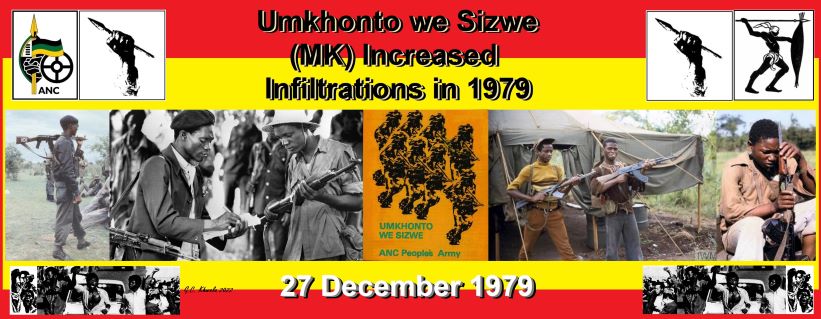
On 27 December 1979, Umkhonto we Sizwe (MK) Commander for southern Natal’s urban areas, Joseph Zakile Zulu, walked into Security Branch offices in Loop Street, Pietermaritzburg, to surrender himself. Zulu had infiltrated South Africa from Swaziland on 9 December 1979, and was deployed to be responsible for operations as Commander in the urban areas of southern Natal.
On the same day that Zulu entered the country, Ikanyeng Molebatsi, Benjamin Tau and Fanie Mafoko entered South Africa from Swaziland as part of the Transvaal Urban Machinery. Prior to these infiltrations, on 5 December 1979, Ncimbithi Lubisi, Petrus Mashigo and Naphtali Manana also entered South Africa from Swaziland in the company of a man codenamed “Lungile”.
Lubisi, Mashigo and Manana had met “Paul”, “Thabo” and “Kenny” of the Transvaal Rural Machinery in Maputo, Mozambique, on the first day of December 1979. The instruction they got from “Paul” was to attack Soekmekaar Police Station, since in that district people were facing forced removals to an arid area that they were not happy about. The local police station was instrumental in the forced removal, and the mission would be to stage an act of “armed propaganda” in the district.
During the month of December 1979, these entries into the country were part of a series of infiltrations that MK launched through Swaziland. One of these infiltrations occurred on 21 December 1979, when Wilfred Madela and Humphrey Makhubo arrived in South Africa from Swaziland, and they were met at their rendezvous point at Ga-Rankuwa Shopping Centre by Benjamin Tau, who had entered the country on 9 December 1979.
Madela and Makhubo were also sent to join the Transvaal Urban Machinery with Tau, Fanie Mafoko and Ikanyeng Molebatsi. The crucial strategic emphasis which shaped the struggle from 1979 onwards was the necessity for an organised underground political presence to complement armed activities.
In line with this approach, the Revolutionary Council was restructured to consolidate not only the supremacy of political leadership but also to ensure the task of mass mobilisation and underground organisation received the necessary emphasis.
A key role was allotted to “armed propaganda” in the form of spectacular attacks to be carried out by specialised operations units. The purpose of such attacks was not so much to damage the apartheid South African war machine, but to inform the world that MK was in business.
Demonstrations of the ANC’s military style and capacity were to be coordinated with a political offensive designed to spread knowledge of ANC policy and to imbue South Africans with a few basic slogans. Thus, 1979 was declared the “Year of the Spear” in commemoration of the victory of the Zulu army over British forces at Isandlwana exactly a century earlier.
In the original plan, the phase of “armed propaganda” was to be replaced by People’s War, on the assumption that a command-and-control infrastructure would be in place by then. Ultimately, therefore, the “armed propaganda” aspect of MK attacks was to serve as a secondary means to deepen mass mobilisation and to attract new recruits into the ranks of Umkhonto we Sizwe.
In essence, the concept of “armed propaganda” consisted of highly visible military attacks orchestrated primarily for political objectives. Such attacks could result in operational challenges when viewed from a military perspective, but would in theory provide a psychological boost to the masses that might revitalise aboveground political organisation.
Therefore, closely aligned to the concept, was the stressed importance of legal, united front organisations, which could consistently politicise the masses, augment military activities, and ultimately pave the way for a successful popular revolution. The impact was to combine the political and military struggles, hence the need to increase the infiltrations into areas where political activities had to be provided armed support.
According to the Brazilian urban guerrilla strategist, Carlos Marighella, “The coordination of urban guerrilla activities, including each armed action, is the primary way of making armed propaganda”. For Marighella, armed propaganda actions are “carried out with specific objectives and aims in mind, inevitably become propaganda material for the mass communication system”.
Castro Khwela
Good day fellow Compatriots!
Discover more from CASTRO KHWELA
Subscribe to get the latest posts sent to your email.

Good morning comrade Castro your recollection of history of our movement is so inspiring and very empowering. Just asking what happened to comrade Zakhile Zulu after entering the SB offices in Maritzburg?
Wonderful work 👌
I appreciate your efforts to educate the masses Commissar
This information is really good and should be included in history our children are taught at school.