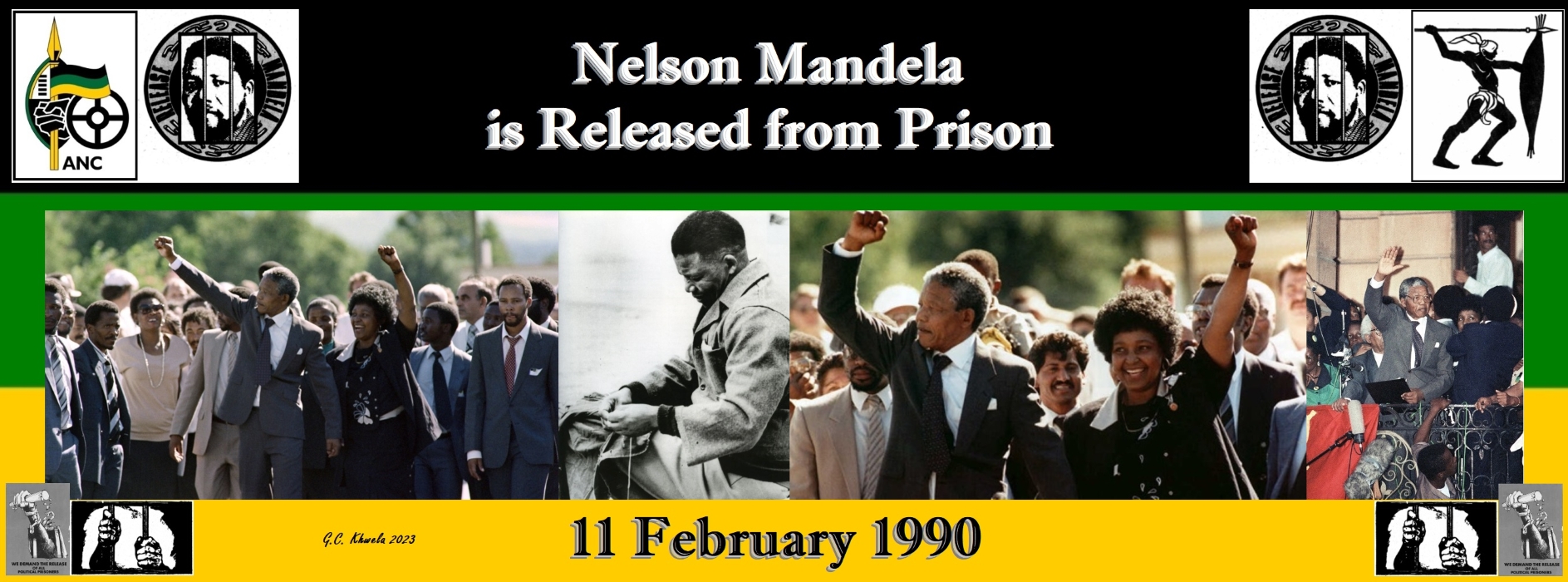
Nelson Mandela is Released from Prison
On 11 February 1990, at around 16:16 in the afternoon, recently released leader of the African National Congress (ANC), Nelson Mandela, emerged from Victor Verster (now called Drakenstein) Prison hand-in-hand with his wife Nomzamo Winnie Mandela, as marshals of the Mass Democratic Movement (MDM) were struggling to hold back the crowds that came to witness the event. Most people wanted to see Mandela since his picture was banned from being published, and those who grew up after he was incarcerated had never seen his face before.
At around 19:45 that evening, Nelson Mandela appeared on the podium at Cape Town’s Grand Parade, as the crowds were restless after waiting for more than two hours for him to begin speaking. Mandela extended his gratitude to all the people in the world that had fought for his release, to the people of Cape Town who tirelessly marched for their freedom as political prisoners, to the African National Congress (ANC) that had fulfilled their expectations in its role “as leader of the great march to freedom”, and to his comrade President Oliver Tambo, who had managed to lead the ANC “under the most difficult circumstances”.
He then saluted the rank-and-file members of the ANC that had sacrificed life and limb in the pursuit of the noble cause of the struggle. Notably, he saluted the combatants of Umkhonto we Sizwe (MK), specifically mentioning Solomon Mahlangu and Ashley Kriel, who had “paid the ultimate price for the freedom of all South Africans”.
Mandela then paid a special tribute to the South African Communist Party (SACP) for its sterling contribution to the struggle for democracy, after having survived 40 years of relentless persecution. He particularly mentioned great communists like Moses Kotane, Yusuf Dadoo, Bram Fischer and Moses Mabhida, whose memory he said “will be cherished for generations to come”. He then saluted the Party’s General Secretary, Joe Slovo, whom he referred to as “one of our finest patriots. We are heartened by the fact that the alliance between ourselves and the Party remains as strong as it always was.”
He then saluted the United Democratic Front (UDF), the National Education Crisis Committee (NECC), the South African Youth Congress (SAYCO), the Transvaal and Natal Indian Congresses and the workers federation COSATU (Congress of South African Trade Unions) and the many other formations of the Mass Democratic Movement (MDM). Mandela also saluted the Black Sash and the National Union of South African Students (NUSAS), for having acted as the conscience of white South Africa during the darkest of the history of apartheid.
Turning to the motive forces of the South African revolution, he extended his greetings to the working class, as “the most dependable force in the struggle to end exploitation and oppression”. He paid tribute to the religious communities who had upheld the campaign for justice when the people’s organisations were silenced. He greeted the traditional leaders, whom he said walked in their footsteps, great heroes like Hintsa and Sekhukhune.
Mandela also paid tribute to the endless heroism of youth, “the young lions”, which “have energised our entire struggle”. Lastly, Mandela paid tribute to the mothers and wives and sisters of the nation, whom he labelled as “the rock-hard foundation of our struggle. Apartheid has inflicted more pain on you than on anyone else.”
With regard to the revolution, Mandela said, “Our resort to the armed struggle in 1960 with the formation of the military wing of the ANC, Umkhonto we Sizwe, was a purely defensive action against the violence of apartheid. The factors which necessitated the armed struggle still exist today. We have no option but to continue … Our struggle has reached a decisive moment. We call on our people to seize this moment so that the process towards democracy is rapid and uninterrupted … Now is the time to intensify the struggle on all fronts. To relax our efforts now would be a mistake which generations to come will not be able to forgive. The sight of freedom looming on the horizon should encourage us to redouble our efforts.”
Mandela mentioned that he felt that it was important for him to publicly explain the talks he had held with the apartheid regime. He then indicated that the talks had “been aimed at normalizing the political situation in the country. I wish to stress that I myself have at no time entered into negotiations about the future of our country except to insist on a meeting between the ANC and the government.”
Furthermore, he had hoped that a climate conducive to a negotiated settlement could soon be achieved, which will then mean the end of the armed struggle. According to Mandela, such a climate had been encapsulated in the ANC’s 1989 Harare Declaration, and it was imperative that the apartheid government immediately ended the State of Emergency and released all political prisoners.
What baffled most of the supporters and the observers was that Mandela referred to apartheid President De Klerk as “a man of integrity”, since he had gone further than any other National Party leader in terms of trying to normalise the situation. One of those entities that were baffled by these words, was the South African Communist Party, which argued that:
“The regime, and the white minority that buttresses its power, is yet prepared to concede the demands put forward by the liberation movement as basic to the achievement of peace and stability. ‘Universal franchise’, for example, must mean one person one vote in a united non-racial democratic South Africa. Everybody must have an equal right to vote and stand for election to an undivided Parliament without distinction on the grounds of race, religion, sex or any other limiting factor” (Editorial Notes, The African Communist, No. 121, 2nd Quarter 1990).
Sources:
Nelson Mandela, “Long Walk to Freedom”.
Thula Simpson, “Umkhonto we Sizwe: The ANC’s Armed Struggle”.
Nelson Mandela, “We Have Waited Too Long for Our Freedom”, Sechaba, Voi. 24 No. 3, March 1990.
Christopher S. Wren, “South Africa’s New Era: Mandela Freed, Urges Step-Up in Pressure to End White Rule”, The New York Times, 12 February 1990.
“Editorial Notes”, The African Communist, No. 121, 2nd Quarter 1990.
Castro Khwela
Good evening fellow Compatriots!
Discover more from CASTRO KHWELA
Subscribe to get the latest posts sent to your email.