
District Six Forcibly Removed
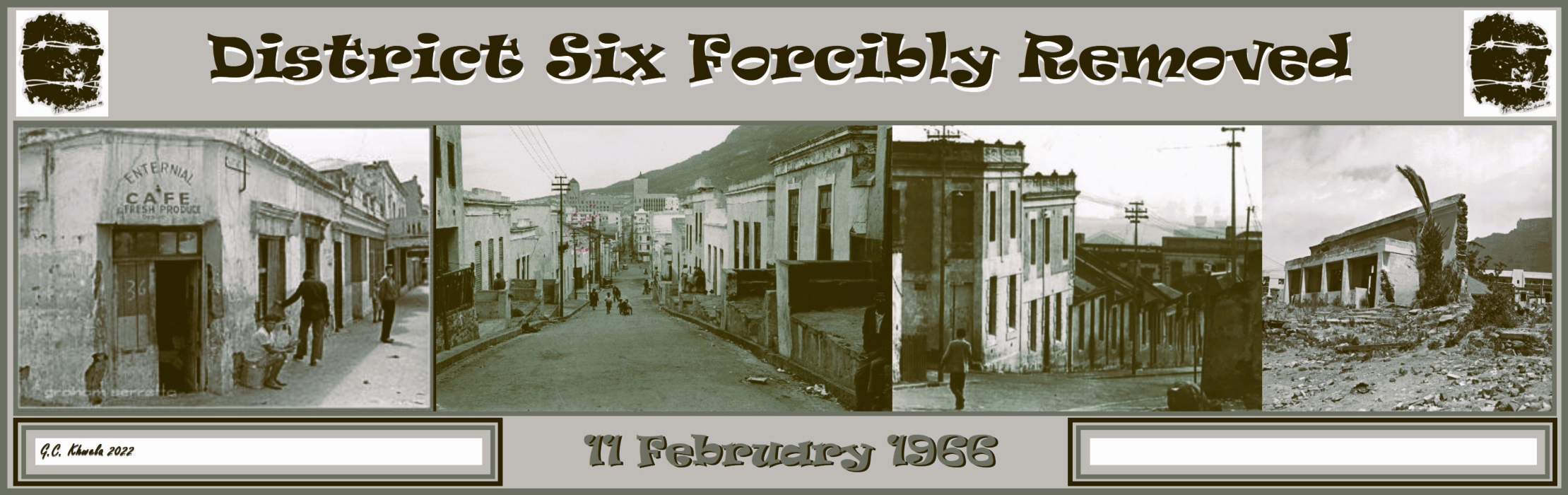
District Six, also known as Kanaladorp (‘kanala’ is a Malay word meaning ‘help one another’), is remembered with the disturbing events flowing from 11 February 1966, when the suburb was declared by the apartheid regime to be a ‘White area’ under the 1950 Group Areas Act. District Six had an intrinsic role in the development of the city of Cape Town. It was named in 1867 as the Sixth Municipal District of the city, and it began to grow after the freeing of those who were enslaved in 1833.
With the passing of the Group Areas Act, residential areas were segregated on the basis of class rather than race. Before then, multiracial spaces, such as District Six, were not uncommon in most South African urban areas. The aim of the Group Areas Act was very much to “racialise” and segregate spaces and therefore the legislation was fashioned as the “cornerstone” of apartheid policy. It was primarily intended to eliminate mixed neighbourhoods in favour of racially segregated ones, which would encourage the separate development of South African races.
During the earlier part of the apartheid period, a few years after the Second World War, District Six was relatively cosmopolitan. Among the multi-ethnic community, were thousands of Jewish residents from the 1880s until their departure to the more affluent areas in the mid-1940s and 1950s. However, under the Population Registration Act of 1950, the area was classified as “Coloured”, since it included a substantial number of so-called Coloured Muslims, called Cape Malays, while there was a sizeable number of Indians, a few black (largely Xhosa-speaking) residents and a smaller number of Afrikaners and English-speaking whites.
When the Group Areas Act (GAA) was passed in 1950, it imposed control over interracial property transactions and property occupation throughout South Africa. It was amended almost annually and was re-enacted in the Consolidation Acts of 1957 and 1966. The GAA created the legal framework for varying levels of government to establish particular neighbourhoods as “group areas”, where only people of a particular race were able to reside.
The GAA displaced hundreds of thousands of people, breaking up families, friends, and communities. This was due in large part to the retroactive application of the law, meaning that once an area was declared a group area, the GAA had the power to demolish all the houses there and displace everyone who was not of the designated group. The GAA added more restrictions to the lives of Africans, and it was one of the first drastic rights infringements for the so-called Coloured and Indian populations.
District Six was not newly exposed to forced removals. The first occurrence of forced removals in District Six occurred in 1901, when the district’s Black African residents were moved to Uitvlugt, which was later named N’dabeni. During this first act of forced removals, the area was razed due to its alleged link to the outbreak of the Bubonic plague. The area was reconfigured and reconstructed into one of the most multi-racial residential areas in South Africa. At the time, approximately 60 000 people resided in District Six, the population being predominantly ‘Coloured’ and Indian with smaller Black and White communities.
When the Group Areas Act was declared, 56 percent of the district’s property was said to be ‘White’ owned, with the rest being 26 percent ‘Coloured’ owned and 18 percent owned by Indians. However, whites made up only one percent of the resident population, the so-called coloured people 94 percent, and Indians 4 percent. Despite these facts, apartheid Minister of Community Development, PW Botha announced in 1966 that District Six would be redeveloped solely for White occupation.
Demolitions began in 1968, when homes and businesses were destroyed, and the only buildings left standing were places of worship. Non-White members of the District Six community, largely the so-called Coloureds, were forcibly removed, mainly to the Belhar township, Rylands Estate and Hanover Park on the Cape Flats. District Six was then renamed Zonnebloem, in 1970, which was a name that made reference to an 18th century colonial farm.
Four primary reasons for the forced removals were given by the apartheid officials. They stated, in line with apartheid philosophy, that interracial interaction bred conflict, thus promoting the separation of races. District Six was deemed as “a slum, fit only for clearance, not rehabilitation”. The area was also portrayed as crime-ridden and dangerous, full of immoral activities like gambling, drinking and prostitution.
“Though these were the ‘official’ reasons for the destruction of District Six, most residents believed that the government wanted the land because of its proximity to the City Centre, Table Mountain and the Cape Town Harbour”. Because of its cosmopolitan nature, District Six also contributed mightily to the distinguished history of South African politics, art, literature and jazz, like Sophiatown.
Sources:
Wikipedia
South African History Online (SAHO).
“District Six Wound to be Healed”, Mail & Guardian, 12 March 2020.
Castro Khwela
Good morning fellow Compatriots!
Discover more from CASTRO KHWELA
Subscribe to get the latest posts sent to your email.


The obsession by the apartheid nationalist regime to create this barbarian law of Group Areas Act was unfair and Satanic because it denied us to co-exist with other racial groups.
When this devilish 👿 👿 👿 Group Areas Act of 1955 was passed, it was just to get rid of us black people.
Why today there is co-existence of all racial groups living together as one and all is well..Then you wonder why the regime introduced this Act for whatever reasons.