Politico-Military Committee (PMC) Replaces the Revolutionary Council (RC)
On 2 September 1983, the African National Congress (ANC) official journal “Sechaba”, in the Editorial of its September 1983 issue, mentioned that the Movement had established a new organisational structure to replace the Revolutionary Council (RC) that had been established by the Morogoro Conference. The new structure reflected the ANC’s fear of being cut-off from the Forward Areas before it had established politico-military structures within South Africa to guide the struggle inside the country.
According to the Editorial, the new structure consisted of a “Politico-Military Council (PMC) with its sub-departments, and the External Co-ordinating Council (ECC) with its sub-committees. By definition the latter will co-ordinate our external work.” When designing the new organisational structure, there was thorough consideration of whether the Movement’s existing priorities were correct, whether resources were being concentrated where they were most required, and whether existing structures were effective and efficient enough in implementing policy objectives.
The Editorial further added that there had been a lot of speculation about the new structure whether it was signifying “the end of the phase of armed propaganda” and the “beginning of people’s war”, or an attempt to “revamp” the ANC’s externally-based operational and military structure to enable an intensification of “its low-intensity guerrilla war”. In order to set the record straight, the Editorial maintained that the Working Committee of the ANC had been preoccupied with the task of “perfecting” the organisational structure in line with the developing situation.
Therefore, “it was logical and correct to continuously evolve new or improved structural forms best suited to the unfolding situation” in South Africa, the region and the world. The ANC saw this as an on-going process to increase its ability to strike at the enemy and effect its revolutionary overthrow. Appropriately, this structure was to clearly identify responsibilities and accountability through an unequivocal distribution of task, based on the central strategic objective of the Movement, which was the seizure of power by the people.
The effort therefore entailed continuously perfecting the organisational structure and the ability to increasingly mobilise the people into revolutionary struggle headed by the ANC. There was a sense of urgency in the development of the new structure, since even though the ANC believed that historically time was on its side, strategically it was not, as the ANC viewed the development of the struggle. The Editorial maintained that the reorganisation was a result and an aspect of serious thinking about the revolution, which the ANC had been involved in, especially during and after the 70th Anniversary celebrations of the Movement in 1982.
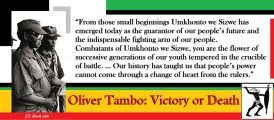
Adding weight to the Editorial, was the January 8 Presidential Statement of 1984, issued by ANC President Oliver Tambo, in which he emphasised that in their analysis of the struggle, they had come to a point where they conceded that “the revolutionary ferment had reached unprecedented heights and had plunged the ruling racist clique into deeper and deeper levels of crisis”. The ANC went on to conclude that the racist state had no way out of the crisis situation within the confines of the apartheid situation, as apartheid could not be reformed. Therefore, the only real solution was to be found in the victory of the revolutionary forces, the dismantling of the apartheid machinery and the transfer of political and economic power to the democratic majority.
Tambo further asserted that all revolutions were about state power, and the South African one was no exception. Accordingly, the slogan “Power to the People” meant one thing only, that the ANC sought to destroy the power of apartheid tyranny and replace it with popular power, with a government whose authority was derived from the will of all the people, both black and white. The main question however was how the struggle was going to get there, what steps were to be taken to attain the ultimate goal, what intermediate objectives were to be set towards building on what had been achieved, especially in preparation for the next stage in the forward march to victory.
Tambo maintained that the answer to these questions related directly to what they had already referred to as the “illegality of the apartheid state”. This implied that they had to begin using their accumulated strength towards destroying the organs of government of the apartheid regime. The effort was to undermine and weaken, thus frustrating, its attempts to assert its control over the people. Accordingly, the drive was to direct their collective might to rendering the enemy’s instruments of authority unworkable. “To march forward must mean that we advance against the regime’s organs of state power, creating conditions in which the country becomes increasingly ungovernable”.
In terms of the ANC’s analysis, was that the apartheid regime maintained an extensive administrative system through which it directed people’s lives, and this included organs of central and provincial government, the military and the police, the judiciary, the bantustan administrations and the community councils. It was these institutions of apartheid power that had to be attacked and demolished, as part of the struggle to put an end to racist minority rule in South Africa. Therefore, as strategists, they had to select for attack those parts of the enemy administrative system which they had the power to destroy, as a result of their united and determined offensive. According to Tambo, “We must hit the enemy where it is weakest”.
Essentially, through the establishment of the new Politico-Military Council (PMC), the Movement had to shift its posture from the defensive to the offensive. The assessment was that the enemy had failed to destroy the Movement and was incapable of doing so. However, invincibility was not enough, as it was in the attack that the Movement had to find victory. Furthermore, the Movement could not wait for the enemy to take the initiative and then react to its plans and schemes. The analysis was that the Movement had a purpose, a goal, an objective, a historic mission to accomplish for the country and for humanity. The historic duty was to pursue it with relentless determination and persistence, whatever the enemy did or omitted to do.
The efforts therefore were to be geared towards organising with more vigour the unorganised, to consolidate, defend and expand existing people’s action on all fronts, and to raise the standard of the organisational and educational work, as well as the psychological preparedness to the level of the major and complex task facing the revolution at that juncture. Tambo singled out the creation of the United Democratic Front (UDF) as a historic achievement in the people’s efforts to unite in the broadest possible front for the struggle against the inhuman apartheid system. For the ANC, the formation of the UDF “was a product of our people’s determination to be their own liberators”.
A special responsibility therefore rested on the shoulders of the ANC and the most advanced parts of the broad democratic movement to act as revolutionaries, to wage a revolutionary struggle and to base themselves on the conscious and organised involvement of the masses of the people, to build a strong and disciplined revolutionary movement. In this context, the Movement deduced that the further mobilisation and organisation of the masses assumed special importance. Indeed, the Movement had managed to build up the unity of the democratic forces as never before and had to consolidate these gains.
The South African Communist Party (SACP) also affirmed this stance, by maintaining that “the need to conquer state power – a policy accepted by both our party and the ANC – presupposes the maximum mobilisation of the South African people and, above all, the sharpening of their offensive capacity. It presupposes a mass uprising, an armed insurrection, which is clearly the most offensive form of mass struggle.”
Sources:
Editorial, “The New ANC Structure”, Sechaba, September 1983.
Oliver Tambo, “Presidential Statement: The Dream of Total Liberation of Africa is in Sight”, Sechaba, March 1984.
Hugh Trevor, “The Question of an Uprising of the Whole People”, The African Communist, No. 97, Second Quarter 1984.
Thula Simpson, “Umkhonto we Sizwe: The ANC’s Armed Struggle”, Penguin, 2016.
Castro Khwela
Good day fellow Compatriots!
Discover more from CASTRO KHWELA
Subscribe to get the latest posts sent to your email.