Lizo Bright Ngqungwana – Commander of the Western Cape
At around 02:00, in the morning of 23 April 1986, while Lizo Bright Ngqungwana was asleep in a three-roomed hut in Crossroads, Cape Town, with his girlfriend and their seven-week-old child, he saw lights flickering through the window. The lights silhouetted the frame of a person standing outside the house, which made Ngqungwana to wake up and watch.
Sergeant Riaan Bellingan, who was still on his secondment to the apartheid Security Branch in Cape Town, was part of a team of fourteen security policemen who stormed the premises, trained their torches on Ngqungwana, who was at the time sitting on the bed, with his hand under a pillow. When the police heard a click, as Ngqungwana was opening the safety pin of his Makarov pistol, they pounced and arrested him before he could make any further moves. They then took the pistol from him.
At dawn, Ngqungwana was taken to Gugulethu Police Station and to Loop Street, where he was brutally interrogated and repeatedly accused of being an Umkhonto we Sizwe (MK) Western Cape Commander. Eventually, he was shown a picture of himself in the police’s “terror album”, which proved to be the tipping point in the questioning. When he was asked when he came into the country, he replied that that he entered the country in June 1985. After his arrest, that evening, Ngqungwana’s Comrade, Quentin Michels was also arrested at his home and brought to the same police station.
Lizo Bright Ngqungwana was born on 15 April 1960 at Ladysmith in Natal. His parents returned to the Eastern Cape in 1971 to settle in Alice and Port Elizabeth. He got involved in the politics of the South African Students Movement (SASM) whilst he was a student at Jabavu High School in Alice, and later at Cowan High School in Port Elizabeth. Ngqungwana left the country in 1978 together with Wandile Hlobo and Zukile Matakane to join the African National Congress (ANC) with the purpose of being part of the ranks of MK. They went through South West Africa (now Namibia) straight into Angola, which was then at war, where they received political and military training as part of MK’s Moncada Detachment.
In 1979, Ngqungwana was sent for further training in the Soviet Union, where he specialised in Military Engineering. On his return, he was posted to the MK Regional Office in Luanda. In 1983, he was deployed to Lesotho by the then MK Army Commissar Chris Hani, where he was involved in the training of new recruits that were intended to rapidly return into the country to establish fighting units.
Towards the end of February in 1983, Chris Hani informed Ngqungwana that he had been appointed MK Commander for the Western Cape. On the night of 3 May 1985, Ngqungwana entered South Africa from Botswana, taken in a vehicle to Bloemfontein, where he boarded a plane to Cape Town, and was later collected by another comrade to Gugulethu. He operated within the country building underground armed formations from May 1985 to April 1986.
On 4 May 1985, Quentin Michels arrived in Gaborone, Botswana, where he was instructed to return to the Western Cape to recruit three other people into a cell that was to obtain a safe house for arms to be stored and procure other safe houses to temporarily host people that were wanted by the police. On his return from Gaborone, Michels approached his friends Ashley Forbes and Pieter Jacobs to form an ANC cell under his command.
On 18 April 1986, in the vicinity of Crossroads Township, MK Western Cape Commander Lizo Ngqungwana gave Quentin Michels two bags containing seven limpet mines and twelve hand grenades. As part of the instructions, Michels was supposed to identify hideouts to accommodate him and also be used to store the weapons. At midday on 20 April 1986, Quentin Michels arrived at Cecil Esau’s home in Cape Town’s Wynberg suburb and handed over the two bags he received from Ngqungwana to Esau, for him to give them to Ashley Forbes.
Following his arrest on 23 April 1986, fourteen other comrades were arrested, including Quentin Michels. When Lizo Ngqungwana and 14 fellow accused entered the dock of the Cape Town Supreme Court on 21 April 1987, the main charge was one of ‘terrorism”. The charges arose from the alleged operations of a number of ANC cells in the Western Cape area under the overall control of Ngqungwana. The group’s activities included armed actions as well as importing arms and ammunition. With Lizo (26), were Cecil Esau (25), Thembinkosi Mzukwa (26), Joseph Ngoma (28), Temba Tshibika (38), Sazi Veldtman (32), Mthetho Myamya (24), Neville van der Rheede (26), Gladwin Mabengeza (36), Cyril Ntabeni (36), and Norman Macanda (29).
Most of the accused had been in custody since April 1986. The trial came to an abrupt end on 29 May 1987, when 13 of the defendants changed their pleas. Six pleaded guilty to terrorism; Ngqungwana admitted being the regional MK commander; Thembinkosi Mzukwa admitted two hand-grenade attacks in 1985 – on Langa police station and an armoured police vehicle; Joseph Ngoma admitted the planting of two mines at Mowbray railway station; Sazi Veldtman, Quentin Michels and Cecil Esau admitted transporting, storing and hiding arms and explosives.
Ngqungwana was sentenced to life imprisonment on Robben Island and was released in April 1991, where he served at the ANC Regional Office in the Western Cape until 1994. In 1994, as all other MK cadres who were on the Certified Personnel Register (CPR) list, which was a document containing the names of all members of the constituent military forces (both statutory and non-statutory), were called up for integration into the newly constituted South African National Defence Force (SANDF). These lists were crucial for the integration of the various forces into the SANDF and for the demobilisation of non-statutory forces.
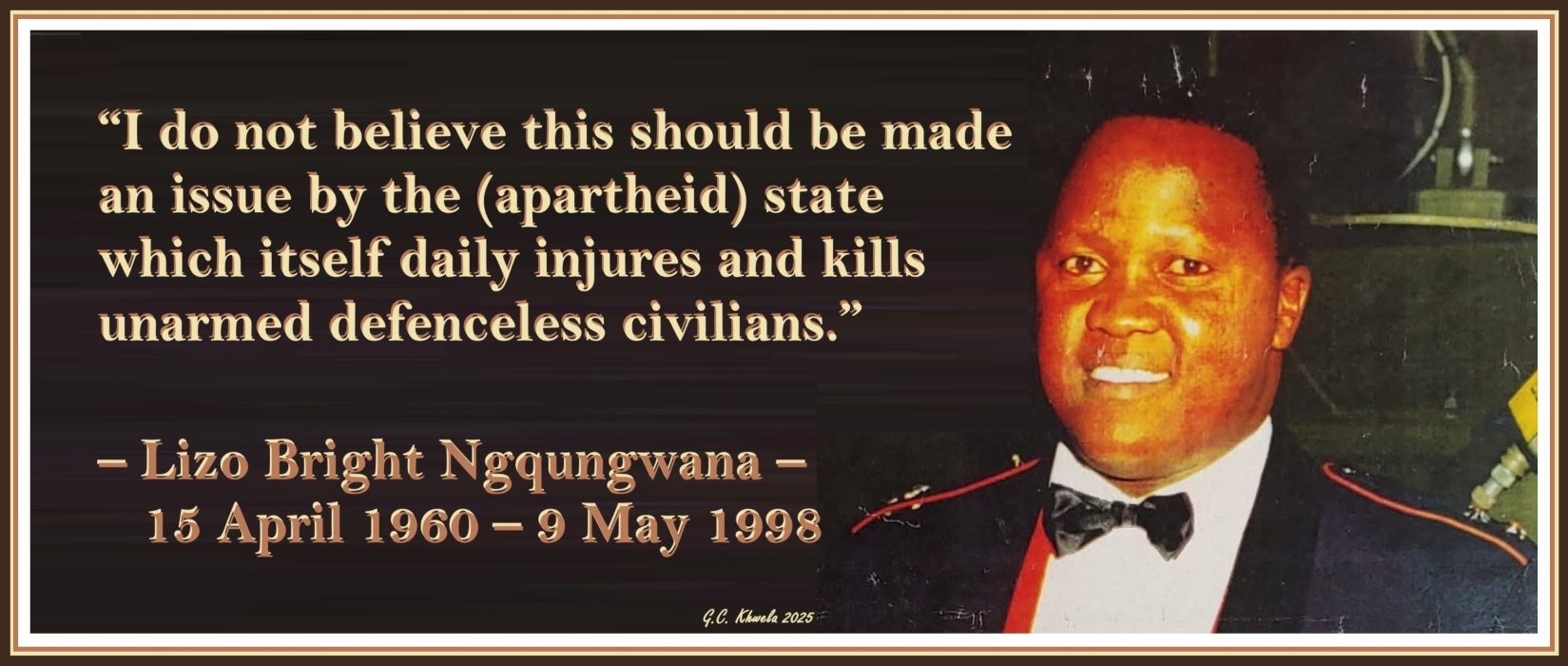
On 9 May 1998, Lieutenant Colonel Lizo Bright Ngqungwana was killed in a car accident involving his car and a taxi in Cape Town, and his funeral was held at his home in Alice.. As the Commander of the convicted combatants, Ngqungwana described the ANC’s policy of avoiding civilian casualties wherever possible. He further declared, “I do not believe this should be made an issue by the state which itself daily injures and kills unarmed defenceless civilians.”
Sources:
Wikipedia.
South African History Online (SAHO).
Editorial, “The ANC or the Government: Who are the terrorists?”, Crisis News, No. 29, May 1989.
Deborah Robinson, “I Met Lizo Ngqungwana’s Wife!!!”, The Political Prisoners of South Africa Documentation Project, 30 August 2014.
Gaye Davis, “Island doors may swing open soon”, Mail & Guardian, 25 May 1990.
Deborah Robinson, “Lizo Ngqungwana: Imprisoned for Life”, Focus, No. 72, September-October 1987.
Cecyl Esau, “Memories of a Political Prisoner on Robben Island, 1987-1991”, Kronos, Vol. 34 No. 1, November 2008.
Sharkey Isaacs, “South Africa: Big taxi blitz on the Way”, Cape Argus, 12 May 1998.
Thula Simpson, “Umkhonto we Sizwe: The ANC’s Armed Struggle”, Penguin, 2016.
Castro Khwela
Good evening fellow Compatriots!
Discover more from CASTRO KHWELA
Subscribe to get the latest posts sent to your email.