Our Best Defence Against Violence Is Political: ANC-IFP Peace Talks Called-Off
On 8 April 1991, the peace talks between the African National Congress (ANC) and the Inkatha Freedom Party (IFP) were called off as a result of the ANC’s ultimatum sent to apartheid President F.W. de Klerk, in which the ANC demanded that De Klerk stop aiding and abetting the IFP in the ongoing feud with the ANC and its alliance partners, the United Democratic Front (UDF) and the Congress of South African Trade Unions (COSATU).
IFP leader Chief Mangosuthu Gatsha Buthelezi was again angered by the ANC allegations that the IFP is backed by the security forces to kill ANC members. Buthelezi accused the ANC of putting the country on the brink of civil war and of aiming to wreck the negotiation process, setting the stage for an attempt to seize power. When Buthelezi launched the Inkatha Freedom Party (IFP) in July 1990, which was before then called Inkatha YeNkululeko Yesizwe (founded in 1975), he declared that “We will not allow the ANC and its SACP partners to crush all opposition and emerge as the only viable party”.
The killings began in earnest in 1983 when the UDF “invaded” Natal, Chief Buthelezi’s home “turf”. After Mandela signed the Pretoria Minute in August 1990, having unilaterally declared that the ANC would suspend the armed struggle, violence escalated dramatically. KwaZulu and Natal became killing fields as supporters of the ANC and the IFP engaged in ferocious encounters to secure and expand their bases of support. Villages changed hands and the inhabitants changed allegiances in order to save their lives. Secured territory was immediately designated as no-go areas for one party or the other.
More ominously, the violence spread into the Transvaal, encompassing Pretoria, Witwatersrand, and Vereeniging – the Vaal Triangle that was littered with some of the most deprived townships, squatter camps, and hostels for migrant workers, most of whom were IFP supporters from KwaZulu and Natal.
Mandela became convinced that De Klerk was doing nothing to bring the violence under control, as there were few arrests, the police were reluctant to intervene, eye-witness accounts provided prima facie evidence that the police were abetting the IFP, and yet there was no follow-up on the part of the authorities. In view of this sinister turn of events, Mandela came to the reluctant conclusion that a “third force” was involved in the violence and that the government’s apparent unwillingness to get the situation under control and weed out the roots of the violence was working to its tactical advantage.
When Mandela confronted De Klerk with his concerns, with what he regarded as substantial confirmation of security force involvement in the violence, De Klerk would, according to Mandela, ask him to produce concrete evidence of police complicity, and go to unnecessary lengths to explain that he could not act on the basis of unsubstantiated allegations of police improprieties.
The ANC, on the one hand, pointedly accused the IFP of fomenting violence in order to broaden its support base albeit, always in the context of the IFP being in complicity with the apartheid state security forces or consenting to the bidding of the security forces reinforcing their relentless allegations that the IFP were stooges of the state, and hence in some manner in cahoots with the apartheid regime. In short, the IFP were enemies of the liberation movement and had thrown their lot with the oppressors of blacks.
Buthelezi, on the other hand, had no intention of being left out of the pre-negotiations loop. Hurt by Mandela’s refusal to accept his invitation to visit him – on receiving the invitation, Mandela had responded that he would be honoured to meet with both Buthelezi and King Goodwill Zwelithini, King of the Zulu nation, to lay a wreath at the tomb of the legendary King Shaka, founding father of the Zulu nation. Buthelezi publicly stated that there would be no cessation in the violence until he and Mandela met. Buthelezi expected to be thanked personally by Mandela for his so-called efforts to secure Mandela’s release.
The South African Communist Party (SACP) maintained that with the ongoing violence, De Klerk had become “over-confident”. It argued that “At the very least he connived in the terrible massacres perpetrated by Inkatha and his own security forces. The violence worked well for him, at least for some months. His ally Buthelezi stabbed his way on to the national political stage. Meanwhile, here in South Africa and internationally, the violence was projected as a Zulu vs. Xhosa, Inkatha vs. ANC faction fight. De Klerk, for his part, was portrayed as being neutrally and wisely above this affair” (The African Communist, No. 125, Second Quarter 1991).
“But”, the SACP averred, “De Klerk blundered. The sheer scale of violence; the growing evidence that Inkatha was overwhelmingly to blame; the obvious bias of the apartheid security forces, and their unwillingness to curb Inkatha; Gerrit Viljoen’s notorious comment, at the height of the massacres, that Inkatha ‘is a factor for peace’ – all of these became too much even for some of De Klerk’s best friends to stomach.” For the SACP, “Our ANC-led alliance has nothing to fear, and anything to gain from the fullest democratisation of politics, and from an immediate ending to all political violence. Our best defence against regime and Inkatha violence is political. The political price they pay for any violence must become prohibitive.”
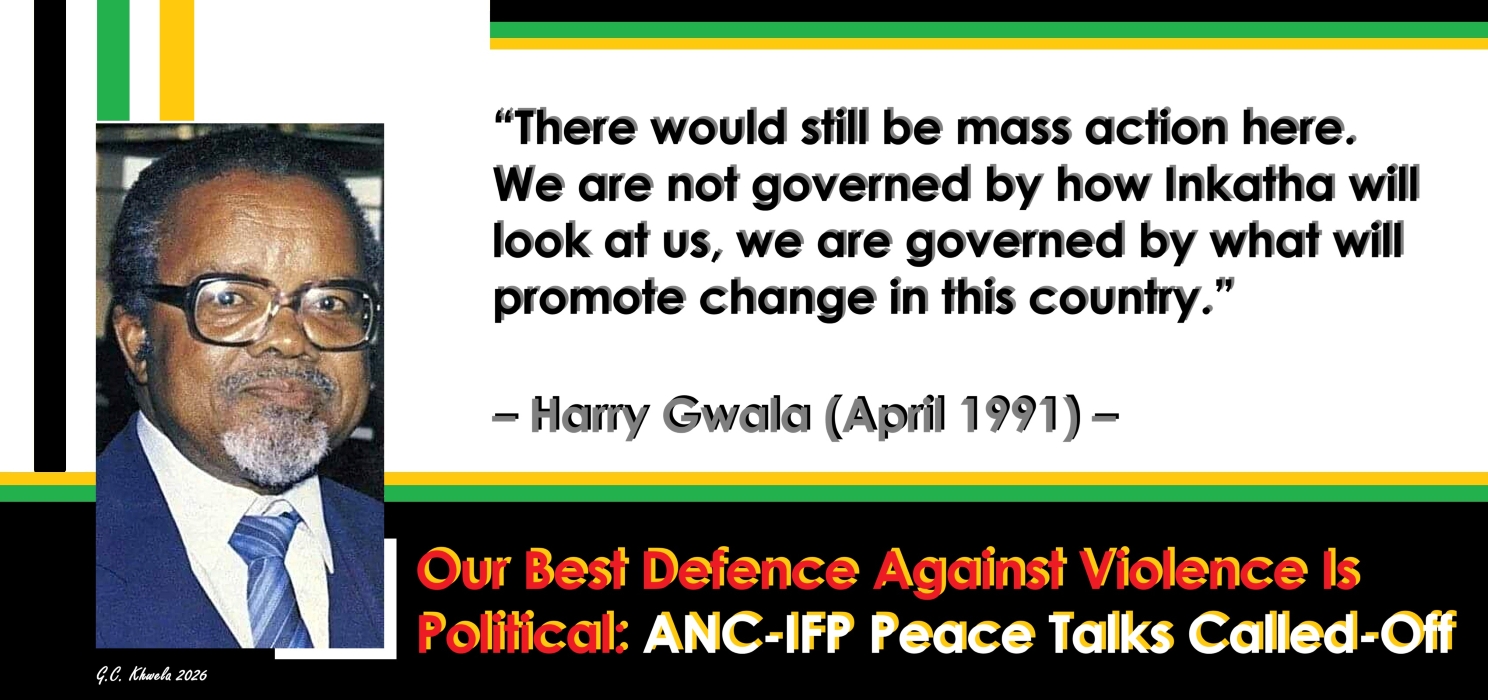
The ANC leader in the Natal Midlands, Harry Gwala, was adamant that despite the violence, ANC mass mobilisation in Natal was to continue unabated. According to Gwala, “There would still be mass action here. We are not governed by how Inkatha will look at us, we are governed by what will promote change in this country.”
Sources:
Wikipedia.
South African History Online (SAHO).
Editorial Notes, “Inkathagate and the Peace Process”, The African Communist, No. 125, Second Quarter 1991.
Yvonne Muthien, “Spear of the Midlands: An Interview with Harry Gwala, ANC Chairperson, Natal Midlands”, INDICATOR SA, Vol. 8 No. 2, Autumn 1991.
Nelson Mandela, “Long Walk to Freedom”, Abacus, 1994.
Thula Simpson, “Umkhonto we Sizwe: The ANC’s Armed Struggle”, Penguin, 2016.
Castro Khwela
Good day fellow Compatriots!
Discover more from CASTRO KHWELA
Subscribe to get the latest posts sent to your email.