The Commonwealth EPG Visit: Part 2
On 21 May 1986, the Commonwealth Eminent Persons Group (EPG) admitted that their Mission to Africa initiative had failed. This followed their meeting with members of the apartheid South African government’s Cabinet Constitutional Committee, which included Ministers Chris Heunis, Louis le Grange and F.W. de Klerk on 19 May 1986.
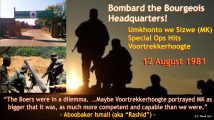
At about 06:00, in the morning before the meeting between the EPG and the apartheid government, six helicopters began circling overheard of Gaborone’s Mogoditshane suburb, with one dropping pamphlets addressed to the Botswana Defence Force soldiers. The message was, “We have no fight with you. For your own safety, please do not interfere. Our only objective is to eliminate the ANC (African National Congress) gangsters”. Five of the helicopters landed, two of them about 500 metres from a complex of houses. A number of heavily armed troops disembarked and marched to a compound, which they sprayed with bullets before retreating to the helicopters.
Later in the same day, the Inter-Press Service announced that the attack in Botswana by armed men in helicopters was accompanied by other similar attacks in Zimbabwe and Zambia. In Harare, an ANC office was bombed and the house of a refugee was razed to the ground. An apartheid government statement claimed that a property belonging to the ANC’s Department of Information and Publicity in Makeni, some 15 kilometres south-west of Lusaka was also hit.
President Kenneth Kaunda was quoted as saying that the planes actually hit a refugee camp on Lusaka’s southern outskirts, killing a Namibian refugee and a Zambian civilian, and wounding eight to ten others. These raids in Zambia, Zimbabwe and Botswana were reportedly deliberately timed to coincide with the EPG Commonwealth’s meeting with the apartheid government.
During the meeting, Chris Heunis, the Minister of Constitutional Development and Planning, indicated that in any negotiating situation there would be many negotiating parties, but the South African government could not be treated as just another negotiator. It represented the state and it would have to endorse any proposals issuing from talks. According to Heunis, the government would also be guided by the President’s pronouncements on conditions for talks, which included: centrally, the creation of an atmosphere on non-violence, and an essential aspect thereof was a renunciation of violence, especially by the ANC.
This, Heunis averred, had to be interpreted – not in a temporary sense – but as a public commitment to reject violence as a means of obtaining political goals. Heunis maintained that there would have to be a visible reduction in violence before the apartheid government could respond to the negotiating concept, since it had proved its commitment to political reforms, and the onus was then on the other side. These preconditions could not be reconciled with those of the ANC, as stated in its “Submission on the Question of Negotiations”, that were published on 27 November 1985, and the events of 19 May 1986 throughout the regions scuppered the EPG initiative.
The exchange of letters between the former Australian Prime Minister Malcolm Fraser and former Nigerian Head of State Olusegun Obasanjo, who were appointed as the EPG’s Co-Chairpersons, and the two Bothas, P.W. and Pik, plainly revealed that P.W. Botha resented what he saw as the Commonwealth’s intrusion in South Africa’s domestic affairs. Nor was there any chance of his government agreeing to bargain with the ANC on equal terms for that would be seen as granting the organisation a legitimacy his Cabinet was not prepared to concede. P.W. Botha refused to budge and preferred instead to pander to his domestic constituency by authorising military raids against Zimbabwe, Zambia and Botswana.
Hardly surprisingly, the Commonwealth initiative collapsed instantly. According to the EPG’s conclusions, “… the situation is deeply disturbing. If diplomacy fails, there can only be war. And a state of war is already upon us.” In his address to the Royal Commonwealth Society in London, on 23 June 1986, ANC President Oliver Tambo maintained that “The Eminent Persons have passed their judgement, and it is in the hands of the international public … It is idle, in the face of the destruction in terms of life which the apartheid system has caused, to be saying nothing should be done, because Blacks will suffer. That kind of argument displays lack of knowledge, lack of appreciation of what apartheid has been and continues to be.
“It is the pain of apartheid that we want to stop by ending apartheid”. Tambo continued, “We are not asking for pity for our suffering. We are asking to be supported for the sacrifices we are ready to make and are making. The burdens that sanctions will bring upon us are a sacrifice we are prepared to make. The death that we suffer in the course of struggle is a sacrifice we are ready to make. We ask for no pity.”
According to Tambo, “There is no need for us here to cover the ground that has so brilliantly been covered by the Commonwealth Group of Eminent Persons. It should suffice that we emphasise only some of its conclusions. These are that the Botha regime is determined to maintain the apartheid system of White minority domination by force; that its so-called reforms constitute an attempt to strengthen this system; that violence against the people is an inherent feature of this system, and that the firm belief that the leading Western powers will not impose sanctions has encouraged the Botha regime to pursue its apartheid policy regardless of its complete rejection by our people and the rest of the international community.”
For Tambo, “The Group of Eminent Persons has also recognised the fact that, in the light of all this, we have no alternative but to fight and has correctly warned of an impending catastrophe of immense dimensions. To avoid that eventuality, the EPG has called on the Commonwealth and indeed the rest of the world to impose effective economic measures, which means sanctions, against apartheid South Africa.”
Sources:
Oliver Tambo, “We Have Decided to Liberate Ourselves”, Sechaba, August 1986.
Ralph Lawrence, “Mission to South Africa: The Commonwealth Report”, Penguin Books for the Commonwealth Secretariat, 1986.
Thula Simpson, “Umkhonto we Sizwe: The ANC’s Armed Struggle”, Penguin, 2016.
Nelson Mandela, “Long Walk to Freedom”, Abacus, 1994.
Castro Khwela
Good day fellow Compatriots!
Discover more from CASTRO KHWELA
Subscribe to get the latest posts sent to your email.