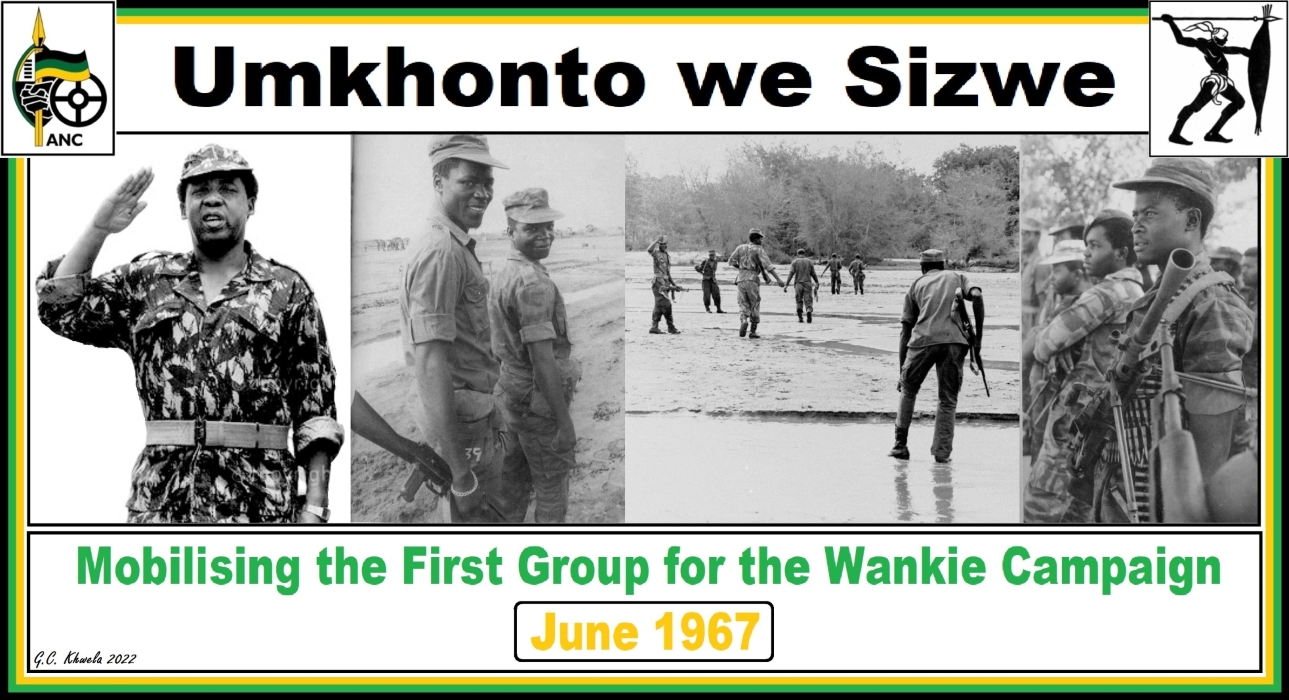
MK Mobilising the First Group for the Wankie Campaign
On 19 June 1967, following the meeting held at Dr Randeree’s plot in Lusaka two days before, a large group of Umkhonto we Sizwe (MK) cadres were gathered in Kaluwe’s Farm, approximately 40 kilometres east of Lusaka. The mobilisation began on 18 June, when a group of nine, namely Joseph Nduli, Daluxolo Luthuli, Leonard Nkosi, Kenneth Mzathi, John Makgotsi, Columbus Mohapi, Lucas Dolcin, Audie Moloto and Siphiwe Radebe, were taken from Kongwa Camp, in Dodoma, to a camp in Morogoro, in a Land Rover driven by Boy Otto.
At Morogoro, they found a number of other MK cadres already there. Breaking the ice, Daluxolo Luthuli asked Philemon Biyela, one of the Morogoro-based cadres, about what happed to Duncan Khoza. Biyela responded that Khoza went along with Styles Makama, Badman Ngwaxela, John Ngisi and Spy Motsila to the Mozambique area, where they were clad in khaki uniform with peaked caps, and each was armed with a Russian submachine gun and Chinese grenades. Their task was to reach the Shangaan-speaking areas of South Africa via the Kruger National Park. Apparently they were violently repelled by the Portuguese forces in Mozambique’s Niassa and Cabo Delgado Provinces and retreated back to Tanzania.
On 19 June, after the group from Kongwa had arrived in Morogoro, Berry Nkosi showed up in a Land Rover and took seventeen guerrillas south to Mbeya, where they found Archie Sibeko waiting, who then drove them into Zambia. They eventually arrived in Lilanda Township on Lusaka’s outskirts, where they met a group of about twenty other cadres, including Joe Modise and Chris Hani. On that afternoon, they were taken by Berry Nkosi in a Land Rover to Kaluwe’s Farm, where they met a large group of guerrillas, including Lawrence Phokanoka, Theophilus Mkaliphi, James April, Basil February and Ralph Mzamo.
Most of these were cadres who knew each other from Kongwa – colloquially known as the “University of Life” – a designation given by African National Congress (ANC) Acting President Oliver Tambo, which was regarded as a world of its own, a place where Comrades trusted each other with their own lives. Some of the cadres even indicated that it was even difficult for them to trust people who had not served at Kongwa, because the camp was a true test of the ability to survive.
The majority of these cadres were very young, in their early twenties, and were impatient to get into action, as they had been trained to explore and establish routes; they wanted to be deployed to find the routes into South Africa. Many attempts were made to get through to South Africa. An attempt to use Botswana as an access point in March 1967 was a disaster, as two cadres were arrested and the trail they were working on had to be allowed to go cold.
A second attempt in late May and early June 1967 into northern Mozambique had disconcerting results, when Josiah Jele led a joint MK-FRELIMO Unit, which was violently repulsed by the Portuguese colonial forces based in Niassa Province. A second joint MK-FRELIMO unit was attacked in the neighbouring province of Cabo Delgado, and was forced to retreat. The challenge was that even if FRELIMO’s influence in the country was growing, it lacked strength outside the north of Mozambique.
An alliance with the Zimbabwe African People’s Union (ZAPU) – whose membership was culturally closer to the ANC – made better sense. When the decision was made to embark on the Wankie Campaign, the approach of the ANC was one of selecting the best cadres. Undoubtedly, there was hesitation from the National Executive Committee (NEC), because of the fear of cadres being killed by the Rhodesian Security Forces, and such a failure resulting in a mass defection, as cadres deciding to go home on their own efforts.
Specifically, it was decided that a contingent from MK would enter Rhodesia alongside ZIPRA (Zimbabwe People’s Revolutionary Army – an armed wing of ZAPU), with a view of establishing a route for infiltrating fighters from the camps via Rhodesia into South Africa. Therefore, it was never the intention for this group to launch an attack on Rhodesian or South African security forces, but only to set up a logistical network in order to facilitate future infiltration.
“A lot of time was allocated for the detachment to be together in the bush to be able to train together in order to ensure that physically we were ready for the rigorous task that lay ahead”, declared Chris Hani. “But in addition to the physical preparation there was also the political preparation, the need for us to forge an understanding between the forces of Umkhonto we Sizwe and the forces of ZAPU and to understand the historical necessity of the battles of Wankie” (Dawn).
Hani added that “There was a need for us to feel that we were not participating merely to help ZAPU and the people of Zimbabwe, but it was important to see it in its global perspective, the need for the people of Zimbabwe and the people of South Africa to fight against an enemy, enemy which had forged an alliance. We all know about the alliance between (Ian) Smith and (John) Vorster. For us South Africans what was also important was the fact that we were moving home to participate in the struggle of our people inside South Africa. So there was also this added dimension.”
What was stated by Chris Hani was also echoed by Pilani Ndebele, the Editor of Zimbabwe Review, the official organ of ZAPU, in which he maintained that “the new dimension in the political conflict in Zimbabwe is manifested by the public participation of the South African army in a bid to contain and annihilate the liberation forces. The alliance of the forces of oppression backed by international finance houses is a pointer to the gravity of the problem. The struggle in Zimbabwe can therefore not be looked at in the narrow context of settler rule but in the context of a struggle against imperialism and all its ramifications” (Sechaba, December 1967).
The South African Communist Party also added its voice to these developments, maintaining that “What now gives the ANC-ZAPU alliance its special significance, one whose potentialities it would be hard to overestimate, is not only that it is sealed in a bond of brotherhood on the battlefield, but above all that it is boldly directed against the main bastion of white supremacy and colonialism in Africa” (The African Communist, Fourth Quarter, 1967).
Sources:
Chris Hani, “The Wankie Campaign”, Dawn, Souvenir Issue, 1986.
Editorial Notes, “Freedom Marches South: The Fighting in Zimbabwe”, The African Communist, No. 31, Fourth Quarter 1967.
Pilani Ndebele, “Zimbabwe is not Negotiable”, Sechaba, Vol. 1 No. 12, December 1967.
Thula Simpson, “Umkhonto we Sizwe: The ANC’s Armed Struggle”, Penguin, 2016.
Stephen Ellis, “External Mission: The ANC in Exile”, Jonathan Ball, 2012.
Janet Smith and Beauregard Tromp, “Hani: A Life Too Short”, Jonathan Ball, 2009.
Vladimir Shubin, “ANC: A View from Moscow”, Jacana, 2008.
Hugh Macmillan, “The Lusaka Years: The ANC in Exile in Zambia”, Jacana, 2013.
Castro Khwela
Good evening fellow Compatriots!
Discover more from CASTRO KHWELA
Subscribe to get the latest posts sent to your email.