The Arrest of the Valiant MK-SDU Combatant Mzwandile Gushu in Ermelo
On 17 July 1992, Hollingwood Mzwandile Gushu was arrested in hospital while he was receiving treatment for his wounds that seriously affected his leg enough for him to require hospitalisation. The wounds were attained on 6 July 1992, when Gushu met Lucky Mbokane, who informed him that the Giwi Breyten Construction Compound was training members of the Inkatha Freedom Party (IFP), the Black Cats and the Black Chain, a gang of IFP-aligned vigilantes that conducted attacks on African National Congress (ANC) members, principally in Wesselton, Ermelo, in the Eastern Transvaal.
The gang, which had received military training from Inkatha-related military practitioners at the Mkuze camp in Natal in the early 1990s, was supported by certain councillors, Caprivi trainees and members of the apartheid security police. Gushu and Mbokane had to confiscate the guns that belonged to the Black Cats gangs, which were stored in the Giwi Breyten Construction Compound. The guns were meant to be used to defend the community, since without turning to stealing such arms, it was unlikely the self-defence unit (SDU) would be able to defend the community from gang violence and harassment.
During the evening of 6 July, Gushu and Mbokane, with the help of Mlungisi Gombela, had two black security guards bound at the entrance to the Compound, when a car approached with two white men. Gushu approached them pretending to be a security guard. Instead of a normal interaction taking place, one of the men sprang out of the car and opened fire in the air. Immediately Gushu ran into the compound, pulled his AK-47 automatic rifle, and started firing back at the white men, killing one, David de Bruyn, instantly. The other one, Wynand Fourie, was injured as he continued to exchange fire with Gushu, hitting him in the leg. Fourie then fled the scene, while Gushu remained wounded and had to be hospitalised.
The entire episode with Gushu began on 12 July 1990, when John Fanyana Mndebele, Nicolas Mthundisi Zwane and Sipho Silos Nkonyane met Umkhonto we Sizwe (MK) Chief of Staff Chris Hani at the ANC Headquarters, at Shell House, in Johannesburg. The three men informed Hani that they were from Wesselton, in Ermelo, wherein the IFP, assisted by the apartheid police and the Black Cats and Black Chain gangs, were terrorising, killing and harassing members of the community. Hani responded by advising them to go back to Wesselton and set-up self-defence units (SDUs) in order to arm themselves. In Ermelo, the three were met by Jabi Aaron Mkhwanazi, a senior member and Commander of MK, who promised to assist them in establishing SDUs through the efforts of a valiant revolutionary, Mzwandile Gushu.
Hollingwood Mzwandile Gushu was born in 1964 at the Goshen Mission Area, which is at Amahlathi, Amathole District Municipality, in the Eastern Cape. From 1972 to 1994, Amathole district was part of the former Ciskei bantustan. As a result of the hardships and oppression which Gushu had suffered in the area, he decided to go and stay at Lingelihle Township in Cradock. It was while he was in Cradock that Gushu came into contact with political activists, such as Matthew Goniwe, Sparrow Mkhonto, Ford Calata and Sicelo Mhlawuli, who later were referred to as the “Cradock Four”.
The police in Cradock area used to harass the political activists repeatedly because of their revolutionary activities. Gushu was then forewarned that the police were about to arrest him and he then decided to go to Cape Town, where he immediately contacted fellow members of the ANC. During 1983 he formally joined the military wing of the ANC, Umkhonto we Sizwe (MK), the unit which was operating in MKTC Crossroads area. While he was living in Crossroads, he underwent military training and learnt to use various arms and military weapons. He actively participated in armed operations on behalf of MK in and around Cape Town and a number of his comrades were killed during 1983 – seven members of his MK unit were gunned down by the police.
After the killing of his commander, MK Commander Decks Dekuze, Gushu realised that his life was in danger in Cape Town because of the security police, he then decided to go back home, where he met with his old acquaintance, Zweli Dumile. Dumile then told him that he was working in the Winkelhaak Mines, in Evander Goldfields, in Secunda. Gushu then decided that it was good for him to go with Dumile to Secunda. At Secunda, Gushu was introduced to Eric Valla as a combatant, who then introduced him to Jacob Israel J.J. Mabena. Mabena was the organiser and chairperson of the ANC in the area. Gushu was then introduced as an MK combatant to Mkhwanazi at Nelspruit.
Jabi Mkhwanazi then proceeded to put Gushu through a refresher or crash course in the use of certain military weapons. It soon became apparent to Mkhwanazi that Gushu was fully conversant with the weapons and, as a result, his military training course only lasted two weeks. Thereafter Gushu returned to Wesselton, in Ermelo, and to Embalenhle, in Secunda, where he was deployed to build SDUs to defend members of the community in general.
Approximately a year afterwards, on 7 July 1991, at around 19:00, at a convenience store in Wesselton, Gushu shot and killed Jwi Zwane, a Caprivi Strip-trained member of the IFP-aligned Black Cats vigilante group, and injuring Happy Mhlongo, who ran to a corner house, into a shack at the back of the property. Gushu followed him and opened fire injuring two other persons inside the shack, Eric Nkosi and Sibusiso Tito Nkosi. According to Gushu, it was in the evening, therefore it was difficult to know that there were other people inside the shack or not.
More than five months later, on 12 December 1991, Gushu went with Sithule Hleza, the ANC Youth League Chairperson, to assassinate Alpheus Msibi, the Inkatha Mayor, who accommodated IFP members in his Thandukukhanya Township house, in Piet Retief. These IFP members were being trained by “Askaris” at Mpuzwa Camp, and were the people that brought chaos to Piet Retief, killing ANC members and SA Communist Party members, as well as Civic leaders.
Gushu told Hleza that they were going to wait for Alpheus Msibi at his bottle store because if there were “Askaris” in his house, it would be difficult to kill him, with askaris guarding him. According to Gushu’s analysis, the “Askaris” were well trained, as former members of MK. He then took Sithule Hleza to Msibi’s bottle store. When Msibi arrived with a van at the bottle store, Gushu approached the vehicle and opened fire on Msibi, who managed to get out and hide under the van. Gushu then shot and killed Msibi’s bodyguard, Themba Mlangeni, who appeared carrying the cashiers till that contained the store’s takings for the day. He then instructed Hleza to take the till, shot Msibi again, they then fled on foot, leaving Msibi dying agonisingly because of his injuries.
On 12 April 1992, Paulos Pistol Nkonyane (aka “Kye-Kye”) and Gushu shot and killed Chris Ngwenya, an IFP Youth Brigade official, and Lindiwe Nkosi, an IFP Women’s Brigade member, outside some shops in Wesselton Township. Meanwhile Ms Thembisile Nkambule, who was with the two, managed to escape with severe injuries. Chris Ngwenya was also a Caprivi trainee and was Jwi Zwane’s assistant in the Black Cat gang, whom Gushu shot and killed on 7 July 1991. Gushu maintained that Ngwenya was highly trained, hence he needed the assistance of Paulos Nkonyane, who was armed with an AK-47 as a member of the SDU, to kill him.
With the killing of Jwi Zwane and Chris Ngwenya, Black Cats gang members began to defect to the SDUs and undertook operations against their own gang members. One of the most notable killings was that of Obed Nhlabathi by Livingstone Lukhele and Bongani Wilberforce Khaba, who was a member of the Black Cats before defecting to the ANC. Although Khaba had been told that Nhlabathi was a Black Cat leader, it is unlikely he had the sort of influence possessed by Jwi Zwane or Chris Ngwenya.
Nhlabathi was only mentioned as part of a list of other Black Cats members, and the community did not view him as an assassination target. Instead, the killing was later on interpreted as a retaliation for an attack on ANC youth members at a Disco, in May 1992, in which Dumisane Simalane, an SDU member, was injured. Bongani Khaba was given a firearm and permission to kill Nhlabathi by Gushu, which he did at the hospital where the Black Cats were being treated for wounds sustained in the shootout.
Following his arrest on 17 July 1992, Gushu was was sentenced to a total of 235 years’ imprisonment for the murders in the early 1990s, of a white man and five IFP supporters, including Advice Gwala, an IFP Central Executive Committee member and leader of the Black Chain gang that attacked the school children at eMbalenhle Township, near Secunda, in 1991. Gushu applied for Amnesty at the Truth and Reconciliation Commission (TRC) hearing on 22 July 1998 for the murders committed in the protection of ANC members and the community at large.
On 16 April 1991, the ANC pressed forward with efforts to develop Self-Defence Units (SDUs) by publishing a thirty-one-page booklet titled “For the Sake of our Lives – Guidelines for the Creation of People’s Defence Units”. Some members of MK Military Headquarters were tasked to attend to the organisation, training and provision of weaponry to SDUs. It was, however, made clear that the overall control of SDUs was to remain with community structures and the MK cadres were to participate as members of the community. As a response, the apartheid state made every effort to subvert SDUs in order to discredit the ANC. Consequently, some SDUs became little more than gangs of criminals, at times led by police agents, and inflicted great damage on popular, ANC-aligned community structures.
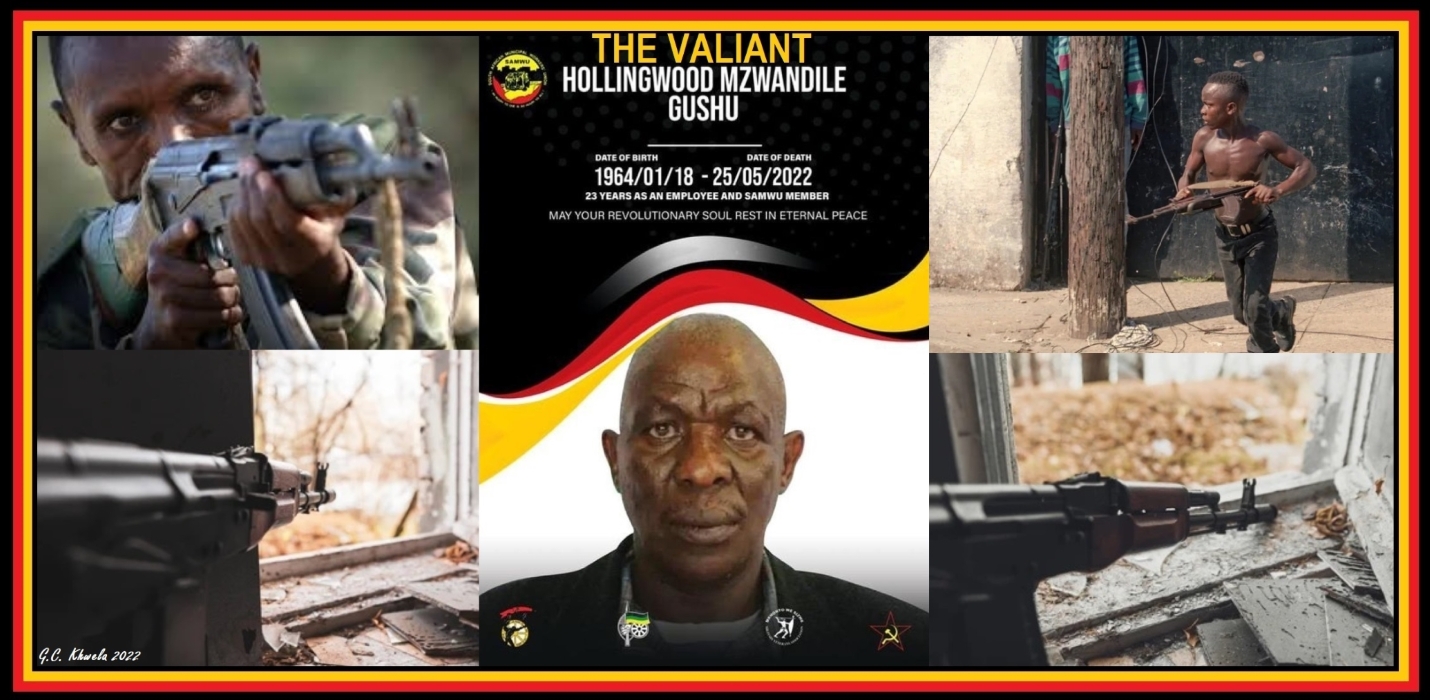
On 22 May 2022, the gallant Umkhonto we Sizwe and self-defence unit (SDU) combatant, “the People’s Warrior”, Hollingwood Mzwandile Gushu, passed on, while he was serving as a municipal employee in Ermelo and an activist of the South African Municipal Workers Union (SAMWU).
Sources:
South African History Archives (SAHA).
Truth and Reconciliation Commission, “Amnesty Hearing: Mzwandile Gushu”, TRC Amnesty Committee, Ermelo, 22 July 1998.
Truth and Reconciliation Commission, “Amnesty Hearing: John Mndebele”, TRC Amnesty Committee, Ermelo, 20 July 1998.
SAPA, “MK Soldier Robbed to Finance ANC Objectives, TRC Hears”, South African Press Association, Ermelo, 22 July 1998.
SAPA, “MK Soldier Admits to More IFP Murders”, South African Press Association, Ermelo, 21 July 1998.
Daniel Frost, “Organised Crime and the Liberation Struggle in Late Apartheid Ermelo”, MA History Dissertation, University of London, 6 September 2015.
Thula Simpson, “Umkhonto we Sizwe: The ANC’s Armed Struggle”, Penguin, 2016.
Anthea Jeffery, “The Natal Story: 16 Years of Conflict”, South African Institute of Race Relations, 1 January 1997.
Castro Khwela
Good day fellow Compatriots!
Discover more from CASTRO KHWELA
Subscribe to get the latest posts sent to your email.