Captain Dirk Coetzee Takes Over Command of Vlakplaas
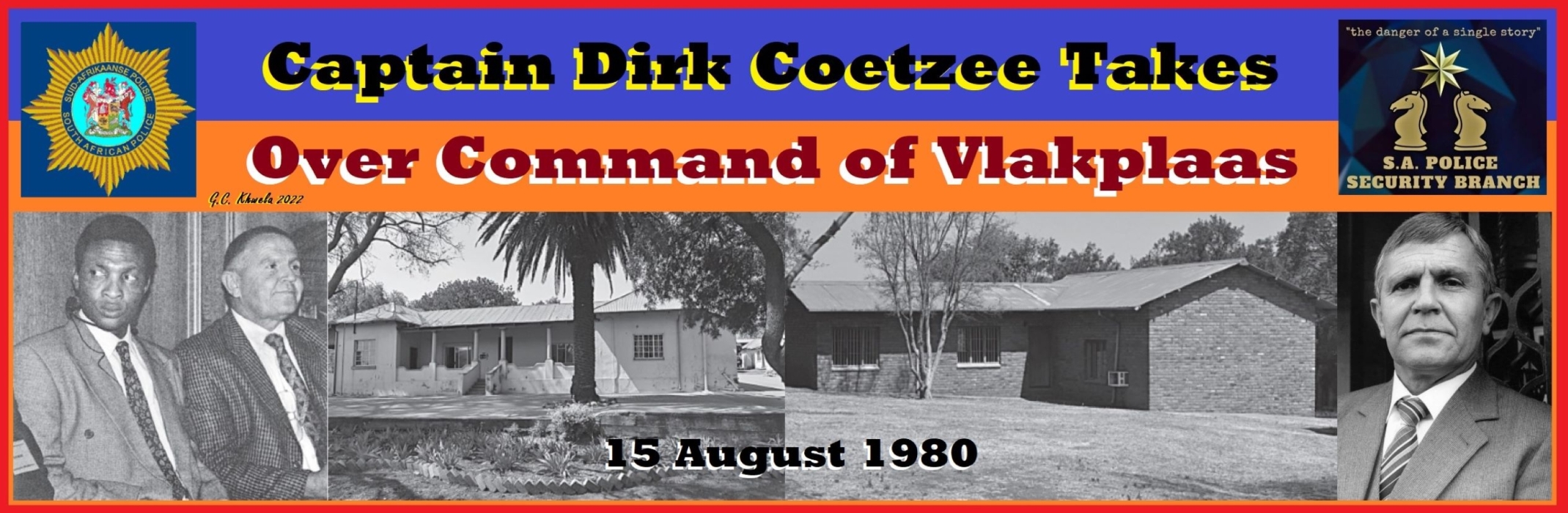
On 15 August 1980, Captain Dirk Coetzee of the apartheid South African Police arrived at a forty-four-hectare farm located approximately seven kilometres out of Erasmia, on the Schurveberg Road, outside Pretoria. On the southern border of the farm was the Hennops River, and on the plot itself was an old farmhouse with an outbuilding that had a garage and two servants’ quarters.
On the farm, there was some livestock, including chickens, geese, ducks, turkeys, a cow, some goats and two dogs. There was also a garden with a few maize plants, some pumpkin and sweet-potato creepers, tomatoes, green beans and onions. There were also several black African males living in the farm, who were either assistants or employees in the farm.
The farm, known as “Vlakplaas”, was used as a facility for the Security Branch, which Coetzee was going to be in charge of, as the new commander of Section C1. Actually, Vlakplaas was the headquarters of Section C1, which consisted of black African men that were previously in the liberation movements and had “turned” to work for the Security Branch, as “askaris”. On that day when Coetzee arrived at Vlakplaas, all the entities existing there, including the “askaris”, were to be under his Command.
The “Askari” project was established by the Security Branch in 1979, using a handful of defectors and captured African National Congress (ANC) and Pan-Africanist Congress (PAC) insurgents, as part of a campaign to improve South Africa’s domestic counter-insurgency capabilities. The first askaris were treated as informers, housed in Vlakplaas, and paid around R200 per month from a secret police fund. When they arrived at Vlakplaas, the Security Branch gave them new clothes, food and some few hundred rands as a stipend.
The first founding Commander was Colonel Johan Viktor, who was the only white officer among black operatives, and was then replaced by Captain Dirk Coetzee on 15 August 1980. Coetzee was described by his peers and subordinates as a “gangster of practically Olympic achievements”. He was a fast-rising star in the apartheid police force. What was interesting is that Vlakplaas commanders had two things in common: all had undergone training at the SAP College in Pretoria and all had served in the counterinsurgency units of the apartheid police in Rhodesia where they had learned their craft.
In 1980, Vlakplaas fell under Section C, which was a counter-terrorism arm of the apartheid Security Branch, and all its operatives were regarded as the “special forces” of the Branch. After August 1981, the askaris on the farm were divided into four groups, each led by a white officer, when a number of white policemen, all of whom were veterans of South Africa’s counterinsurgency units in Rhodesia and South West Africa (Namibia), arrived in Vlakplaas.
When Vlakplaas was established, it was referred to as a rehabilitation centre for former terrorists, who received intensive training in counterinsurgency techniques, which included physical training and theory on efforts to counter guerrilla warfare. The apartheid police purchased Vlakplaas in 1979 as a secret hideout for a handful of white policemen and askaris to carry out clandestine operations against people identified as enemies of the state.
The farm was the brainchild of Colonel (later Brigadier) Johan Viktor who had learned in Rhodesia that captured soldiers could be “turned” and used against their former comrades. As early as 1963 apartheid police Colonel Att Spengler had first tried the technique of “turning” ANC operatives into askaris at a police farm at Rietvlei, south of Pretoria.
When Coetzee took over command of Vlakplaas, he changed their conditions of employment, had their salaries raised, got them clothing allowances, signed them up for the police medical aid plan and secured them firearm permits. Coetzee even gave them driving lessons and helped them to obtain identity documents and passports. When Coetzee arrived at the farm, there were serious disciplinary challenges among the askaris, as they drank heavily and smoked marijuana, which were considered to be a result of uncomfortable working conditions.
Coetzee, his predecessor, Colonel Johan Viktor, and his successor, Colonel Eugene de Kock, were among the first counter-insurgency specialists in the apartheid South African Police Force, mainly gaining training and experience from the Rhodesians. Captain Dirk Coetzee was a star student at the police college, a man who was considered to have had a healthy regard for his own talents. Under Coetzee a small group of askaris included Jeff Bosigo, Peter Kgoadi, Thabo Makgage, Steven Mbanda, Piet Mogai, Gladstone Mose, and Joe Mamasela (who became one of the most notorious killers), Brian Ngqulunga, Ernest Ramatlala and Almond Nofamelo.
On 19 November 1981, in Durban, anti-apartheid activist and Human Rights lawyer Griffiths Mxenge who represented many banned ANC cadres, was murdered. Coetzee ordered his men, Joe Mamasela, Brian Ngqulunga, Almond Nofomela and David Tshikalanga to undertake the killing. The four askaris lured Mxenge to a sports stadium in Umlazi, the black township outside Durban. After poisoning his dog, they attacked Mxengu and stabbed him forty-seven times, leaving him dead. Four years later Mxenge’s widow, Victoria, was shot and hacked to death in front of her children in the driveway of her home in Umlazi.
In 1981 Coetzee was involved in a number of murders apart from that of Griffiths Mxenge. All were as identified ANC activists such as the Lesotho based Vuyani Mavuso and Peter Dlamini who were taken by Coetzee and Major Koos Vemeulen to a spot near Komatipoort. Here they were given knockout drops that didn’t work before being shot anyway by Vermeulen. Their bodies were again burned on a pyre while Coetzee, Vermeulen and the askaris cracked open a few beers and enjoyed a braai. Isaac Ace Moema was another ANC activist murdered by Coetzee.
In Coetzee’s operations the line between the law and the underworld became very blurred. Making money illegally from the sale of a victim’s possessions, drug-dealing, illicit diamond-dealing and pornography all became part of Coetzee’s brief. In December 1981, after Coetzee had embarrassed his superiors in the security police just once too often, he was removed from Vlakplaas. By this time there were seventeen askaris serving on the farm.
Sources:
Wikipedia.
South African History Online (SAHO).
African National Congress, “Statement to the Truth and Reconciliation Commission”, August 1996.
Hennie van Vuuren, “Apartheid Grand Corruption: Assessing the Scale of Crimes of Profit from 1976 to 1994”, Institute for Security Studies, 2006.
Jacob Dlamini, “Askari: A Story of Collaboration and Betrayal in the Anti-Apartheid Struggle”, Jacana, 2014.
Thula Simpson, “Umkhonto we Sizwe: The ANC’s Armed Struggle”, Penguin, 2016.
Jacques Pauw, “Into the Heart of Darkness: Confessions of Apartheid’s Assassins”, Jonathan Ball, 1997.
Robin Binckes, “Vlakplaas: Apartheid Death Squads, 1979–1994”, Pen and Sword, 2018.
Castro Khwela
Good evening fellow Compatriots!
Discover more from CASTRO KHWELA
Subscribe to get the latest posts sent to your email.