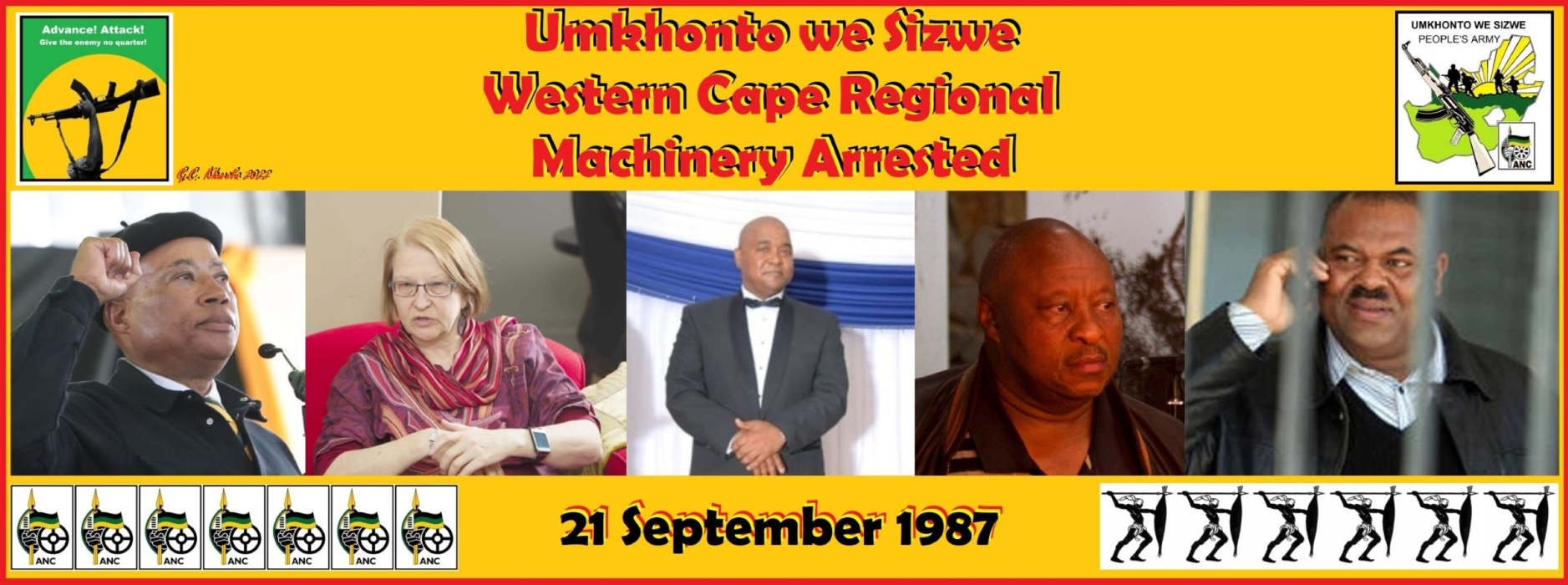
MK Western Cape Regional Machinery Arrested
On 21 September 1987, Gary Kruser arrived at Cine 400 in Athlone, Cape Town, where he was supposed to meet with Bongani Jonas of the Umkhonto we Sizwe (MK) Western Cape Regional Machinery. When he arrived, the place was saturated with police vehicles, and he was immediately arrested.
The arrest of Gary Kruser followed several incidents in the Western Cape during that period. Firstly, on the evening of 16 September 1987, Tony Yengeni was driving in Rondebosch with a passenger by the name of “Bonono” next to him. When he reached the courts of the Western Province Tennis Club, which were located next to the University of Cape Town, he stopped the car, as the time was exactly 20:00. He then got out of the vehicle to a nearby phone booth, with an intention to make an urgent phone call. During this time, he was talking to “Bonono”, who had remained in the car.
Meanwhile, two white men came towards Yengeni and Bonono while they were talking, and one pointed a gun at Yengeni’s forehead. This was Jeffrey Benzien, from the apartheid Security Branch, who said, “Tony Yengeni, you’re under arrest”. Shortly afterwards, Captain William Liebenberg and Sergeant Riaan Bellingan arrived at the scene. The second arrest was that of Mzwandile Vena, which occurred in the Lansdowne area the same evening, and the following morning, on 17 September 1987, at around 03:40. After Vena’s arrest, Jenny Schreiner was the third arrested in her flat at 5 Marie Court in Wellingon Avenue, in Cape Town’s Wynberg suburb.
On the same day, at around 17:00, when Isaiah Siyali arrived at the Milnerton Police Station, he found his white commanding officer with Tony Yengeni being surrounded by close to fifteen “askaris” (former liberation war combatants who had become turncoats). At that moment, the white commanding officer was briefing them on a plan to arrest Bongani Jonas, a member of the Tony Yengeni-led MK in the Western Cape. The commanding officer then instructed Siyali and “David” (who had both become “askaris”) to take Yengeni in a civilian motor vehicle to a meeting place at around 19:00. The car was to be followed by other members of the apartheid Security Branch, while the remainder of the askaris were to maintain radio contact.
At around 18:15, “David” drove out of Milnerton Police Station in a light blue Fiat with Siyali sitting at the back and Yengeni sitting in the passenger seat in-front, with his hands and feet bound. The Fiat took the direction of Athlone, being followed by the other vehicles with askaris and apartheid Security Branch officers behind. While they were driving on the main road towards the Athlone, they noticed a black Mercedes with three people inside approaching from the opposite direction.
Immediately David asked Yengeni if that was Bongani Jonas in the Mercedes, and when he nodded, David turned the car around and then they tried to alert the commanding officer, since the radio was malfunctioning. The Fiat then began the pursuit of the black Mercedes without any support, as they entered the N2 in the direction of Somerset West. After passing the Gugulethu off-ramp, David accelerated until the Fiat was alongside the Mercedes. He then shouted at Siyali to shoot at Jonas, the driver, who was at that moment approximately two metres away. Siyali missed with his service pistol, and was then rebuked by David, who instead withdrew his own pistol and opened fire.
Following them missing with their service pistols, a car chase towards Somerset West began, until Jonas stopped the Mercedes at the side of the highway, and he with another male passenger got out of the car and fled into the nearby bushes. David immediately stopped behind the Mercedes and began to pursue the two, while Siyali remained with Yengeni in the car. They also noticed that there was a female passenger in the Mercedes, who had remained in the car.
David managed to catch up with Jonas, shot him through his left thigh, and dragged him through the bushes, while he was screaming in pain. Jonas, Yengeni and the female passenger, who had remained in the Mercedes, were taken to the apartheid Security Branch Headquarters in Culemborg for questioning, where they used to have their torture chambers. Jeff Benzien and another officer, called Captain Liebenberg, who were using all sorts of torture: the wet sack, the electric shocks and the beatings. Those detained were beaten from the neck down, as they tell them: “We don’t want you to show where we have beaten you”.
Among those arrested with Schreiner and Yengeni were Michael Lubambo, Mubutu Nduku, Wellington Nkwandla, Thetheli Tetana, Gary Kruser, Christopher Giffard, Sitlabo Magadle, Alpheus Ndude and Lumka Nyamaza (later Yengeni). These arrests were part of a historical process that began on 25 January 1986, following the ousting of Prime Minister Leabua Jonathan by the military junta of Major General Justin Lekganya on 20 January 1986. The military junta expelled the first 60 of the an envisaged eventual total of 140 members of the African National Congress (ANC) from Lesotho. Faced with these expulsions, the ANC opted at the time to forward some of Umkhonto we Sizwe (MK) combatants into South Africa.
Most of the cadres that were arrested had been part of the process of recruitment that was undertaken in 1974 by Chris Hani, when he secretely entered South Africa before being deployed to Lesotho. From Lesotho, Hani led the ANC machinery that was responsible for actions in the Western Cape, among other areas, such as the Eastern Cape and the Orange Free State. However, it was the student uprising that stimulated armed actions on the part of the ANC’s military wing, Umkhonto we Sizwe (MK). During and in the aftermath of the uprisings, scores of young people from the Western Cape went into exile where they joined MK.
One of these was Tony Yengeni, who was now in 1986, after having received military training in Angola in 1979, was on his way to Cape Town, around the same time when MK’s Western Cape Commander, Lizo Bright Ngqungwana, had also arrived in Cape Town from Lesotho. Ngqungwana was followed in May 1986 by the arrival of Mtheteleli Titana, Bongani Jonas and two other MK combatats that illegally entered South Africa from Botswana to reinforce the Western Cape regional structure. In June 1986, Mxolisi Petane also entered South Africa to augment the Western Cape regional command as the Political Commissar.
On 25 July 1986, after arriving in the country a month before, Petane began his operation by unsuccessfully attacking the Dion shopping centre in Parow, where he placed a landmine in a vehicle, which was difused by the bomb squad of the apartheid police. The operation was intended to announce MK’s presence in the Western Cape region, without causing any serious damage. The Western Cape region had been rather quiet in terms of guerrilla military operations. Several sporadic incidents of sabotage by the ANC took place in the region before 1986, resulting in one death and several slight injuries. The only conviction during this period was that of MK operative Oliver Bekizitha Nqubelani, arrested the day after a briefcase bomb explosion at the Cape Town Supreme Court on 15 May 1979.
Ultimately, on 27 November 1986, Mxolisi Petane was arrested by the apartheid police after throwing a grenade and injuring some of them, as they raided his hideout in the KTC squatter camp, near Cape Town. Around the same period, Tony Yengeni met Jenny Schreiner, the daughter of Denys Schreiner, the Deputy Vice-Chancellor of the University of Natal, to reconstitute another unit, the “Basil February MK Squad” in the MK Western Cape structure. Tony Yengeni and Jenny Schreiner had operated together in the underground structures set up by the ANC and the South African Communist Party (SACP) in 1984, which was led by the Western Cape command structure. This structure which included Jeremy Cronin and Desi Angelis, among others, held fortnightly underground meetings with Tony Yengeni being based in Lesotho.
One of the operatives of this underground structure was Lawrence Maduma, who in 1985 underwent another training course in Lusaka, and thereafter was recruited into the unit led by Tony Yengeni in the Western Cape. Chris Giffard and Max Ozinsky also became part of the unit, with Giffard recruiting Ozinsky into the Yengeni-Schreiner unit in 1986 while they were still students at the University of Cape Town (UCT). Their first assignment was to produce printed propaganda leaflets for dissemination on the UCT campus and deliver them to organised protest groups elsewhere in Cape Town. These cadres were part of an Area Politico-Military Committee (APC), which was an integrated, nonparallel structure that folded military and political wings into one structure.
Following the brutal murder of Ashley Kriel on 9 July 1987, Tony Yengeni reactivated the Jenny Schreiner “Basil February MK Unit” and on 20 July 1987, they loaded a Toyota Corolla sedan with six gas cylinders filled with petroleum gas, an SPM and two 158 mini limpet mines, which Jenny parked outside Castle Court, on the corner of Caledon and Tennant Streets. The target was a block of flats that accommodated married members of the apartheid South African Defence Force (SADF). The vehicle exploded at around 20:40, shattering the windows of the apartment and damaging other cars in the vicinity.
On the evening of 21 July 1987, two limpet mines exploded causing extensive damage in the toilets and the terminal buildings of Cape Town’s D.F. Malan Airport after they were placed there by Schreiner, who received them being well-armed by Yengeni. In August 1987, Jenny Schreiner was instructed to collect Mzwandile Vena from Botswana to Cape Town, who had been deployed to replace Lizo Bright Ngqungwana as MK Western Cape Commander, following Ngqungwana’s sudden arrest.
Mzwandile Vena became part of the Unit that blew up the Transkei Development Corporation fuel Depot in Umtata on the evening of 25 June 1985, which included “Jabulani” and “Dick”. This was followed by a sabotage attack on the Umtata electrical power station by Mzizi “Mpilo” Maqhekeza and “Monwabisi”. “Jabulani” and “Dick” also demolished the drain-water pipeline of Transkei’s Department of Agriculture and Forestry, leaving the Transkeian capital of Umtata without electricity and a damaged water drainage system.
Following the arrests of Ngqungwana, Vena, Petane, Yengeni, Schreiner and Jonas, as well as the killing of Ashley Kriel and the arrests of his unit consisting of Niklo Pedro and Anwar Dramat, as well as the arrests of Ashley Forbes and fourteen others, Adriaan Vlok was over the moon. Speaking on the night of 6 October 1987, as a successor to Louis le Grange as Minister of Law and Order, Vlok felt emboldened to declare victory in the Western Cape. He claimed that his men had smashed the ANC’s Cape regional network following fifteen months of investigation that resulted in forty-nine people connected to the spate of sabotage and guerrilla attacks being arrested.
These structures under the Western Cape Regional Machinery operated for close to two years before they were uncovered in September 1987. In 1986 there were at least 19 incidents in the Western Cape, including four grenade attacks on personnel, four explosive devices in buildings and five gunshot attacks on personnel. Several police personnel were injured, some seriously. Primed explosive devices were detonated at the Mowbray railway station toilet on the eve of May Day, and at the Mowbray police station on 3 July. The attacks resulted in slight injuries for a policeman and a policewoman. A shoot-out at a roadblock also occurred near Warrenton in the Northern Cape on 13 December 1986, in which one MK operative was killed.
Several mini-limpet mine attacks involved ‘soft’ targets with a high potential for civilian casualties. In a significant ‘soft target attack’ that did not result in any injuries, Jennifer Schreiner, under the command of Tony Yengeni, placed two limpet mines in a toilet at the Cape Town international airport around midnight in 21 July 1986. There were also sabotage attacks on power pylons, railway lines, petrol stations, and a bus stop outside a government residence. A powerful car bomb exploded outside SADF residences in District Six and a primed limpet mine was discovered at a bus terminus in Cape Town. Hand grenade attacks were carried out in 1987 against SAP personnel (both on patrol and in their homes) and community councillors, or persons linked to these groups.
On 9 January a hand grenade was thrown into a vehicle driven by the well-known Warrant Officer Barnard near the KTC Squatter Camp. The explosion killed his colleague, Constable Labuschagne, and seriously injured Barnard. Three days later a Constable Mtetwa was killed by automatic gunfire in Gugulethu. Community councillor Dennis Lobi’s house was attacked with grenades on 14 and 16 June, injuring four people. Operations continued into 1988 to 1989, the whites-only election in September 1989 drew a number of bombings, thus nullifying Adriaan Vlok’s claim that he had smashed the ANC’s Cape regional network.
During the State vs Tony Sithembiso Yengeni and 13 Others Trial, dubbed “the Rainbow Trial” (because the triallists represented the broad spectrum of South African society), it was reflected in the evidence that cadres in the Basil February MK Squad stockpiled weapons in secret caches, trained others in their use, and used them in bombings and assassination attempts. Interestingly, were the different methods of secret writing, which included invisible inks, photographic equipment used to produce microfilm, and throwaway codes. Court records featured hundreds of pages of decoded notes on intelligence collected on the organised protest groups, observations of police activities, and evaluations of individual underground cadres, all encoded onto strips of microfilm that could be hidden behind postage stamps on posted letters.
The trialists – Tony Yengeni, Jennifer Schreiner, Lumka Yengeni, Michael Lumbambo, Mbutu Nduku, Wellington Nkwandla, Mtheteleli Titana, Gary Kruser, Christopher Giffard, Captain Mahlale, Alpheus Ndude, Gertrude Fester, Zuraya Abbas and Colleen Lombard – defied the apartheid state for nearly two years. When asked to plead guilty or not guilty, they refused. They read out another plea. It ended prophetically: “Victory is certain. South Africa shall be free.” History will applaud them and many people today do not know the names of these heroes and heroines or choose to forget the sacrifices they made for us to be free.
“Victory is certain! South Africa shall be free!”
Sources:
Wikipedia.
South African History Online (SAHO).
Truth and Reconciliation Commission, “Truth and Reconciliation Commission of South Africa Report, Vol. 2”, Truth and Reconciliation Commission (TRC), 29 October 1998.
Truth and Reconciliation Commission, “Truth and Reconciliation Commission of South Africa Report, Vol. 3”, Truth and Reconciliation Commission (TRC), 29 October 1998.
Truth and Reconciliation Commission, “Truth and Reconciliation Commission of South Africa Report, Vol. 5”, Truth and Reconciliation Commission (TRC), 29 October 1998.
Aneez Salie, “How the Death of Ashley Kriel Made an MK Soldier Want to Fight”, Cape Times, 23 September 2019.
African National Congress, “Walking with Pride: Court Statements by ANC Cadres on Trial”, African National Congress (ANC) Archives, 20 March 1990.
SAPA, “Policeman Tells TRC How Yengeni Cracked Under Torture”, South African Press Association, 14 July 1997.
Michael Donen, “How Tony Yengeni and His Co-Accused Turned Apartheid Show Trial on Its Head”, Independent Online, 24 August 2020.
Carien Grobler, “Infamous Apartheid-Torturer Jeff Benzien Dies at 70”, The Citizen, 29 November 2024.
Gregory Houston, “Military Bases and Camps of the Liberation Movement, 1961-1990”, Human Sciences Research Council Report, January 2013.
Gregory Houston, et. al., “Transcripts of Interviews with Unsung Heroes and Heroines of the South African Liberation Struggle”, Vol. 1, Democracy, Governance, and Service Delivery (DGSD), Human Sciences Research Council (HSRC), 23 March 2015.
Gregory Houston, et. al., “The Liberation Struggle and Liberation Heritage Sites in South Africa”, Democracy, Governance, and Service Delivery (DGSD), Human Sciences Research Council (HSRC), 15 November 2013.
Thula Simpson, “Umkhonto we Sizwe: The ANC’s Armed Struggle”, Penguin, 2016.
Stephen Davis, “The ANC’s War Against Apartheid: Umkhonto we Sizwe and the Liberation of South Africa”, Indiana University, 2018.
Jacob Dlamini, “The Terrorist Album: Apartheid’s Insurgents, Collaborators, and the Security Police”, Harvard University, 2020.
Castro Khwela
Good evening fellow Compatriots!
Discover more from CASTRO KHWELA
Subscribe to get the latest posts sent to your email.