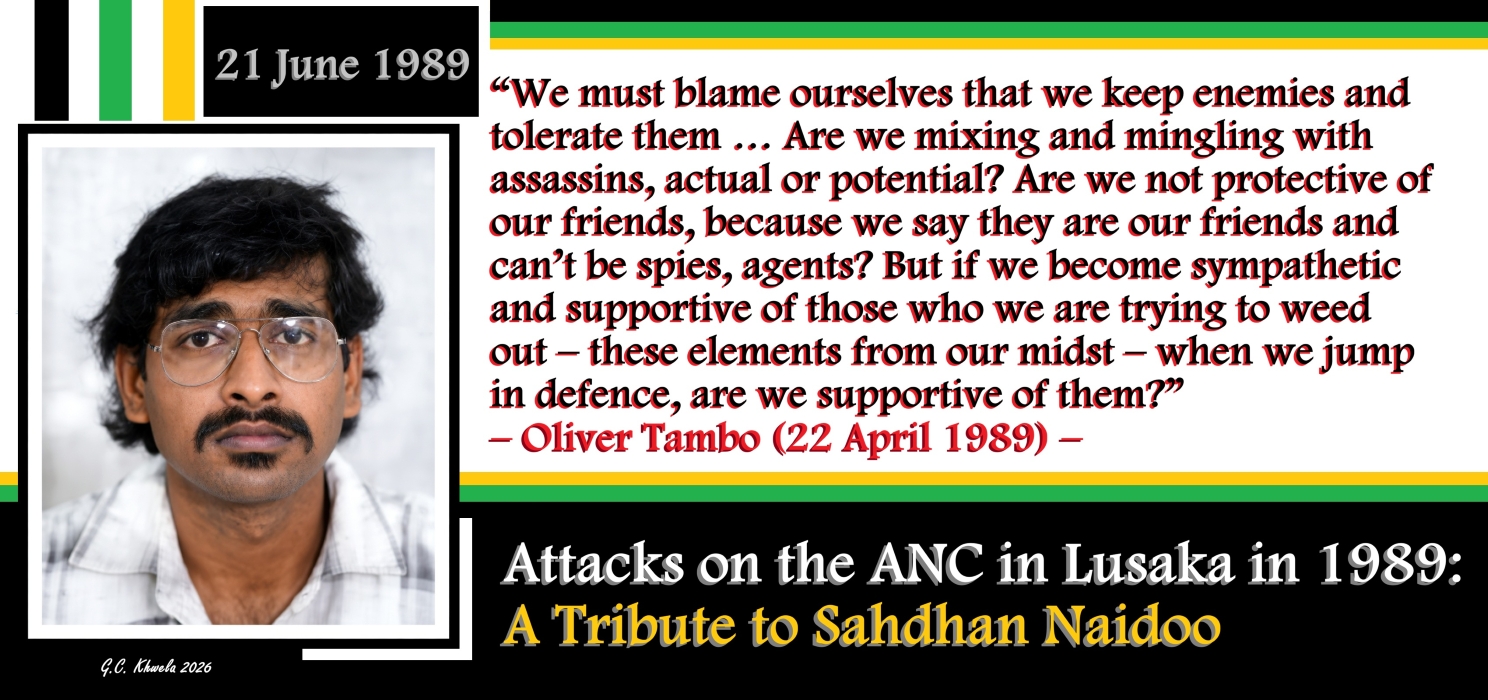
Attacks on the ANC in Lusaka in 1989: A Tribute to Sahdhan Naidoo
On Wednesday, 21 June 1989, at about 23:00, a bomb ripped through the African National Congress’ (ANC) offices in Lusaka, Zambia, resulting in a man in his mid-twenties losing both of his legs. The blast severely damaged the administrative and operational complex used by the liberation movement and the individual who suffered a bilateral amputation (losing both of his legs) was a Zambian security guard or caretaker assigned to watch the premises. The attack was clearly perceived to be part of a broader clandestine “dirty tricks” campaign orchestrated by the South African apartheid regime’s security forces and military intelligence targeting external ANC strongholds.
The bomb followed another explosion on 19 June 1989, at about 06:30 in the morning, in the alley joining Nkwazi Road between Chachacha Road and Freedom Way. The incident occurred during rush hour, and commuters witnessed pieces of flesh and bone being thrown through the air. The bomb reverberations ripped open the roof of an outlet belonging to Associated Wholesalers and also damaged the walled fence of nearby commercial enterprises. A man’s blackened torso and his feet, severed at the ankles, were found at a rubbish heap near the scene of the explosion. One other person was injured in this attack.
The previous day to the 19 June 1989 attack, between 22:00 and midnight, an explosion occurred at Alfa House in Emmersdale suburb, Lusaka, where some ANC members were staying. However, there were no casualties reported. Half an hour later, another bomb exploded at a petrol station in Matero Township, wherein a security guard was injured. The bomb attack at Alfa House was a targeted assassination attempt aimed at high-ranking ANC officials staying at the residential facility, which served as a transit residence and safe house for exiled ANC members and cadres of its armed wing, Umkhonto we Sizwe (MK). This bombing occurred just three days before the attack on the main ANC Headquarters. June 1989 marked an intense escalation in a clandestine bombing campaign.
The analysis was that a powerful explosive device was detonated at the premises. While it caused immense structural damage to the building, the primary targets survived the explosion, though it severely heightened security anxieties and fears of deep intelligence penetration within the ANC’s Lusaka networks. Ultimately it was established that apartheid security forces and covert military intelligence units launched these operations to cripple the ANC’s external command structure just as international pressure for political transition was peaking.
These bombings in the inner-city and suburbs of Lusaka were subsequence to an attack on an ANC-run farm in the Makeni area, forty-two kilometres north of Lusaka, on 15 April 1989, whereby Sahdhan Naidoo, the ANC’s Farm Manager, and Moss Mthunzi Ningiza (Thole), the mechanic, were shot dead by a gang of men who stole some household goods, including TV sets and stereo players before speeding away in a Toyota Land Cruiser. The Alpha Farm, which was adjacent to the Chongela Farm, also run by the ANC, was managed by Sahdhan Naidoo to provide food for the ANC’s increasing population in Lusaka and for the camps in Angola, before they were moved to Uganda and Tanzania..
Naidoo and Ningiza were shot by their ‘comrade’, “Tex” Tlhotlhalemajoe, on the farm in an incident that was disguised as a robbery. Tex was reported to be a self-confessed “agent” who was undergoing a process of rehabilitation. After he was charged with murder, together with two Zambian farmworkers, he died in prison in December 1989, apparently from food poisoning, before he could be brought to trial. The assassinations of Sahdhan Naidoo and Moss Mthunzi Ningiza (Thole) on 15 April 1989 were directly linked to the broader external “dirty tricks” campaign run by the apartheid regime’s security forces.
While the June 1989 attacks relied on explosive devices targeting prominent facilities, this April 1989 operation achieved the same strategic objective – disrupting and terrorising the ANC’s external network in Lusaka – through espionage and infiltration. The Truth and Reconciliation Commission (TRC) and historical records verified this connection through several key findings. Two members of the notorious Vlakplaas unit—a covert, state-sanctioned hit squad run by the South African Police Security Branch—later applied for amnesty for setting up the operation. Their amnesty applications failed because they refused to provide full disclosure regarding the details of the mission.
The two Vlakplaas operatives that were denied amnesty for the cross-border operation that resulted in the killing of Sahdhan Naidoo were Eugene Alexander de Kock and Izak Daniel Bosch. Eugene de Kock was the notorious commander of the C1 counter-insurgency unit at Vlakplaas. He was the primary applicant who spearheaded the planning of the covert cross-border hit. Izak Daniel Bosch was a Vlakplaas operative who worked directly under De Kock’s command and applied alongside him for this specific operation.
During the TRC amnesty hearings held in July 2000, De Kock and Bosch applied for immunity regarding the murder of “one Mr Naidoo” and the subsequent cover-up. The TRC Amnesty Committee officially dismissed their application as it concluded that both men failed to meet the statutory requirement of full disclosure, leaving out critical facts regarding how the execution-style raid on the Makeni farm was orchestrated and carried out by their cross-border team.
The shooter was a co-worker on the farm known by the pseudonym “Tex” Tlhotlhalemajoe, who was an integrated apartheid agent who had successfully infiltrated the ANC. The ANC had placed him on the farm under the impression that he was a combatant undergoing political rehabilitation. On the night of 15 April 1989, “Tex” had waited until Sahdhan Naidoo returned to the farm after 21:00 and then ordered the farmworkers against a wall, cornered Naidoo and Ningiza, ordered them to remove their shirts, and shot both men. He shot Naidoo in the forehead before killing Moss Mthunzi Ningiza (Thole). Moss’s fiancée, who was watching television with them, managed to escape the house and sounded the alarm.
Although the apartheid state initially attempted to disguise the murders as a robbery, internal investigations and subsequent TRC hearings proved it was a calculated political assassination. The attack on the Makeni farm was part of the final, desperate surge of cross-border operations deployed by Vlakplaas and military intelligence to bleed the ANC’s logistics and support bases in Zambia just months before the formal unbanning of the liberation movement.
Following his swift capture by the ANC’s security department (NAT), Tlhotlhalemajoe was heavily interrogated in Lusaka. Facing his captors, he fully confessed to his role as a deep-cover operative. However, he died in prison in December 1989, apparently from food poisoning, before he could be brought to trial. His sudden death in December 1989 explains why the true relationship between “Tex” and the Vlakplaas command structure was so heavily contested during the Truth and Reconciliation Commission (TRC) hearings a decade later.
Because Tlhotlhalemajoe was dead, Eugene de Kock and Izak Bosch attempted to completely erase him from their amnesty testimonies. They fabricated a cover story involving a Zimbabwean operative named Chris Kentane and a local criminal syndicate to hide the fact that Tex had been their own deeply embedded asset. The TRC ultimately saw through this omission, noting that the operatives failed to provide a full and honest disclosure regarding how Tex was run, leading directly to their denial of amnesty.
The TRC amnesty hearings exposed massive lies told by the Vlakplaas command regarding Tex’s operation. Eugene de Kock and Izak Bosch testified under oath that they had contracted a Zimbabwean Selous Scout named Chris Kentane, under “Operation Delta”, to orchestrate the hit using a local criminal gang called the “Kabalalas”. They claimed they only found out about the murders through a local newspaper. The TRC Amnesty Committee determined that De Kock and Bosch deliberately fabricated the “Kentane and the criminal gang” narrative to protect their actual web of deep-cover assets – including Tlhotlhalemajoe. This lack of full disclosure was the primary reason the TRC denied the Vlakplaas operatives amnesty for the incident.
On 22 April 1989, at the funeral service for Sahdhan Naidoo and Moss Mthunzi Ningiza (Thole) held at the Lusaka Hindu Hall, ANC President Oliver Tambo revealed to the five hundred mourners assembled that the killers were suspected to have been ANC members. He further said “we must blame ourselves that we keep enemies and tolerate them. Zambians are also victims of these killings.”
Tambo then asked a question: “Are we going to have another incident of this kind, a ghastly incident? Are we mixing and mingling with assassins, actual or potential? Are we not protective of our friends, because we say they are our friends and can’t be spies, agents? But if we become sympathetic and supportive of those who we are trying to weed out – these elements from our midst – when we jump in defence, are we supportive of them? If our security had picked up this Tex, would there not have been protests? Friend or foe … I know … I know.”
The following Monday, 24 April 1989, Zambia’s Daily Mail newspaper confirmed that the suspected assailant was believed to be an ANC member, “Tex” Tlhotlhalemajoe, who had been captured and was being held by ANC Security Officers. The series of bomb explosions at or near ANC offices in June were attributed to apartheid security agents, four former members of the Movement, who had gone to the United High Commissioner for Refugees (UNHCR) and declared themselves as refugees.
On 25 May 1989, at a press conference with Alex Shapi, the Zambian Secretary of State for Defence and Security, the ANC Spokesperson, Tom Sebina, announced a commencement of a process of voluntary disarmament among ANC cadres in Zambia. He also acknowledged that there were pamphlets circulating in Lusaka referring to “discontent among MK (Umkhonto we Sizwe) members who had been withdrawn from Angola”, which he claimed were the product of apartheid South Africa’s “dirty tricks” department.
“WE MUST BLAME OURSELVES THAT WE KEEP ENEMIES AND TOLERATE THEM.”
Sources:
South African History Online (SAHO).
African National Congress, “Sandhan Naidoo: 1961 – 1989”, Recording of the Funeral Service for Sandhan Naidoo and Moss Mthunzi, ANC, 22 April 1989.
Paul Trewhela, “A Can of Worms in Lusaka”, Searchlight South Africa, Vol. 3, No. 1, August 1992.
James Ngculu, “The Honour to Serve: Recollections of an Umkhonto Soldier”, David Philip, 2009.
Stephen Ellis, “External Mission: The ANC in Exile”, Jacana, Jonathan Ball, 2012.
Hugh Macmillan, “The Lusaka Years: The ANC in Exile in Zambia, 1963 to 1994”, Jacana, 2013.
Thula Simpson, “Umkhonto we Sizwe: The ANC’s Armed Struggle”, Penguin, 2016.
Truth and Reconciliation Commission, “Truth and Reconciliation Commission of South Africa Report”, Truth and Reconciliation Commission (TRC), 29 October 1998.
Castro Khwela
Good evening fellow Compatriots!🙏🏾✊🏾👊🏾
Discover more from CASTRO KHWELA
Subscribe to get the latest posts sent to your email.