Tripartite Agreement Signed: Towards Resolution 435 Implementation
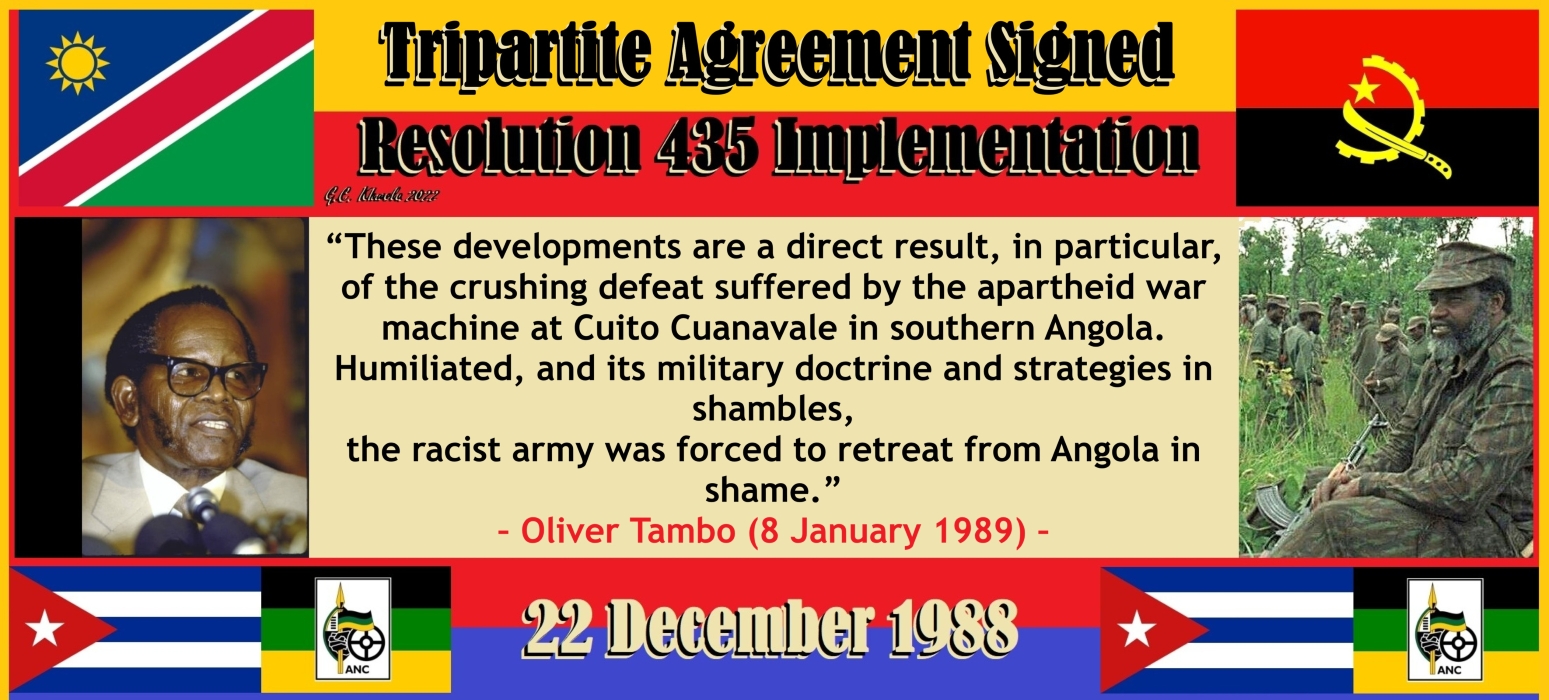
On 22 December 1988, representatives of Angola, Cuba and South Africa signed a final Tripartite Agreement in New York City which called on the parties to request the United Nations (UN) Secretary-General to seek authority from the UN Security Council to commence the implementation of Resolution 435.
The Resolution was in terms of the Accord delayed to the date of 1 April 1989, and the signatories also pledged, in line with the Geneva Protocol, that “Consistent with their obligations under the Charter of the United Nations, the Parties shall refrain from the threat or use of force, and shall ensure that their respective territories are not used by any state, organization, or person in connection with any acts of war, aggression, or violence, against the territorial integrity, inviolability of borders, or independence of any state of south-western Africa.”
Under the terms of the agreement, Cuba was to withdraw its forces from Angola, and South Africa was to grant Namibia independence and withdraw its forces. Cuba agreed to a phased withdrawal of its forces from Angola, to be completed by July 1991 and South Africa agreed to implement UN Security Council Resolution 435, which led to the independence of Namibia. The apartheid SADF would withdraw from Angola and Namibia, paving the way for Namibian independence in 1990.
Accordingly, the Accord marked an end for Umkhonto we Sizwe (MK) presence in Angola, and this was confirmed by the President of the African National Congress (ANC), Oliver Tambo, at Lusaka’s Inter-Continental Hotel on 8 January 1989. Tambo mentioned that the ANC fighters were pulling out of Angola in order to facilitate efforts to achieve Namibian independence.
While being flanked by Reverend Jesse Jackson, the American Black civil rights activist, Tambo said that the move to withdraw MK fighters from Angola was meant to deny the apartheid regime in South Africa and its allies the opportunity to use the presence of ANC facilities in the country as an excuse for stalling the process. Furthermore, Tambo declared that the withdrawal was to be undertaken in such a manner that it would not interrupt the revolutionary struggle inside South Africa. For Tambo, the ANC was going to do everything in its power to facilitate the process, recognising the fact that the New York agreements constituted an advance of great strategic significance for the southern African region.
With the signing of these agreements, including the progress made at the London, Cairo, New York and Geneva negotiations, the parties approved a comprehensive series of practical steps that were to enhance mutual confidence, reduce the risk of military confrontation and create the conditions in the region necessary to implement the UN Resolution. As the measures were approved by all, a de facto cessation of hostilities was regarded as being in effect.
However, following the London talks, the aims of the apartheid South African regime and the United States’ Ronald Reagan administration with regard to the ANC began to emerge. Apartheid South Africa demanded, as part of the settlement, superpower guarantees that the ANC guerrillas be removed from Angola and not be allowed into an independent Namibia. According to the London Independent newspaper of 1 May 1988, “If the Angolans and their Cuban and Russian backers agree, the chief prize for Pretoria may not be the removal of Cuban troops from Angola, but the collapse of the ANC’s military campaign, and the delivery of the ANC to the negotiating table.”
In response to these statements, the ANC National Executive Committee (NEC) issued a statement from Lusaka, dated 10 October 1988, in which it said, “Whatever possibilities exist of a settlement in the on-going negotiations on Angola and Namibia will be the result, in the first place, of struggle, and the serious armed defeats inflicted on the racist army by the combined forces of Angola, Cuba and SWAPO. This contrasts starkly with the previous chronicle of years of talks on Namibia, which South Africa and its friends continually exploited to sabotage the implementation of Resolution 435.”
Again, in a statement issued in February 1989, in its official journal “Sechaba”, the ANC asked a question “What is the task facing us in this context?” The ANC then replied to itself that the task “facing us and Africa as a whole is to fight to complete the anti-colonial revolution on the continent; a process which is basically anti-racist. This is definitely in the interests of the Namibian people…This is political maturity, revolutionary solidarity and internationalism in action.”
Sources:
South African History Online (SAHO).
Fidel Castro Speaks, “The Battle for Angola”, Sechaba, Vol. 22, No. 11, November 1988.
Editorial, “Sanctions and Armed Struggle”, Sechaba, Vol. 22, No. 12, December 1988.
Editorial, “Namibia and Our Struggle”, Sechaba, Vol. 23, No. 2, February 1989.
Oliver Tambo, “Mass Action for People’s Power: January 8th Statement, 1989”, Sechaba, Vol. 23, No. 2, February 1989.
Thula Simpson, “Umkhonto we Sizwe: The ANC’s Armed Struggle”, Penguin, 2016.
Jayson N. Williams, “Contested Narratives: South African and Cuban Military Action in Angola (1987-1988)”, School of Advanced Military Studies (SAMS), Command and General Staff College, SAMS Monograph, 26 May 2016.
Castro Khwela
Good morning fellow Compatriots!
Discover more from CASTRO KHWELA
Subscribe to get the latest posts sent to your email.