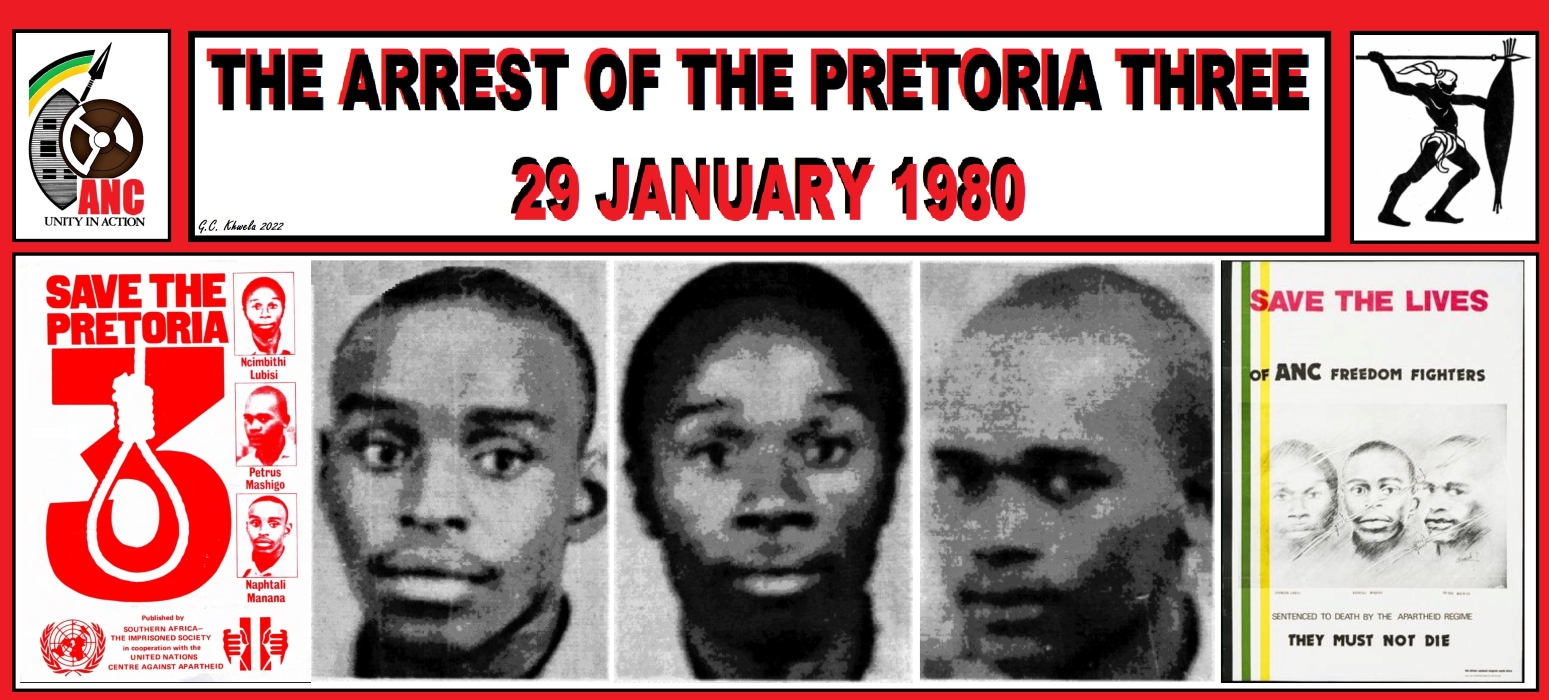
On 29 January 1980, Petrus Mashigo who had been arrested in White River, Eastern Transvaal (now Mpumalanga Province), was handed over by Major van Wyk to apartheid Security Branch Warrant Officer Ehlers, who took him to the Security Branch offices in Tzaneen. On the road to Tzaneen, Mashigo informed Ehlers to take the route that passed through Lydenburg, and they proceeded for twenty-kilometre until they reached a board on the left-hand side of the road.
This board, which was used as a reference point for a Dead Letter Box (DLB), wherein weapons were stored, they walked sixteen steps across the road and then some thirty steps in the direction of Tzaneen. After they reached a short thick tree, near which the ground was recently disturbed, Ehlers began to dig and unearthed two blue trunks containing weapons. According to the apartheid Minister of Police, Louis le Grange, the arms cache consisted of rocket launchers, AK-47 assault rifles, ammunition, anti-tank rockets and hand grenades.
The following day, on 30 January, a team of apartheid Security Branch police took up positions outside a rondavel with a thatched roof, in a kraal, in the Oakley Reserve, within the district of Hazyview, in the Eastern Transvaal. Warrant Officer Potgieter moved closer to the door, knocked on the door, and shouted “Police, open up!”
After shouting several times, a child began to scream and the door suddenly sprung open. As the child screamed louder than before, Detective Sergeant Johan du Plooy fired with his pistol into the rondavel, and the child started crying uncontrollably. The police then ordered the person inside to come out with hands raised and to throw himself on the ground with his hands raised. A few seconds later, a man dived out of the rondavel and threw himself on the floor as ordered. The police pounced on Ncimbithi Lubisi and placed him in handcuffs.
Ncimbithi Lubisi and Petrus Mashigo were part of the Transvaal Rural Machinery, together with Naphtali Manana, who were arrested following an attack at Soekmekaar Police Station, in a small town that was known as Soekmekaar, now Morebeng, north-west of Tzaneen, in the Northern Transvaal (now Limpopo Province). Prior to this attack, early in December 1979, Lubisi, Mashigo and Manana had a meeting in Maputo, Mozambique, with “Paul Dikeledi”, “Thabo” and “Kenny”, commanding personnel of the Umkhonto we Sizwe (MK) Transvaal Rural Machinery.
Paul Dikeledi (real name Peter Sello Motau), who was the Commander of the Machinery, instructed the three to attack Soekmekaar Police Station, since in that district people were being forcibly removed to an arid area and were not happy about it. Police officers attached to that police station were assisting in the removal, and it would be an appropriate “armed propaganda” act if the police station was targetted.
On 5 December 1979, Mashigo, Lubisi and Manana entered South Africa from Swaziland in the company of a man codenamed “Lungile”. On 4 January 1980, Mashigo, Lubisi, Manana and “Lungile” were waiting for a lift on the road from Duiwelskloof to Soekmekaar. At approximately 18:30, a bakkie stopped to offer them a lift, which they hijacked by holding up the driver at gunpoint. They then departed in the vehicle, leaving the owner, Ntate Montle, behind.
When they arrived at their destination, Soekmekaar Police Station, they got out, with Mashigo and Lungile entering through the station’s front yard through a small gate, where they found two policemen seating on the porch. When they approached the station’s steps, Mashigo fired two shots in the air, prompting the two policemen to jump, with one running into the station building and the other fleeing to the left of the building towards the backyard. Mashigo was at that time running towards the station building and resumed firing directly at the building, peppering it with bullets. He then ran around the left side of the building, in pursuit of the policeman who fled towards the backyard, firing shot over the head of the fleeing policeman.
Meanwhile, Lungile was running towards the right-hand side of the building, turning around it, while throwing a grenade, which unfortunately exploded in front of Mashigo, injuring both his legs. While this action was taking place, Naphtali Manana was standing guard at the gate. He noticed some vehicle light approximately 200 metres away, and began firing shots in the air to scare away the car. The car immediately made a U-turn and departed. Shortly afterwards Lungile and Mashigo reunited with Manana and the three of them returned to the getaway vehicle, the hijacked bakkie, in which Lubisi was waiting.
On 14 April 1980, nine members of the African National Congress (ANC) appeared in the Pretoria Magistrate’s court in connection with the Silverton Bank Siege, alleged plans to attack the Port Natal Administration Board, and an attack on January 4 on Soekmekaar police station, in which no damage was caused, and one policeman was slightly injured. All were charged with high treason, two counts of murder, and 21 counts of attempted murder. All of them pleaded not guilty and they also denied that there were plans to attack the Port Natal Administration Board.
Furthermore, none of them was accused of being present at the Silverton siege, but all nine were accused of murdering the two women, according to the “common purpose” doctrine. One of the MK combatants, Benjamin Tau, was also charged with conspiring with the three dead cadres to carry out the bank siege, and of surveying the premises beforehand, even though he had been in custody at the time. Another combatant, Ikanyeng Molebatsi, together with Benjamin Tau, were accused of conspiring with the Silverton Trio to launch a rocket attack on petrol tanks at Watloo, near Mamelodi, and also of planning to attack the Pretoria West and Villiera police stations.
Benjamin Tau admitted he had infiltrated the country on a mission to attack the Watloo installations but denied he had reconnoitred the bank for attack. According to Tau, the police had forced him to point at the bank and then photographed him. However, he declared that he would refuse to attack a bank because he knew it was against ANC policy.
Justifying the attack on Soekmekaar police station, Petrus Mashigo told the court that the operation had been intended as “armed propaganda” action in protest against the forced removal of the community in the area. It was intended to show that the ANC sympathised with the plight of the people and to demonstrate to police that what they were doing was wrong. Mashigo testified that during his training cadres were told not to use methods involving the killing of civilians, and that the ANC opposed methods such as the taking of hostages.
Remarkably, Ikanyeng Molebatsi testified that they had decided against carrying out the attack on the Watloo tank farm because they realised that too many lives would be lost. This was clearly in line-with the African National Congress (ANC) and Umkhonto we Sizwe’s (MK) guerrilla warfare strategy, which maintained:
“In contrast with a conventional military force, in which virtually all planning takes place at HQ level by experienced officers, in guerrilla warfare most of the initiative is with the unit, and detailed planning takes place at the lowest level. Each cadre has to be trusted to make decisions with regard to choice of target within ANC policy, whilst keeping a close eye on developments and feelings among the people in his/her community – a responsibility which no soldier in a conventional force ever has to face.” – African National Congress Further Submission to the Truth and Reconciliation Commission (TRC), 12 May 1997.
Castro Khwela
Good evening fellow Compatriots!
Discover more from CASTRO KHWELA
Subscribe to get the latest posts sent to your email.