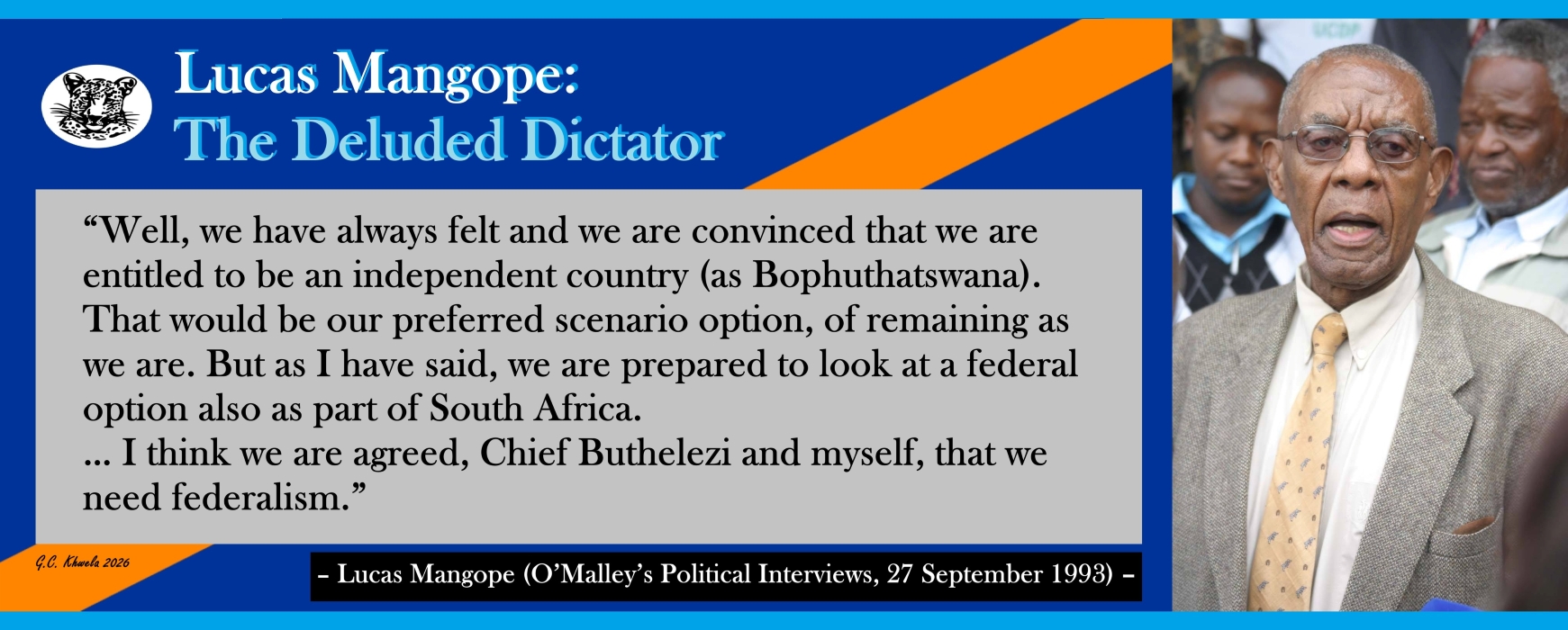
Lucas Mangope: The Deluded Dictator
On 10 March 1994, President Lucas Mangope, the leader of the Bophuthatswana, apartheid Bantustan, retreated from the capital, Mmabatho, to his hometown of Motswedi, located outside Zeerust, in the face of a popular uprising after he had tried to boycott participation in South Africa’s first democratic elections. Mangope rejected the South African Independent Electoral Commission’s (IEC) pleas for free political activity in Bophuthatswana, as a member of the anti-election Freedom Alliance. His stance caused widespread demonstrations in which 40 people were shot and wounded by local Bophuthatswana police. A public servants’ strike was also called in the entire Bantustan.
In Mabopane and Ga-Rankuwa, large banners of the South African Communist Party (SACP) and the African National Congress (ANC) were waved over the crowds. Masses of people were pouring in from different directions, each group with its own flags and placards, most of them written: “Away with Bantustans!”, “Away with Mangope!” and “Forward to a democratic South Africa!” Marshals also formed human chains, with police, marching alongside the crowd as escorts. Crowds raised their clenched fists and responded to shouts of “Viva ANC!”, while police took off their uniforms and joined the marchers.
Reacting to these insurrectionary developments, Mangope dismissed the staff of the Bophuthatswana Broadcasting Corporation, shutting down three radio and two television stations. He then sought armed support from the Afrikaner Weerstandsbeweging (AWB) to quell the uprising. However, the Bophuthatswana Defence Force (BDF) mutinied and fought the intruding AWB renegades, a few of whom were dramatically shot and killed. This prompted the intervention of the South African Defence Force (SADF), leading to Mangope’s removal from office.
Mangope, who with racist Pretoria’s blessing had ruled Bophuthatswana as a one-party republic since 1977, was to be “secured” by the apartheid SADF for his own safety, according to an official statement. Following these unprecedented developments, the apartheid government and the multi-party Transitional Executive Council (TEC) issued a statement after a joint delegation had visited Mangope on Saturday, 12 March 1990, to inform him that his reign was over.
Kgosi Lucas Manyane Mangope, who was born on 27 December 1923, and fondly known as “Tau Tona”, “the Great Lion”, was the founder and only leader of the Bantustan of Bophuthatswana. He was also the founder and leader of the United Christian Democratic Party (UCDP), a defunct political party based in the North West of South Africa.
When the Tswana Territorial Authority was established in 1961, Mangope became its vice-chairperson, working under Kgosi T.D. Tidimane Pilane. He was promoted to the Chief Chancellor of the organisation in 1968. He remained in the position until 1972 when he became the first Chief Minister of Bophuthatswana. Thereafter, Mangope became President in 1977, when Bophuthatswana was declared “independent” by the apartheid regime.
Mangope had a significant advantage in his dealings with the apartheid regime, which was shared by few of the other Bantustan leaders. One advantage he had was the fact that he fluent in Afrikaans, since as a school teacher, Mangope specialised in the teaching of the language. For this effort Mangope was awarded a trophy that became his source of pride. Afrikaner journalists were often delighted in his articulation of their language and his ability to speak eloquently and knowledgeably of Afrikaner history.
At times, Mangope praised the candour and trustworthiness of Afrikaners and even urged his followers to attend festivals celebrating the anniversaries of the establishment of South Africa as a “Republic”. At an Institute of Race Relations’ (IRR) Conference, held in Johannesburg, in 1977, he commended former Prime Minister Verwoerd’s perseverance and vision, by saying: “He has brought us more years of precious time to sort things out than we are willing to give him credit for”.
On 10 February 1988, Mangope was briefly overthrown by members of a military police unit, led by Rocky Malebane-Metsing of the People’s Progressive Party (PPP), who had accused him of corruption and charged that the recent election had been rigged in Mangope’s favour. He was later reinstated following an intervention mission by the apartheid SADF. The racist government stated that it was responding to a request for assistance from the legal government of a “sovereign” nation. He was accused of using his defence force and police to suppress protests and had been accused of police brutality when a student protest was suppressed by his Bantustan police force.
Widely considered a puppet and a joke in South Africa during his presidency, Mangope was nevertheless given some recognition during visits to Israel, meeting with prominent figures such as Moshe Dayan. Bophuthatswana had an unofficial “embassy” in Israel in the 1980s, despite Israel not recognising the Bantustan as a state. He was also accused of spying for foreign powers, misappropriation of state funds, repossession of land from tribal authorities without adequate compensation and discrepancies in appointments and salaries within the Bophuthatswana Defence Force.
Nevertheless, Mangope’s supporters argued that Bophuthatswana, designated as an ethnic Tswana homeland, was comparatively more successful than the other Bantustans in social and economic development, owing to its mineral wealth.
As the political winds of change swept through the country after FW de Klerk’s unbanning of liberation movements and the release of political prisoners in the early 1990s, Mangope told his counterparts at the Convention for a Democratic South Africa (CODESA) to “go jump”. From then on, he and the Inkatha Freedom Party’s (IFP) Prince Mangosuthu Buthelezi chose to consort with right-wingers when everybody else rallied behind the idea of a non-racial, democratic South Africa. He would maintain this stance after CODESA, turning down the ANC’s offers of influential positions in the post-apartheid administration.
At the Kempton Park negotiations in 1993, Mangope made it clear that Bophuthatswana would remain independent of the new and integrated South Africa and that he would not allow the upcoming elections to take place in “his country”. With most residents in favour of reintegration, the homeland’s military mutinied. Mangope called on outside help, but was eventually forced to flee the Bantustan, and shortly thereafter, all the Bantustans were reincorporated into South Africa.
It was Mangope’s refusal to provide guarantees for free political activity, despite his belated decision to take part in the elections, that led the apartheid government and the ANC to deliver the coup de grace to the deluded dictator.
Sources:
Wikipedia.
South African History Online (SAHO).
South African History Archives (SAHA).
Africa Institute Bulletin, “Chief Lucas Mangope”, Africa Institute Bulletin, No’s 9 and 10, 1977.
Jeffrey Butler, Robert I. Rotberg and John Adams, “Lucas Mangope”, The Black Homelands of South Africa: The Political and Economic Development of Bophuthatswana and KwaZulu, University of California Press, 1978.
Vusi Gunene, “Blazing Bop”, Mail & Guardian, 9 March 1990.
Padraig O’Malley, “Lucas Mangope: O’Malley’s Political Interviews”, Padraig O’Malley and the Nelson Mandela Foundation, 27 September 1993.
John Carlin, “Bophuthatswana taken off the map”, The Independent, 14 March 1994.
California Digital Library, “Lucas Mangope”, UC Press e-Book Collection, 1982-2004,
Christian John Makgala, “Botswana-Bophuthatswana relations in the context of Lucas Mangope’s quest for international diplomatic recognition, 1977-1994”, Sabinet African Journals, 1 Jul 2021, Published online, https://hdl.handle.net/10520/ejc-newcontree_v2021_n86_a6.
Mogoeng Mogoeng, “The undeniable evidence of Kgosi Lucas Manyane Mangope’s Visionary Leadership and Developmental Grace”, ActionSA Website, 15 March 2024, https://www.actionsa.org.za/the-undeniable-evidence-of-kgosi-lucas-manyane-mangopes-visionary-leadership-and-developmental-grace/
Oupa Segalwe, “Life of a polarising president: Oupa Segalwe on writing ‘Lucas Mangope: A Life’”, Sunday Times, 21 July 2024.
Setulego Matebesi, “Lucas Mangope leaves a complex legacy of power and postcolonial leadership”, Mail & Guardian, 27 August 2024.
Padraig O’Malley, “Mangope, Lucas Manyane”, hosted by the Nelson Mandela Foundation, https://omalley.nelsonmandela.org/index.php/site/q/03lv02424/04lv02426/05lv02560.htm
Castro Khwela
Good evening fellow Compatriots!
Discover more from CASTRO KHWELA
Subscribe to get the latest posts sent to your email.