
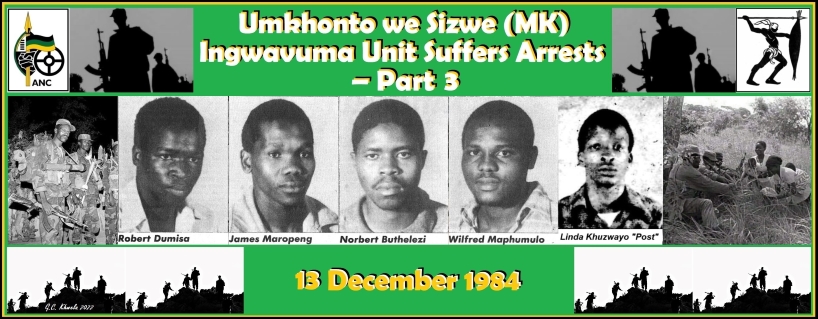
Accordingly, on 10 November 1984, Robert Dumisa noted in his diary that his Umkhonto we Sizwe (MK) Ingwavuma Unit Commissar told him that the apartheid South African Defence Force (SADF) troops were seen patrolling the river and the road in the vicinity of their base, while another contingent of soldiers were observing the area from Salamfene, and yet more were seen making their way down the mountain.
Dumisa further noted that given this portentous turn of events, they had to conduct reconnaissance to determine the location of the apartheid security forces so as to avoid confrontation or detection. His immediate solution was that they had to depend on the people for information and at the same time keep the enemy speculating about their whereabouts.
Despite these observations, the situation continued to deteriorate, when on 13 November 1984, Dumisa noted that two days before, Jameson Mngomezulu’s young daughter, Busisiwe, came back alone from Swaziland to report the arrest of her father.
According to Dumisa, such an action to come and report without being told to do so was a reflection of matured thinking. When the ten-year-old girl was asked by the soldiers where the guerrillas were, she informed them that there was only one man who lived with her father and she did not know where he was. She completely denied knowledge or the presence of the Unit.
However the writing was on the wall, as Dumisa noted, “This arrest is going to give us serious problems”. Accordingly, on 11 December 1984, the apartheid security forces arrested Vusumuzi Nyawo and Norbert Buthelezi on the same day.
Ultimately, on 13 December 1984, Dumisa and James Marupeng were also arrested by an apartheid police contingent in the Ubombo Mountains in the Isihlangwini Area.
The initial phase of “Operation Ingwavuma” was conceived to involve doing groundwork for the creation of guerrilla operational areas (guerrilla zones) in Northern Natal by first politicising the local population. Other preparations included mapping out the terrain, recruiting people and establishing training bases.
It was envisaged that recruits would establish mass peasant political organisations and underground units that would be assisted by MK military structures. Trained MK guerrillas were to constitute the core of the structure.
The area of Ingwavuma was chosen because of its strategic importance, as it is situated on the most Northern tip of Natal which borders Swaziland and Mozambique. African National Congress (ANC) and MK operatives in Swaziland were a vital link between the movement and the local population.
MK sought to take advantage of simmering anti-government discontent among the local population, who were unhappy that the government planned to cede the area of Ingwavuma to Swaziland. Some of those who opposed the move became sympathetic to MK and joined the organisation to undergo military training. Based on this development, MK concluded that it was possible to start a People’s War at Ingwavuma.
A two-man reconnaissance team that was sent to the area for two weeks returned with a negative report about the possibility of establishing bases. Another team, however, compiled a report that encouraged the establishment of bases.
Subsequently, two units were established, one named “Nozishada” and the other “Maqendindaba”. Both units trained several people from the local population. One MK recruit from the area was captured by the police and leaked information about the existence of MK bases in the area. Apartheid South African security forces arrived to gather more information and later the KwaZulu Police combed the area.
One of the guerrillas, known as Linda Khuzwayo (aka “Post”), went to the village and found that the Maqendindaba base was surrounded by SADF troops. He fired his pistol to warn four members of the unit, who escaped through a secret route, but “Post” was shot and killed.
Others were arrested, such as Wilfred Maphumulo (aka “Gosa”) and Operation Ingwavuma thus proved to be unsuccessful in establishing an MK guerrilla base to ignite a People’s War. However, in his observations regarding the efforts towards building for People’s War, ANC President and MK Commander-in-Chief, OR Tambo remarked:
“While it is true that we have lost many cadres in the confrontation with the forces of repression, qualitatively, victory on the military front belongs not to the enemy but the people. This is so exactly because in the face of the harshest enemy repression, we have succeeded both to intensify our military offensive and to enlarge the popular forces inside our country, organised to wage the struggle arms in hand.”
In his diary, the Commander of the Ingwavuma Unit, Robert Dumisa, paid homage to all that he served with in the MK Northern Natal Military Command, as well as the heroes of that struggle, both the dead and those who were arrested and serving their sentences in Robben Island.
He ended with the slogan:
“VICTORY IS IN SIGHT, AND ALL OUR SACRIFICES ARE NOT IN VAIN!”
Castro Khwela
Good evening fellow Compatriots!
Discover more from CASTRO KHWELA
Subscribe to get the latest posts sent to your email.


Ngi ya rabula this is our History that be forgotten, even in school if it’s our government this must added to the curriculum aluta continua