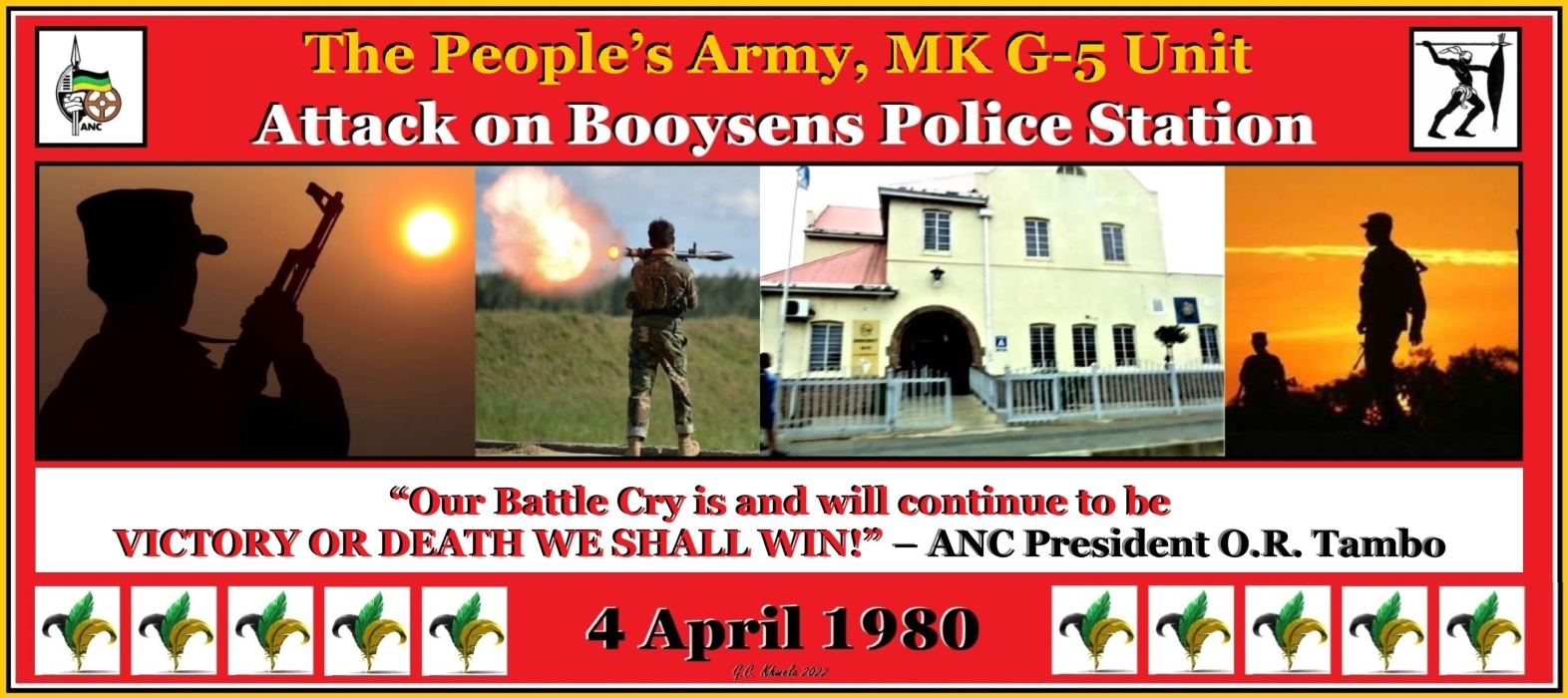
The People’s Army, MK G-5 Unit Attack on Booysens Police Station
“Our Battle Cry is and will continue to be VICTORY OR DEATH WE SHALL WIN!” – ANC President O.R. Tambo
On 4 April 1980, the golden Ford Valiant that was used in the attack of the Booysens Police Station in the early hours of the morning, was found abandoned in the Zone 3, Diepkloof, in Soweto, south of Johannesburg, and the guerrillas had managed to return safely to their base. Their base was a disused gold mine, which enabled them to get more than ten metres underground.
“These dugouts served as their house and headquarters from which they planned and executed their operations. It was from this hole that in a disciplined and organised manner they took turns conducting reconnaissance and acquiring food. Nobody left the base without reason. Every movement was purposeful and timed” (Dawn, Vol. 12, No. 1, January 1988).
It all began late on the evening of 3 April 1980, in Diepkloof, Soweto, when Anthony Tsotsobe and Petros Linda Jabane entered a Ford Valiant belonging to Derrick Ndlovu, who had agreed to give them a lift. When they were inside the car, Tsotsobe pulled out a pistol and demanded Ndlovu to hand over the keys. After obliging to the demand, Tsotsobe paid Ndlovu R10.00 and indicated to him that they were borrowing the car, which he was to get back the following morning. The two then ordered the other passengers in the vehicle to disembark. With Jabane driving, they then took the vehicle to a spot where they were supposed to meet Johannes Rasegatla, Solly “Jabu” Shoke and Nicky “Ntsizwa” Hlongwane, whom they found were waiting.
The three, Rasegatla, Shoke and Hlongwane were members of Umkhonto we Sizwe (MK) Transvaal Urban Machinery’s G-5 Unit, which had succeeded to hit the Moroka police station on 3 May 1979, and the Orlando police station on 2 November 1979. The was G-5 Unit was now reinforced by Jabane and Tsotsobe, and they wanted to hit a police station in a white area. They then headed to Booysens Police Station, with each guerrilla having an AK-47 automatic rifle, as well as one RPG-7 rocket launcher for the Unit. The Valiant stopped near a garage, with Hlongwane checking if there was any danger, as a police van pulled on the other side of the street, and a policeman leaving the van to enter the station.
At around 01:00 in the morning, the guerrillas went out of the car and Tsotsobe had the RPG-7 on his shoulder. He then shouted, “Fire!”, as he dispatched shot towards the police building. The first rocket landed on the roof, without any significant damage, and the second one hit the building, causing it to shake, while the third flew over the building. His comrades then began to spread out and opening fire on the station with their AK-47s.
The policeman who had just arrived in the police van parked outside the station, and was at the charge office when the attack began, returned fire with his .38 revolver through the window. Approximately ten minutes after opening fire towards the police station, the guerrillas retreated into the Valiant, after tossing pamphlets from the car, which were calling for the release of all political prisoners, including Nelson Mandela and Walter Sisulu.
A neighbour of the police station, Leo Nikles, who resided in the corner of Metz and Booysens Streets, jumped into his bakkie, after turning on his red lights, and began following the Valiant up to the highway to Soweto. The Valiant, which was moving at around 140 kilometres per hour, began slowing down at regular intervals. Eventually the Valiant stopped completely and then began to reverse. With Nikles fearing to get shot, he abandoned the pursuit and broke away. The Valiant was then found abandoned in Diepkloof Zone 3, Soweto.
On 5 April 1980, the African National Congress (ANC) Information and Publicity Unit issued a report on the operation, which read, “A unit of Umkhonto we Sizwe guerrillas attacked the Booysens police station with hand grenades, AK-47 assault rifles and an RPG-7 rocket launcher (bazooka). The rocket launcher was used for the first time in the history of armed liberation struggle led by the ANC in South Africa” (Dawn, Nov/Dec 1981).
According to the ANC, “By 1978 the first MK operations by units of the Transvaal Urban Machinery took place. These were aimed at police stations in the PWV area. At the same time attacks were launched from the Western Front, aimed at establishing guerrilla bases in the Western Transvaal. At this time the ANC’s dilemma was that in order to be successful militarily, it had to establish a political base inside the country: yet a political base could not grow without military actions serving to reinforce people’s confidence and motivate them to become involved in political and other forms of resistance. There was a need to capture the imagination of the oppressed through demonstrating that the enemy was not invincible, and to gain international recognition of the armed struggle” (ANC First TRC Submission).
The United Nations Centre Against Apartheid published the following in its 1984 Notes and Documents: “Year 1980 saw the introduction of a new weapon on the South African scene – the RPG-7 rocket launcher. In the largest assault yet, the freedom fighters of the African National Congress attacked the Booysens police station in the center of Johannesburg, pounding the building for ten minutes with a combination of rocket-propelled grenades, AK-47 fire and hand grenades. They escaped unharmed, leaving behind leaflets demanding the release of Nelson Mandela and Walter Sisulu. This first attack in a white urban area was targeted to shake confidence of the residents in the ability of the police to protect them” (Woods, 1984).
The South African Presidency in 2010 awarded the Umkhonto we Sizwe’s Transvaal Urban Machinery G-5 Unit “The Order of Mendi for Bravery in Gold” for “Displaying acts of bravery and valour during the struggle for the liberation of the people of South Africa.” According to the Order, the G-5 Unit was “one of the units that made the late president of the African National Congress, Oliver Tambo, so proud that he is known to have said that this would be one of the first units that recognition should be given to when banned organisations and freedom fighters return from exile. This is the first Umkhonto we Sizwe unit that conducted assaults on police stations throughout Soweto in the late 1970s and 1980s.”
Furthermore, the Order said, “The G5 Unit stood up at a time when the police launched an onslaught against unarmed civilians. It managed to liberate many people from the fear and terror that were visited upon them by the regime and championed by the police. The G5 was the first unit to apply survival tactics in urban settings, an important tactic of guerilla warfare. They lived in dugouts and endeavoured to shield the masses from police brutality and not expose them to further rough treatment” (SA Presidency).
DISCIPLINE IS THE MOTHER OF VICTORY!
TO MOVE FORWARD WE MUST ATTACK, ACT IN UNITY AND UNITE IN ACTION!
Sources:
South African History Archives (SAHA).
Sechaba Correspondent, “Free Mandela”, Sechaba, June 1980.
Editorial, “Smoke and Fire in South Africa”, Sechaba, September 1980.
Dawn Correspondent, “Our People’s War is Gathering Momentum”, Dawn, Vol. 5 No. 11, Nov/Dec 1981.
Jeanne M. Woods, “Five Years of Armed Struggle in South Africa”, Notes and Documents – United Nations Centre Against Apartheid No. 12, 1984.
MK Combatants, “Heroes of Our Revolution”, Dawn, Vol. 12, No. 1, January 1988
African National Congress, “Statement to the Truth and Reconciliation Commission”, August 1996.
Truth and Reconciliation Commission (TRC), “Amnesty Applications”, 12 May 1997.
SA Presidency, “The Order of Mendi for Bravery”, 27 April 2010.
Thula Simpson, “Umkhonto we Sizwe: The ANC’s Armed Struggle”, Penguin, 2016.
Castro Khwela
Good day fellow Compatriots!
Discover more from CASTRO KHWELA
Subscribe to get the latest posts sent to your email.