King Sabata Jonguhlanga Dalindyebo – Qhawe lama Qhawe
On 6 April 1986 – precisely forty years ago – King Sabata Dalindyebo passed on in Lusaka, Zambia, where he had lived for more than six years. Kumkani Sabata, King of the Thembus, was born in Tyalara, Transkei, on 25 November 1928 – only a month after his father, King Sampu Jongilizwe Mtirara, had died.
He was related to both Nelson Rolihlahla Mandela and Chief Kaiser Matanzima, former “President” of the Transkei. Chief Matanzima, however, was a deadly foe of both King Sabata and Nelson Mandela – his cousins – though at times he made empty gestures to Mandela. Two of King Sabata’s uncles acted as regents before he was installed as Paramount Chief in 1954.
With the aid of the racist South African regime, Matanzima worked hard to establish a power base. Apartheid Pretoria was desperate to find a relatively ‘competent’ figure to make the bantustan policy work. King Sabata led protests to Pretoria, but despite the opposition Matanzima was elevated to the level of Regional Chief of Emigrant Thembuland. In 1961, he got a new office: Chairman of the Transkei Territorial Authority. In 1963, the Democratic Party led by Victor Poto, with the backing of King Sabata, won the first elections in the Transkei, thus defeating Matanzima’s supporters. This was overturned. Matanzima was elevated to the status of Paramount Chief. He was preparing for the final coup.
King Sabata used his traditional power base to mobilise his people for democracy, instead of collaborating with the minority white power-structure. As a leader of the Democratic Party – the main opposition in the Transkei – he was a symbol of opposition to apartheid. He was hounded and harassed. At one time he was found guilty in the Transkei Supreme Court of “injuring and violating the dignity” of President K.D. Matanzima. He was fined R700 or 18 months in gaol. He was convicted, fined and dismissed and replaced by his racist-regime-supporting half-brother.
After the police raided his Great Palace in 1978, King Sabata said: “Since the early ‘60s, my close associates have been subjected to arbitrary action by the government to make me a lone voice in Transkei politics. I want the world to know that I have been persecuted for my political convictions since 1963, and have been ridiculed and humiliated even by junior chiefs who are (apartheid) government supporters. All along I have been quiet but now I cannot take any more.”
Nelson Mandela also raised his concerns about what was being done to King Sabata, as he met with the chiefs of the AbaThembu at Robben Island in 1980. According to Mandela, “I met the chiefs in a large room in the visiting area, and they explained their dilemma. Although their hearts were with Sabata, they feared Matanzima. After listening to their presentation, I advised them to support Sabata against Matanzima, who was illegally and shamefully usurping power from the king.”
King Sabata left the country on 15 August 1980, after being deposed by the Matanzima cabinet. As a senior member of the African National Congress (ANC) and leader of our people, he spent the last years of his life serving the ANC in Lusaka. At the Second National Consultative Conference of the ANC held in Kabwe, Zambia, in 1985, King Sabata inspired the delegates with his forthright eloquence and sense of humour, with his dedication and loyalty to the ANC and its President, OR Tambo, and to the struggle of our people.
Even after his death Matanzima could not pardon him. King Sabata’s body became the subject of a legal wrangle. Matanzima defied a court order, arrived at the funeral home, snatched King Sabata’s body and buried his political opponent, while the rest of the Sabata family stayed at home. At the funeral there were present only bantustan leaders and about 300 well-armed Transkei soldiers and policemen. Busloads of people were stopped – no one would be able to attend the funeral without a permit from the police – and roadblocks were set up in the Transkei.
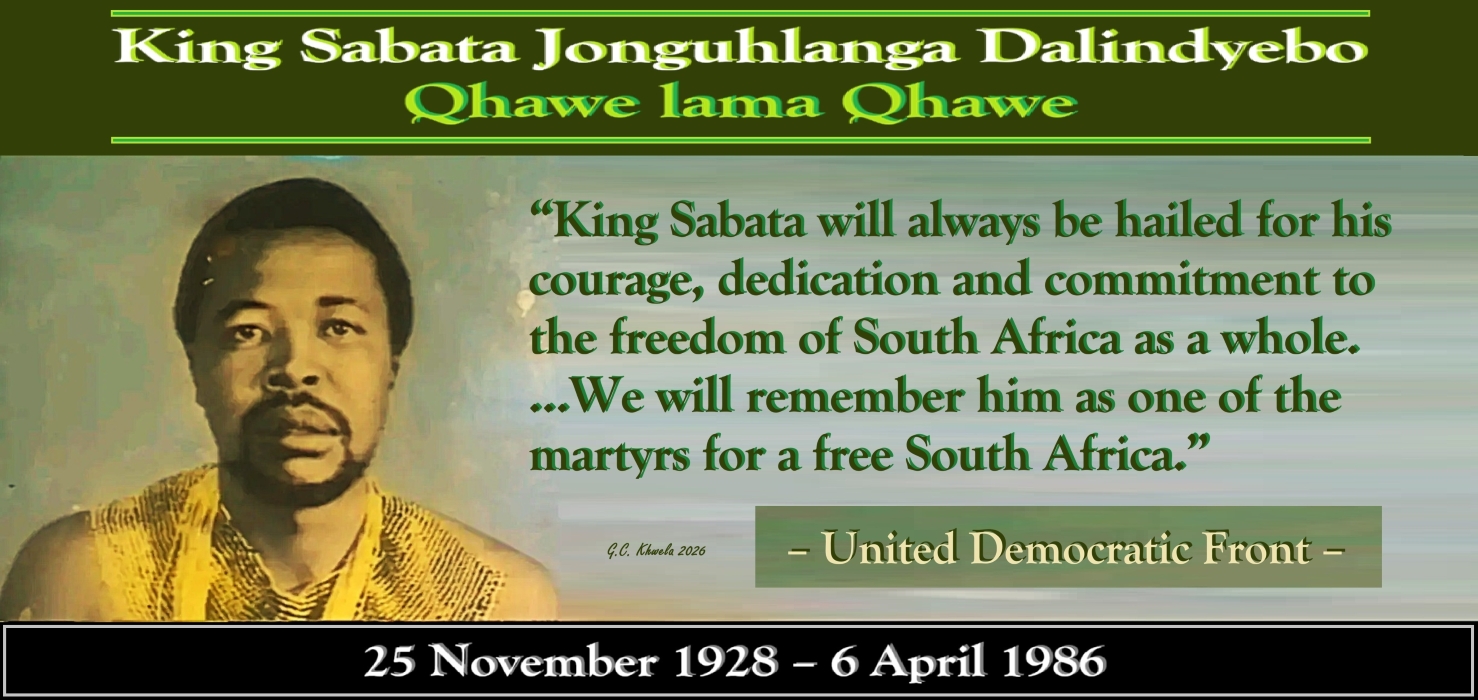
In the Eastern Cape, King Sabata’s followers, together with the Regional United Democratic Front (UDF), issued a statement paying homage to “Comrade King” and at a memorial service attended by more than 5 000 people in New Brighton, Port Elizabeth (now known as Gqeberha), the Publicity Secretary of the UDF, Stone Sizane, said: “King Sabata will always be hailed for his courage, dedication and commitment to the freedom of South Africa as a whole. …We will remember him as one of the martyrs for a free South Africa.”
Mama Albertina Sisulu, Transvaal President of the UDF, was the main speaker at a memorial service for King Sabata held at Khotso House in Johannesburg. She said that the King had opposed the turning of South Africa into ethnic homelands: “King Sabata refused to be a government puppet, and joined the ranks of the African National Congress”.
King Sabata Dalindyebo will forever be remembered for his fierce opposition to apartheid and his fight against bantustanisation of the Transkei. The National Executive Committee (NEC) lowered the flag of the ANC in his honour, and said: “The African National Congress announces with deep sorrow the passing away of King Sabata Jonguhlanga Dalindyebo of the Thembu. King Sabata succumbed to complication of diabetes and high blood pressure at the University Teaching Hospital in Lusaka, Zambia, at 19:15 hours on Sunday, 6th April 1986.”
“Sabata Jonguhlanga, whose grandfather, Dalindyebo, was among the founding fathers of the ANC, was born in the Transkei on 25 th November, 1928, the son of Jongilizwe Dalindyebo, head of the Thembu royal house of Ngangelizwe. He went to school at Clarkebury-Engcobo, and ascended the Thembu throne in 1955, taking over from the regent, Dabulamanzi, the traditional tutor of Nelson Mandela – Sabata’s cousin.”
“As Ukumkani waba Thembu – Paramount Chief of the Thembu – he ascended the throne at the advent and turmoil for the Thembu and the South African people as a whole, when the apartheid regime was introducing so-called Bantu Authorities as a prelude to creation of bantustans and the mass de-nationalisation of vast millions of South Africans. Sabata vigorously opposed these schemes, becoming a member in 1962 of the Makhuluspan volunteers, organised by Walter Sisulu to mobilise the African people of the Transkei against the impending bantustans.”
“His involvement with Makhuluspan, which had originally been a crime-prevention community organisation, was so effective that all the areas and chieftains but one, under his authority, refused to join the Bantu Authorities, Sabata’s consistent opposition to the bantustan system led to his brief detention in 1980 and subsequent exile, where he continued in the ranks of the ANC to work for a united, democratic and non-racial South Africa.”
“The African National Congress, on behalf of the struggling people of our country, dips its banner in honour of this stalwart, yet humble, son of our people, who, in spite of being dogged by illness, fought to his last breath for the unity and freedom of all the oppressed.”
Mhlekazi!
Jonguhlanga!
Amandla!
Source:
Wikipedia.
South African History Online (SAHO).
Obituary, “King Sabata Jonguhlanga Dalindyebo Hamba Kahle, Qhawe lama Qhawe”, Sechaba, June 1986.
Castro Khwela
Good day fellow Compatriots!
Discover more from CASTRO KHWELA
Subscribe to get the latest posts sent to your email.