Chris Hani’s Death Protests Result in Election Date
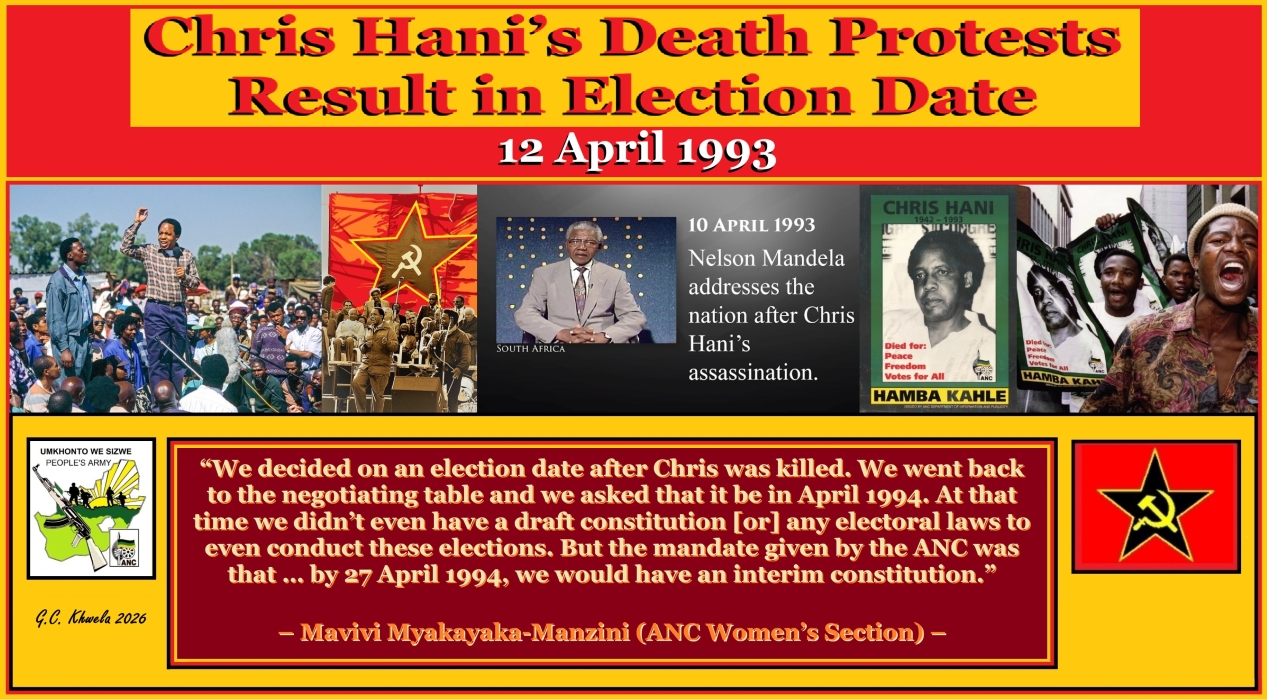
On 12 April 1993, two days after Chris Hani was shot and killed, millions of Black South Africans took to the streets to protest against the killing of Chris Hani, former Chief of Staff of Umkhonto we Sizwe (MK), the armed wing of the African National Congress (ANC) and General Secretary of the South Africa Communist Party (SACP). The protesters called for country-wide armed uprisings, but leaders in South Africa urged them to remain calm.
Hani was killed a year prior to South Africa’s first democratic elections, by two right wing associates Clive Derby-Lewis and Janusz Waluś. Janusz Waluś was arrested in Boksburg minutes after the assassination. An alert neighbour took down the registration number of the vehicle involved in the shooting and informed the police. The suspect was then apprehended in the car, and two weapons were found in his possession. Further investigation by the apartheid police had revealed a ‘hit list’ in Waluś’s home. The weapon used to kill Hani was one stolen from the SA Air Force on 14 April 1990 in Pretoria.
The Communist Party maintained that “Comrade Chris, as an individual, is irreplaceable. He had emerged in the past months, according even to the opinion polls of our opponents, as easily the second most popular politician in the country (after Comrade Nelson Mandela, of course). But the shots that killed comrade, unwittingly mobilised a huge army of liberation across the face of our country.”
Millions mourned black leader Chris Hani with one of the largest general strikes in South African history, but marches countrywide were marred by widespread looting and the killing of four protesters by police in Soweto. The national protest, one of the most violent in months, reflected deep-seated anger over Hani’s assassination on Saturday, 10 April 1993, by a white extremist, and growing discontent with the slow pace of negotiations in townships still beset by crippling poverty and hungry for change.
Apartheid President Frederik W. de Klerk, in an interview, vowed to crack down on the rioting, promising to send 3,000 police and army reinforcements to join the 23,000-strong force already deployed to halt the escalating violence. “What happened in South Africa today cannot be tolerated in any civilized country,” he declared. The bloodshed indicated once again the inability of the South African police to control protests without the use of deadly force, and ANC leaders were quick with sharp criticism of the authorities.
But the rioting and looting that accompanied dozens of marches, from Cape Town and Port Elizabeth to Durban and Johannesburg, also indicated the anger of ANC youthful supporters. Many of those followers had been suspicious of the ANC’s decision to participate in constitutional negotiations with the white-minority government, and they had supported those talks only out of admiration for Hani, a popular ANC leader and key negotiator.
After Hani’s killing, negotiations came to a dramatic halt. With the spontaneous outpouring of grief, anger and frustration, the country was engulfed in angry protests and violence. ANC leader, Nelson Mandela, appealed for calm on national television, issuing a moving appeal for all South Africans to work together, to close ranks and prevent anger from destroying their joint future, and not allow for the destruction that Hani’s killers sought.
During a march in Cape Town, black youths looted dozens of stores during a two-hour melee in which a black youth was shot to death, a peace monitor was stabbed, a policeman was shot and wounded and an ANC official, Trevor Manuel, was assaulted by ANC supporters when he attempted to restore order. Most of the demonstrators, joined by former World Heavyweight Champion boxer Muhammad Ali, were peaceful, disciplined and listening to those in charge.
The bloodiest incident of the day occurred in Soweto, the sprawling black township on the edge of Johannesburg, where ANC President Nelson Mandela delivered an impassioned speech to 20,000 people crowding a soccer stadium, calling on ANC supporters to exhibit “the calm and dignity” expected of “a government in waiting”. After the speech, though, thousands left the stadium and gathered at the township’s largest police station. Police opened fire on the crowd without warning, killing the head of the ANC’s Soweto Branch and three other protesters.
More than 250 were injured, five critically. A police spokesman, Capt. Eugene Henning, said officers had opened fire “to disperse the crowd to protect their (police) lives and property” after protesters attacked the station with bottles and stones. He denied that the police were using bullets, although the birdshot and buckshot often used for riot control could cause mortal injuries at close range.
The angry mood in Soweto was evident even earlier, during Mandela’s speech. Among the placards held aloft by the crowd were a few reading: “De Klerk Must Be Assassinated for Hani’s Death.” Although Mandela was warmly welcomed onto the stage, he was booed and jeered when he made a friendly reference to expressions of sympathy for Hani’s death from De Klerk’s ruling National Party.“ I understand your anger,” Mandela said. “There is no party that has been more responsible for your pain than the National Party.” But he added: “We don’t want to think of the past. We want to think of the present and the future.”
Ultimately, both sides acknowledged that negotiations were the only way to stop the country’s descent into chaos. The ANC-SACP-COSATU Tripartite Alliance met immediately after the assassination and set out the demands that there should be an immediate announcement of an election date; the interim government, which was termed as the Transitional Executive Council (TEC), should be installed as a matter of urgency; and that all armed formations should be placed under immediate multi-party control.
These demands were followed by intense negotiations, and subsequently 27 April 1994 was announced as the date of the first democratic elections. A deadline for the conclusion of negotiations was also set, which only left approximately ten months to go. According to the leader of the ANC Women’s Section, Mavivi Myakayaka-Manzini, “We decided on an election date after Chris was killed. We went back to the negotiating table and we asked that it be in April 1994. At that time we didn’t even have a draft constitution [or] any electoral laws to even conduct these elections. But the mandate given by the ANC was that … by 27 April 1994, we would have an interim constitution.”
Sources:
Wikipedia.
South African History Online (SAHO).
Scott Kraft, “S. Africa Protest of Hani Slaying Turns Violent”, Los Angeles Times, 15 April 1993.
Editorial, “Chris Hani – Fighter for the Workers and the Poor”, The African Communist, No 132, First Quarter, 1993.
Nelson Mandela, “Long Walk to Freedom”, Abacus, 1994.
Thula Simpson, “Umkhonto we Sizwe: The ANC’s Armed Struggle”, Penguin, 2016.
Castro Khwela
Good evening fellow Compatriots!
Discover more from CASTRO KHWELA
Subscribe to get the latest posts sent to your email.