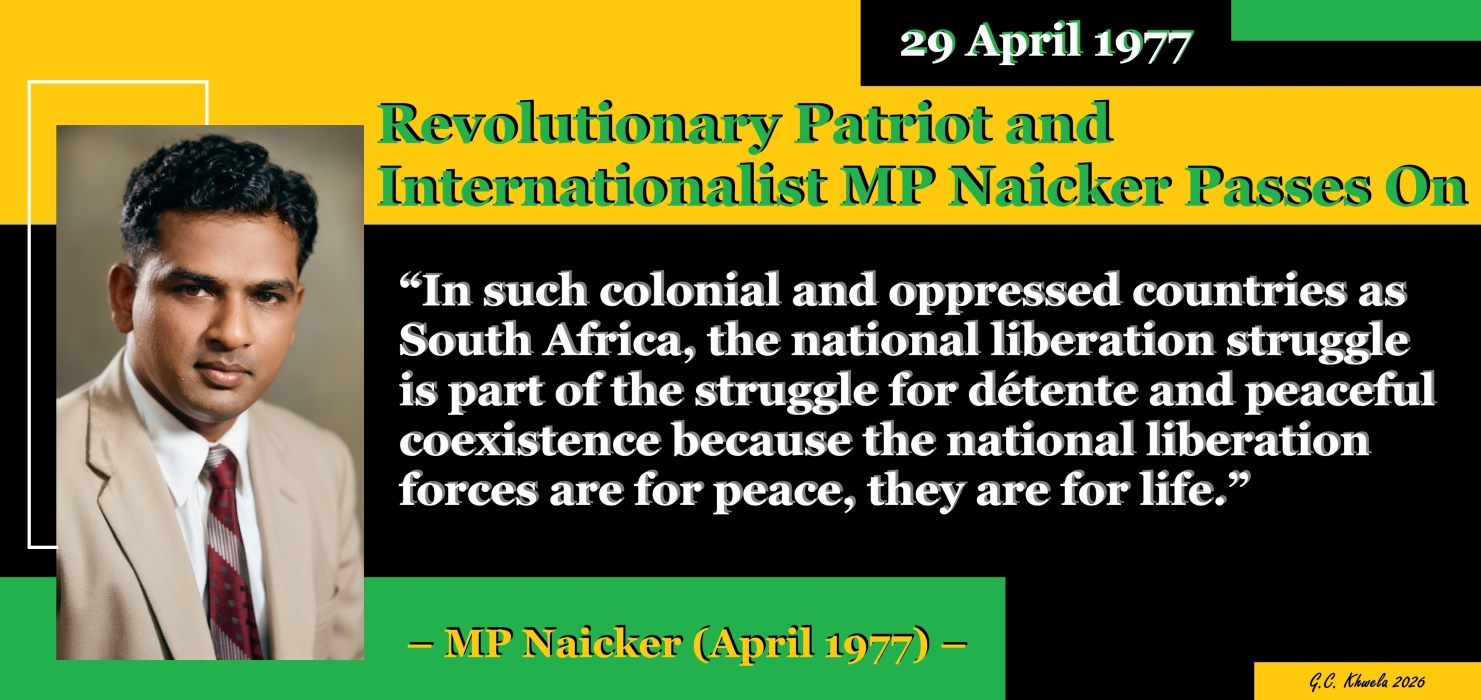
Revolutionary Patriot and Internationalist MP Naicker Passes On
On 29 April 1977, Marimuthu Pragalathan Naicker, fondly known as “MP”, passed on at the age of 56 from a suspected heart failure en route on a flight from London to Berlin. MP Naicker was a journalist, an anti-apartheid revolutionary patriot, an organiser, a devout internationalist, and Director of Publicity of the African National Congress (ANC) External Mission. At the time of his death Naicker was also a journalist and editor for the ANC’s official journal, ‘Sechaba’, and he died while on a mission on behalf of the liberation struggle abroad.
MP Naicker was born on 28 July 1920 in Durban into a working-class family of Indian descent and had to leave primary school to work in a factory, and although his family was poor he managed to complete high school. He began working as a truck driver then was employed as a full-time union organiser in Natal, organising among sugar plantation workers. He rose to become secretary of the Natal Sugar Workers’ Union and was a member of the Natal Indian Congress (NIC). At age 18, Naicker joined the South African Communist Party (SACP), after being exposed to the Marxist classics.
In 1944, Naicker joined the Anti-Segregation Council, which was founded to pursue mass mobilisation against Indian segregation, with his cousin, Monty Naicker, being the founding chairperson. In 1945, Naicker was among those in the Anti-Segregation Council who succeeded in ousting the NIC’s moderate leadership under the leadership of A. I. Kajee and P. R. Pather, becoming the NIC Vice-President from 1945 until 1952.
An outstanding organiser, MP Naicker got involved with Debi Singh in the organisation of the 1946 passive resistance campaign, and edited the Passive Resistance Bulletin, ‘Flash’. He was appointed Secretary of the Passive Resistance Council which fought racist General Smuts’ Ghetto Act of 1946, prohibiting property deals by Asians. As a result of the campaign, he was imprisoned twice for month long terms, and his wife Saro also being imprisoned for participating in the campaign for a month with hard labour.
After the passing of the Suppression of Communism Act in 1950, Naicker was banned from further activity in the trade unions and the Congress movement. During the Defiance Campaign in 1952, Naicker was appointed as Volunteer-in-Chief of the South African Indian Congress (SAIC) and as joint secretary, alongside Masabalala Bonnie Yengwa, of the Joint Action Council in Natal of the Congress of the People campaign in Natal from 1954-1955. For having participated and playing a leading role in the Campaign, Naicker served a month imprisonment with hard labour.
Whilst in prison, he met and befriended Inkosi Albert Luthuli, with whom he worked closely in building the Congress Alliance. During this time, Naicker worked for the leftist newspaper, as Durban branch editor-manager of the ‘New Age’, which was based in Johannesburg, alongside other comrades, such as Joe Nzingo Gqabi and Ruth First.
Naicker was appointed editor of the revolutionary newspaper ‘The Guardian’ in 1956 and was credited with reorganising the paper’s Durban based bureau and establishing it as a key publication in resistance and revolutionary politics in Natal. He was also involved with the publication of the ‘Spark’, wherein he was featured on the front page of the final issue before the paper was banned in South Africa. The paper was banned by B.J. Vorster under the Suppression of Communism Act, and the last issue was distributed on the 28 March 1963. Within these publications he worked alongside Brian Bunting, Fred Carneson, Ruth First and Govan Mbeki.
Journalism, for MP Naicker, was simply another front on which to fight the enemy. When he was Editor-Manager of the ‘New Age’ office in Durban, it became a recruiting ground and a battlefield, with people from all walks of life and from all over the country pouring into the office. The special triumphs of his political career flowed directly from his political contacts.
For instance, his exposure of the kidnapping of Anderson Ganyile in Basutoland, was possible because the note smuggled out by Ganyile was taken to him. The expose was responsible for the outcry that led to Ganyile’s release. Similarly, during the Pondoland campaign of the 1960s, the people involved sough out MP Naicker and the ‘New Age’ office to tell their story, and it was his pioneering work in building up contacts that stirred the publicity which was given to the campaign.
During the 1956 Treason Trial, Naicker was charged alongside 155 other Congress Alliance activists, but his charges was withdrawn in 1958. He was imprisoned again for four months in 1960 without trial after the emergency which followed the Sharpeville massacre. After being jailed twice, for 90 days in 1963, and 180 days in 1964, under the notorious 90 day No-Trial-Law, Naicker was forced to leave the country.
In 1965, Naicker left South Africa and was active in political work in the anti-apartheid movement in exile. During his years in exile, he became the Director of Publicity for the African National Congress (ANC) External Mission in London, using the pseudonym “Mandla Nkosi”. Naicker travelled abroad to several African, Asian and European, including Latin American countries, the former Soviet Union and Czechoslovakia to represent the ANC.
MP Naicker became the first editor of ‘Sechaba’, the official journal of the ANC, from 1967. When his wife Saro and their daughter Suganya joined Naicker in exile, Saro also worked for ‘Sechaba’. Later on, Naicker worked with activists who made an effort to establish an ANC office in New Delhi, India, to organise the distribution of ‘Sechaba’ to international readers in India. He also became a member of the Executive Committee for International Organisation of Journalists (IOJ), and was awarded their gold pin in 1971. In September 1976, at the Eighth Congress of the IOJ in Helsinki, Naicker was awarded the prestigious Julius Fucik medal for outstanding services to journalism.
Shockingly, Naicker died suddenly on 29 April 1977 from a suspected heart failure during a flight from England to the German Democratic Republic, where he was travelling to deliver ANC publicity material for printing. Naicker was buried at the Golders Green Crematorium in London on 8 May 1977, and at his funeral tributes were presented from the Acting President of the ANC, Oliver Tambo, the Chairperson of the SACP, Yusuf Dadoo, and SACP activist Brian Bunting. In a statement issued by the ANC, the Movement said:
“M.P. has passed away at what is probably the beginning of the most challenging time in the history of our struggle. We salute him for his contribution, one which he began as a young man. And it is without question the solid foundation he so ably helped to establish which makes it possible for our movement to meet the demands we face in our revolutionary struggle. The cream of our youth is flooding to the African National Congress today and living up to the finest traditions of struggle. This is the best tribute which can be made to M.P. and comrades like him. On occasions like this we steel ourselves for participation with renewed vigour.”
We dip our flag in salute to this gallant fighter for freedom. HAMBA KAHLE, MP.
Sources:
Wikipedia.
South African History Online (SAHO).
Obituary, “M.P. Naicker: Worker, Trade Unionist, Journalist and Freedom Fighter”, Sechaba, Vol. 11, Fourth Quarter 1977.
Editorial, “Death of M.P. Naicker: Editor of Sechaba, Director of Publicity and Information, ANC”, Sechaba, Vol. 11, Third Quarter 1977.
Yusuf M. Dadoo, “Death of M.P. Naicker”, The African Communist, No. 70, Third Quarter 1977.
World Marxist Review, “Comrade Naicker’s Last Interview: Reprinted in April 1977”, The African Communist, No. 70, Third Quarter 1977.
Judge Thumba Pillay, “MP Naicker: 100 Years”, Gandhi-Luthuli Documentation Centre, August 2020 https://gldc.ukzn.ac.za/wp-content/uploads/2020/08/MP-Naicker-Mercury-July-30-page-4-1-Part-1.pdf
Castro Khwela
Good morning fellow Compatriots!🙏🏾✊🏾👊🏾
Discover more from CASTRO KHWELA
Subscribe to get the latest posts sent to your email.