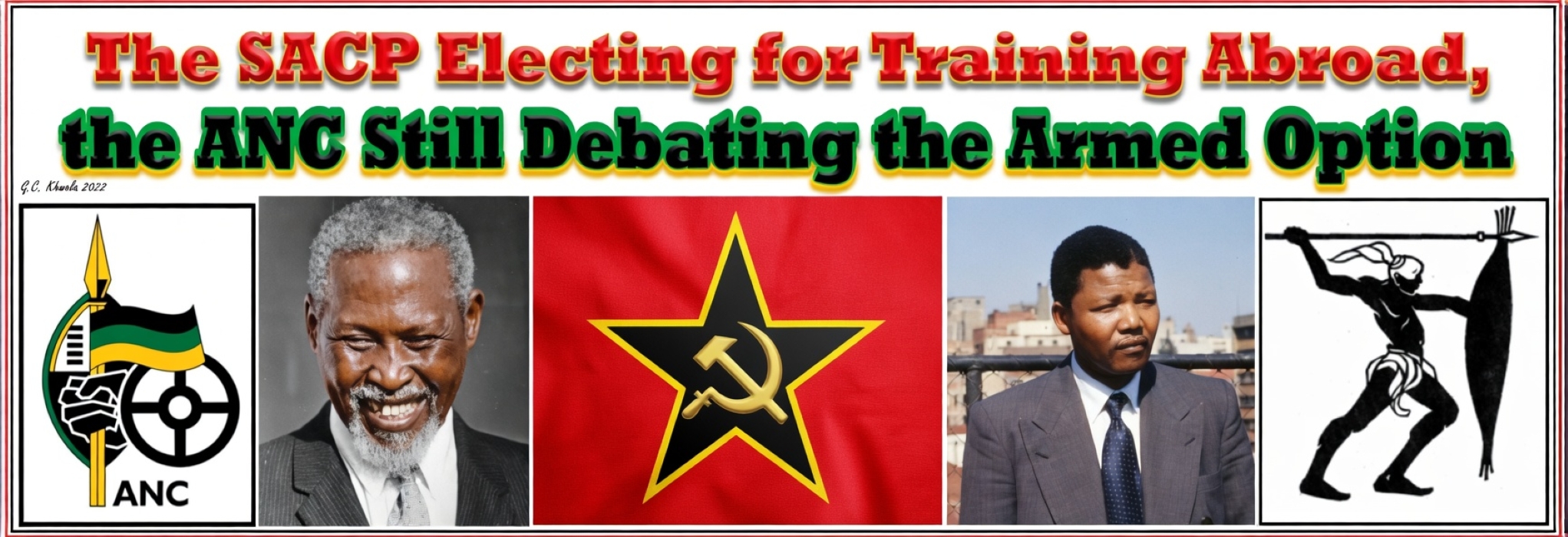
The SACP Electing for Training Abroad, the ANC Debating the Armed Option
Exactly sixty years ago, on 1 July 1961, Tennyson Makiwane was conversing with Wilton Mkwayi and Moses Mabhida about the South African Communist Party’s (SACP) December 1960 decision to take steps to initiate the training and equipping of selected personnel in new methods of struggle and thus prepare the nucleus of an adequate apparatus to lead struggles of a more forcible and violent nature. Accordingly, Mabhida and Mkwayi were to be sent to Prague, Czechoslovakia, for military training during the latter part of the year. One of them would have to undergo preparation in Tanganyika, and the Party had decided that Mkwayi was going to go first to receive training. Furthermore, Makiwane informed them that somebody from London was going to join them for the training.
On the same day, the SACP’s representative in Europe, Vella Pillay, who was based in London, approached Nandha Naidoo about the request for somebody to be sent to study radio technology and communication, thus be able to train others. According to Pillay, the course was intended to take three months, perhaps longer if needs be. Mac Maharaj was also going to undertake military training in East Germany while at the same time studying printing. When Naidoo agreed to be involved, Pillay told him that he was supposed to travel to Prague, where he was to meet Moses Mabhida and Milton Mkwayi, who would be in the Atlantic Hotel.
Meanwhile, on the same night, the ANC’s (African National Congress) National Executive Committee (NEC) held a meeting in Groutville, near Stanger in Natal. During the meeting, ANC President Albert Luthuli criticised Nelson Mandela’s statement to the Rand Daily Mail newspaper on 29 May 1961, wherein he said that the ANC was closing a chapter on a phase of the struggle. According to Luthuli, the statement raised an important matter that should have been discussed by the organisation before a public announcement could be made.
Mandela acknowledged the validity of the criticism but reiterated the basic point that a turn was necessary, since the state had left them with no alternative to violence. For Mandela, it was wrong and immoral to subject the people to armed attacks by the state without offering them some kind of alternative. Some people had taken up arms on their own initiative, hence violence would occur whether the ANC adopted armed struggle or not. Mandela argued with a question that would it not be better for the ANC to guide the violence itself, according to principles whereby it would save lives by attacking symbols of oppression, rather than people? If the ANC failed to lead at this stage, it would be a latecomer to a process that it would be unable to control.
Luthuli initially opposed Mandela’s argument, since for him non-violence was not simply a tactic, but a principle, a way of life. However, the champions of the armed struggle worked on him the whole night, and he ultimately realised that they were correct, and agreed that a military campaign was inevitable. When someone made a comment that perhaps the Chief was not prepared for such a course, Luthuli retorted, “If anyone thinks I’m a pacifist, let him try to take my chickens, and he will know how wrong he is!”
The South African Communist Party (SACP) remained steadfast in its December 1960 decision to adopt an armed struggle because it believed the apartheid state had completely closed off all avenues for peaceful protest, and its unique Marxist-Leninist theoretical framework and underground organisational structure gave it the capacity to act ahead of its nationalist allies. While the African National Congress (ANC) and other members of the Congress Alliance were officially bound to policies of non-violence, the SACP operated as a distinct, underground vanguard party that felt a historical urgency to channel growing popular anger into organised resistance.
The political landscape of South Africa had fundamentally shifted after the March 1960 Sharpeville Massacre. The apartheid regime declared a State of Emergency and banned both the ANC and the Pan Africanist Congress (PAC). Unlike the ANC, which had always operated legally and was thrown into disarray by the sudden ban, the SACP had already been banned a decade earlier under the 1950 Suppression of Communism Act. The SACP had spent seven years mastering underground survival, secret communications and clandestine cell operations. It believed that continuing to rely solely on legalistic, non-violent protests was suicidal against an openly fascist state.
The SACP’s commitment to an armed transition was driven by its adherence to Marxist-Leninist revolutionary theory. The party analysed the South African condition as “Colonialism of a Special Type”, where the coloniser and the colonised lived within the same geographic borders. According to this framework ruling classes never peacefully abdicate power; state violence must be met with organised revolutionary violence; and bourgeois democratic methods (petitions and peaceful marches) were obsolete once the state criminalised basic opposition.
Before the December 1960 conference in Emmarentia, Johannesburg, the SACP leadership had already secured assurances of global support. SACP delegations that had travelled to Moscow and Beijing in mid-1960 to consult with international communist leaders, including Mao Tse Tung, they were promised military training, financing and weaponry. Knowing it possessed exclusive access to global superpower logistics gave the SACP the strategic confidence to forge ahead independently, anticipating that its allies would eventually have to follow suit. Primarily the SACP feared losing its political influence over the radicalised, angry masses. For example, the breakaway Pan-Africanist Congress (PAC) was rapidly gaining traction among the youth by promoting a more aggressive, militant stance.
Simultaneously, uncoordinated, spontaneous outbreaks of violent resistance were popping up in rural and urban areas. SACP leadership – including figures like Michael “Mick” Harmel and Moses Kotane – argued that if the formal liberation movement did not provide disciplined military leadership, the masses would turn to anarchic or counter-productive terrorism. The SACP did not view its decision as a betrayal of the Congress Alliance, but rather as an act of leadership. SACP members occupied highly influential positions within the senior organs of the ANC and the South African Congress of Trade Unions (SACTU).
Key figures like Nelson Mandela, Walter Sisulu, and Govan Mbeki had attended the SACP’s December 1960 meeting. By adopting the posture first as the SACP, communist leaders who held dual membership were able to gradually lobby, convince, and shift the internal policy of the ANC over the course of 1961. This directly led to the joint creation of Umkhonto we Sizwe (MK) in late 1961 as a technically autonomous military wing, bypassing the ANC’s official constitutional restrictions on violence at the time.
Finally, the advocates of the turn to violence pressed their point and eventually the National Executive Committee (NEC) endorsed the Working Committee’s preliminary decision. The Chief and others suggested that this new resolution should be treated as if the ANC had not discussed it, in order not to jeopardise the legality of its unbanned allies. For the Chief, the military movement was supposed to be a separate and independent organ, linked to the ANC and under the overall control of the ANC, but fundamentally autonomous.
The strategic compromise brokered by Chief Albert Luthuli and other senior leaders during the tense private debates of July 1961 was designed to reconcile a profound dilemma: how to launch a necessary armed resistance without completely exposing the broader, legal structures of the liberation movement to state destruction. This compromise resulted in a deliberate double-blind policy that protected the unbanned allies and created a structurally autonomous military organ. The proposal to proceed with the armed struggle while officially pretending the ANC had never even debated it was a calculated manoeuvre to preserve the “legal” space of the Congress Alliance and shield vulnerable partners from state suppression.
While the ANC and the PAC had been banned in April 1960, other critical organs of the Congress Alliance – such as the South African Congress of Democrats (COD), the South African Indian Congress (SAIC), the Coloured People’s Congress (CPC), and the massive South African Congress of Trade Unions (SACTU) – remained legally permitted to operate. If the ANC officially adopted violence, the state would instantly use it as a legal pretext to ban and imprison members of these allied organisations under the Suppression of Communism Act or treason regulations.
By maintaining an official stance of non-violence, the broader national liberation movement retained plausible deniability. It allowed legal components of the movement to continue doing vital open-air work, such as labour organising, printing literature, calling for international sanctions, and rallying mass civil disobedience, without being legally classified as active terrorist combatants. It protected internal, underground ANC leaders who were not cut out for guerrilla warfare. A blanket institutional policy of armed struggle would automatically turn every underground political organiser, safe-house provider, and leafleteer into a target for immediate execution or life imprisonment, destroying the network needed to support a military wing.
Chief Luthuli insisted that the newly formed military wing, Umkhonto we Sizwe (MK), must operate as a separate and autonomous organisation – loosely linked to the ANC but structurally independent – for very specific political, philosophical, and tactical reasons. Chief Luthuli was deeply committed to non-violence as a core principle. In 1960, he was awarded the Nobel Peace Prize. If the ANC formally transformed itself into a military guerrilla outfit, Luthuli’s immense international moral authority would be compromised. Making MK structurally autonomous allowed Luthuli to maintain his position as a global icon of peaceful resistance while pragmatically understanding that younger cadres under Nelson Mandela would pursue sabotage independently.
The ANC was founded in 1912 on the immutable constitutional principles of peaceful persuasion, constitutional lobbying, and non-violent resistance. Changing the constitutional foundation of a mass-based organisation required broad democratic consultation with grassroots branches. Because the ANC was banned and underground, holding such a democratic conference was impossible. Autonomy bypassed this hurdle: MK could act without altering the official historical identity of the ANC. Luthuli was terrified that an unstructured, emotional turn to violence would result in an asymmetric bloodbath where untrained African citizens would become “cannon fodder” against a highly mechanised apartheid military organisation.
By making MK a separate, professional entity with its own High Command, the leadership ensured that military operations were strictly disciplined, restricted to sabotage of inanimate infrastructure (like power pylons), and heavily regulated to avoid civilian casualties. The ANC was explicitly a nationalist African organisation, whereas the armed struggle required a highly tight, cross-racial, and cross-ideological command structure. Making MK autonomous allowed it to seamlessly pool resources, financing, and fighters from the SACP, SACTU, and white, Indian and so-called Coloured radicals.
As explicitly stated in the 1961 Umkhonto we Sizwe Manifesto, “Umkhonto we Sizwe is a new, independent body… It includes in its ranks South Africans of all races… It is, however, well known that the main national liberation organisations in this country have consistently followed a policy of non-violence.” This structural separation allowed MK to draw from the SACP’s exclusive funding and training links in Moscow and Beijing, while ensuring the broader liberation movement could still claim a peaceful path to democracy if the state ever decided to negotiate.
According to Chief Luthuli, there would be two separate streams of the struggle, and this was readily accepted. He also warned against the new phase becoming an excuse for neglecting the essential task of organisation and the traditional methods of struggle, which it was accepted that it would be self-defeating because the armed struggle, at least in the beginning, would not be the centrepiece of the Movement.
Sources:
South African History Online (SAHO).
African National Congress, “Manifesto of Umkhonto we Sizwe”, African National Congress, Manifesto, 16 December 1961.
Govan Mbeki, “The Struggle for Liberation in South Africa”, African National Congress Books, 20 September 1992.
Nelson Mandela, “Long Walk to Freedom”, Abacus, 1994.
Stephen Ellis, “External Mission: The ANC in Exile”, Jonathan Ball, 2012.
Thula Simpson, “Umkhonto we Sizwe: The ANC’s Armed Struggle”, Penguin, 2016.
Dirk Kotze, “South Africa’s Communist Party Strips the ANC of Its Multi-Class Ruling Party Status”, University of South Africa (UNISA), 11 December 2017.
Robert Trent Vinson, “Albert Luthuli, MLK and Global Human Rights”, Africa Is A Country, January 2019.
Simon Steven, “The Turn to Sabotage by The Congress Movement in South Africa”, Past & Present, Vol. 245, Issue 1, November 2019.
Paul S. Landau, “Spear: Mandela and the Revolutionaries”, Jacana, 2022.
Vuyisile Msila, “Chief Albert Luthuli: The Ambivalent or Ambidextrous ANC Leader?”, South African Journal of Cultural History, Vol. 38, No. 1, 1 June 2024.
Castro Khwela
Good morning fellow Compatriots!🙏🏾✊🏾👊🏾
Discover more from CASTRO KHWELA
Subscribe to get the latest posts sent to your email.