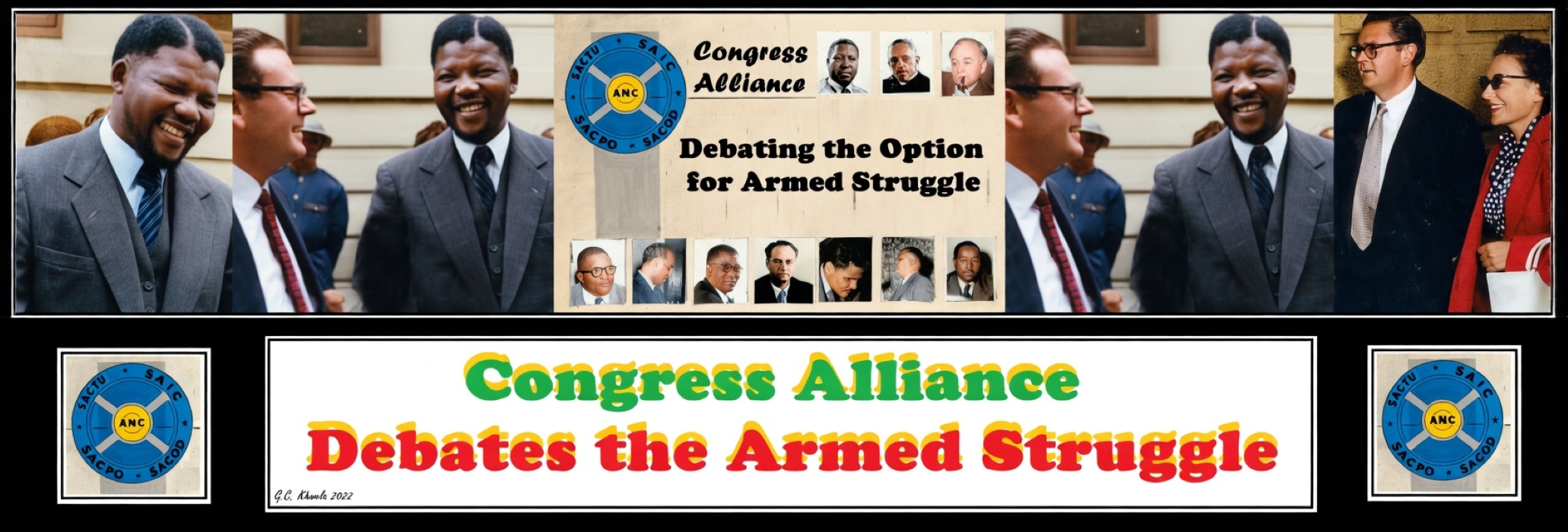
Congress Alliance Debates the Armed Struggle
On 2 July 1961, the night following the debate the African National Congress (ANC) had in Groutville, near Stanger, on the armed struggle, the meeting of the Congress Alliance Joint Executives took place in a beach house, also near Stanger. Nelson Mandela had arrived for the ANC National Working and Executive Committee meetings disguised as a chauffeur for Hymie and Hazel Rochman. Mandela had used the Rochman Johannesburg residence as a gardener, wearing coveralls, as he used to sleep in the maid’s quarters. During this occasion, Mandela drove incognito to Natal in July to Stanger, to a sugar plantation belonging to Walter Singh, a close friend to Inkosi Albert Luthuli.
The National Executive Committee (NEC) meeting which ran late the previous night, 1 July 1961, under the chairmanship of Moses Kotane and Masabalala Bonnie Yengwa, who was Luthuli’s close ally and the senior ANC leader in the province of Natal, was meant to provide guidance to the Congress Alliance meeting the following day, on 2 July 1961. Both Nelson Mandela and Walter Sisulu wanted to come to some conclusions at the ANC NEC meeting, particularly around the question of transforming the ANC into an order of military command and implementation using violence. This position was strongly opposed by Masabalala Bonnie Yengwa on the basis that it would subject members of the organisation to unavoidable arrests.
Nevertheless, Mandela and his supporters made the case that the ANC should take the lead in order to stem the random violence that was occurring in the country. Others who were not certain about their position relating to the two opposing views, such as Johnny Makhathini, said the idea was that the ANC could only gain sovereignty that was lost – particularly during the cancellation of the three-day anti-republic strike by Mandela – through the armed struggle. According to Makhathini, the “armed struggle” would crucially assert that “South Africa is not a legitimate state”. Indeed, the disgraceful end of the 1961 three-day strike was generally perceived as a humiliating military defeat altogether.
Trying to reach a middle ground on the matter, Moses Kotane maintained that an organisation such as “the ANC did not have to announce that it had adopted violent methods”, according to a report by Walter Sisulu. This approach eased the tensions, since an agreement was reached that the ANC did not have to approve or associate itself with the armed struggle, gave Mandela the leeway to operate around the ANC.
The Congress Alliance meeting on this day, 2 July 1961, included delegates from the ANC, the SA Indian Congress (SAIC), the SA Congress of Trade Unions (SACTU), the Congress of Democrats (COD), the Coloured People’s Congress (CPC) and the Federation of South African Women (FEDSAW). It was chaired by President of the ANC, Inkosi Albert Luthuli, who mentioned the fact that the ANC had endorsed its Working Committee’s decision on violence the previous night: “Look we have already taken a decision in the ANC but I would like to request my colleagues that in spite of the fact that we’ve taken a decision, let’s start afresh as if we had taken no decision in the ANC”.
In the ensuing debate, J.N. Singh argued that “Non-violence has not failed us, we have failed non-violence”. What Singh was saying, practically was that if their cause was right, why couldn’t they orchestrate mass withdrawals of labour. Nelson Mandela responded that non-violence had in fact failed, because it had failed to stem state violence or change the heart of the oppressors. As the debate continued through the night into the early hours of the following morning, Yusuf Cachalia raised a concern, “Look, I appeal to you, let’s not take this decision. Let’s not decide to use violence. They will arrest us, they will throw us into jail, they will slaughter us.”
Responding to this concern, M.D. Naidoo retorted by referring in particular to some of his Comrades in the Indian Congress, “well you people are just afraid of militant action, that’s all. That’s why you are so articulate, you know, loquacious, you are afraid of militancy”. He concluded by saying: “Ah, you are afraid of going to jail that’s all!” The proponents of non-violence were livid at that moment, as pandemonium ensued and the discussions going back to square one.
Later, with an intervention by Moses Kotane, the proponents of the armed struggle were enabled to recover lost ground, as he said, referring to Mandela, “well, look, he has established the need for this organisation. I think the solution is that we should allow him to go and start it. But he must not involve us. The ANC is going to be busy applying the policy of non-violence which can only be changed by the National Executive; it can’t be changed by us. But he can go and start this organisation, and co-ordinate with others that are in the field. But we don’t want him to involve us. But as our member we will not discipline him because of the conditions, and we want him to keep on reporting.”
Ultimately, at about 07:00, as the dawn was approaching, the meeting endorsed the ANC’s decision of the previous night. Mandela’s main request to take the entire ANC toward a new chapter or phase was rejected, as the ANC did not abandon the strategy of non-violent struggle. The agreed resolution was based on Kotane’s suggestion, as it gave Mandela authority to build the military organ and join with whomever he wished in doing so. The envisaged military organ was not to be subjected to direct ANC control, as the ANC’s policy was to remain one of non-violence, which only National Conference could change.
The Congress Alliance maintained that it would not object to a vanguard violent corps, and no one was to condemn Mandela’s actions in building such a violent force, which, however, had to report to the ANC President Inkosi Albert Luthuli and the rest of the National Executive Committee. Following this Congress Alliance decision, Nelson Mandela and Joe Slovo met to discuss who they wanted to join them in the “High Command” of the new military wing, as well as how they would organise regional commands and urban units. Mandela was representing the ANC’s NEC Working Committee and Slovo the South African Communist Party’s (SACP) Central Committee.
According to Mandela, “This was a fateful step. For fifty years, the ANC had treated non-violence as a core principle, beyond question or debate. Henceforth, the ANC would be a different kind of organisation. We were embarking on a new and more dangerous path, a path of organized violence, the results of which we did not and could not know.” Indeed, it was a moment of historic significance: it was a result of a realisation by the people and their leaders that the times had changed and that the armed struggle in South Africa had become the main form of struggle since the racists closed all channels of peaceful settlement and negotiation, especially after the Sharpeville incident, where they murdered unarmed people and in the same month they banned the African National Congress.
The Congress Alliance decision on 2 July 1961 to allow Nelson Mandela and Joe Slovo to form Umkhonto we Sizwe (MK) while refusing to adopt the armed struggle as official policy meant that MK was established as a separate, autonomous entity legally independent of the African National Congress (ANC) and its allies. This historic compromise carried critical strategic, legal and political implications for the liberation movement. The ANC had been banned in 1960 under the Unlawful Organisations Act. Operating a military wing directly would have completely exposed its underground networks and remaining non-banned allies (like the South African Indian Congress) to immediate state execution or treason charges.
This organisational separation allowed the ANC and its senior leaders to publicly deny any involvement in violence, safeguarding the legal standing of members operating inside South Africa. The decision also allowed the ANC to formally preserve its long-standing institutional commitment to non-violent resistance. ANC President-General Chief Albert Luthuli was deeply committed to non-violence – a stance that earned him the 1960 Nobel Peace Prize. This compromise kept his moral authority intact, preventing an ideological split within the leadership.
While the alliance agreed to the creation of MK, it mandated that early operations focus strictly on symbolic sabotage targeting infrastructure (like power grids and government buildings) rather than human lives. By keeping MK independent but under the private guidance of select ANC and SACP leaders, the Alliance managed to funnel popular, unorganised anger into a disciplined framework rather than letting it devolve into an uncontrolled civil war. The South African Communist Party (SACP) had secretly decided to adopt an armed struggle in late 1960, prior to the ANC. Creating MK as a distinct, neutral body allowed SACP members (like Slovo) and ANC members (like Mandela) to co-find a military command structure without forcing the broader, more conservative elements of the ANC to officially merge with communist networks.
By keeping the African National Congress (ANC) officially committed to non-violence while allowing Umkhonto we Sizwe (MK) to handle the armed struggle independently, the ANC was expecting to gain global legitimacy, diplomatic leverage, international economic sanctions and the preservation of its mass political mobilisation network. Even though domestic non-violent avenues were crushed by the apartheid regime, the ANC leadership – particularly Chief Albert Luthuli – saw immense strategic value in maintaining an untarnished moral high ground on the global stage. In 1961, Western superpowers, like the United States and United Kingdom, were hyper-sensitive to “communist-backed terrorist insurgencies” due to Cold War considerations. By remaining officially non-violent, the ANC ensured it could not be easily written off by Western governments as a violent, “communist-backed” radical group.
The ANC aimed to leverage its moral authority to pressure the international community into implementing global trade boycotts, arms embargoes and diplomatic isolation against the apartheid state. A transition to an officially violent organisation would have alienated sympathetic foreign governments and liberal anti-apartheid networks globally. The ANC capitalised heavily on this global recognition; adopting an official policy of armed struggle at that exact moment would have destroyed the massive diplomatic leverage and international goodwill his award generated. While the ANC and PAC were banned under the Unlawful Organisations Act, other arms of the Congress Alliance – such as the South African Indian Congress (SAIC), the Coloured People’s Congress (CPC), and the Congress of Democrats (COD) – were not yet banned in mid-1961. Adopting an official armed policy would have instantly criminalised these remaining legal entities and their members.
If ANC members were arrested, the formal separation between the ANC and MK provided lawyers with the legal framework to argue that the ANC itself did not sanction violence. This protected underground leaders from automatic execution or treason convictions during the early 1960s. The ANC was traditionally a broad-church, conservative, Christian-aligned liberation movement. A sudden shift to an official military structure would have alienated large, deeply religious sectors of its rural and urban membership base who were not ideologically prepared for guerrilla warfare.
The ANC leadership firmly believed that the gun must always be subordinate to the political objective. By keeping the mother body non-violent and separate, the ANC ensured that MK remained a precise surgical tool for infrastructure sabotage rather than allowing a military high command to take over the entire liberation movement.
Sources:
South African History Online (SAHO).
Albert Lutuli, “Nobel Prize Lecture: Africa and Freedom”, Nobel Peace Prize 1960, 11 December 1961.
A. Lerumo, “Forms and Methods of Struggle the South African Democratic Revolution”, The African Communist, No. 9, April/May 1962.
Nelson Mandela, “Long Walk to Freedom”, Abacus, 1994.
African National Congress, “Statement to the Truth and Reconciliation Commission”, African National Congress (ANC), August 1996.
Stephen Ellis, “External Mission: The ANC in Exile”, Jonathan Ball, 2012.
Thula Simpson, “Umkhonto we Sizwe: The ANC’s Armed Struggle”, Penguin, 2016.
Robert Treant Vinson, “Albert Luthuli, MLK and Global Human Rights”, Africa Is A Country, 17 January 2019.
Paul S. Landau, “Spear: Mandela and the Revolutionaries”, Jacana, 2022.
Castro Khwela
Good day fellow Compatriots!🙏🏾✊🏾👊🏾
Discover more from CASTRO KHWELA
Subscribe to get the latest posts sent to your email.