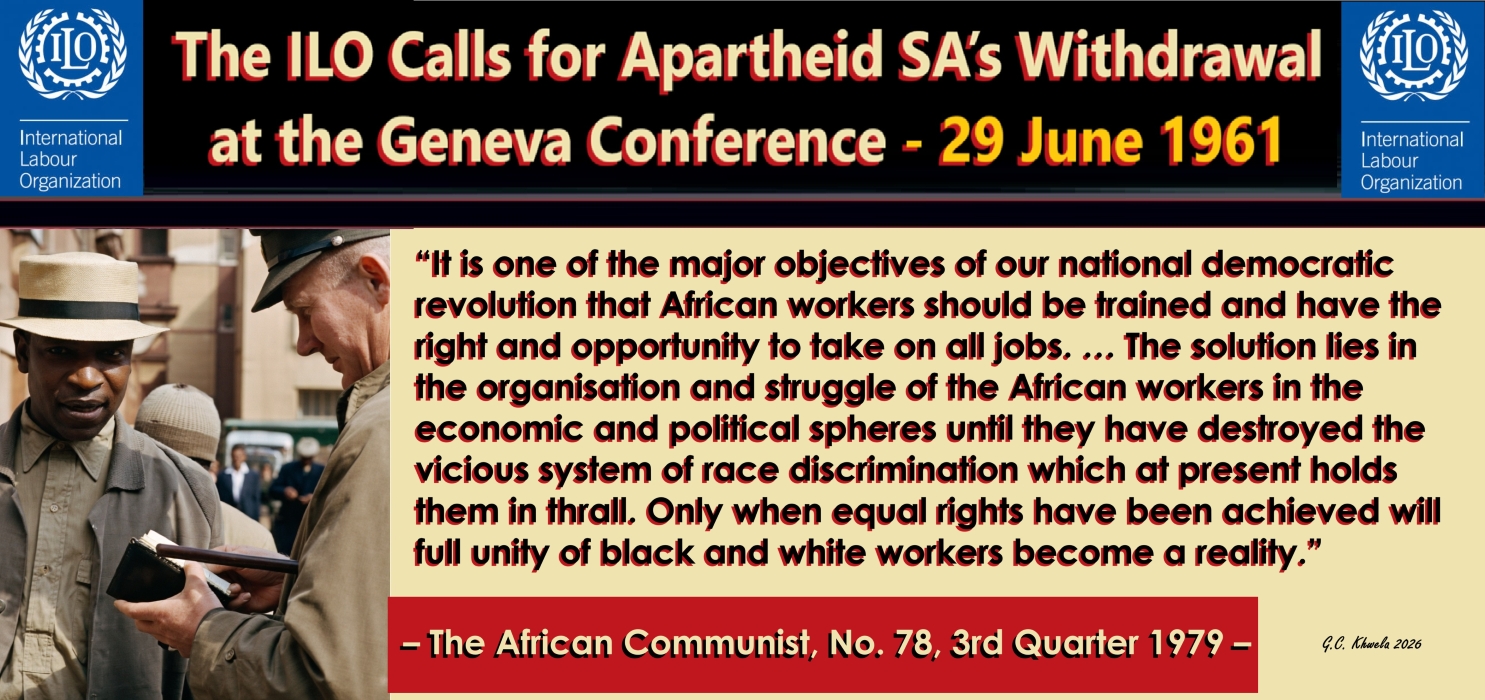
The ILO Calls for Apartheid SA’s Withdrawal at the Geneva Conference
On 29 June 1961, during its plenary conference in Geneva, the International Labour Organisation (ILO) adopted a resolution condemning the racial policies of the South African government and calling for South Africa’s withdrawal from the organisation, by 163 votes to nil, with 29 abstentions. The ILO is the international organisation responsible for drawing up and overseeing international labour standards. It is the only “tripartite” United Nations (UN) agency that brings together representatives of governments, employers and workers to jointly shape policies and programmes promoting Decent Work for all.
This action was primarily prompted by the international outcry following the Sharpeville massacre in March 1960 and a drastic shift in geopolitical representation within the UN and ILO. The fatal shooting of 69 peaceful African protesters by South African police spotlighted the extreme violence used to enforce apartheid. This drew immediate condemnation from the UN Security Council and global bodies. By 1960–1961, a large, newly independent wave of African member states joined the ILO and they formed a unified, powerful voting bloc dedicated to dismantling colonial and segregationist policies.
South Africa’s legislative frameworks systematically funnelled Black workers into cheap, segregated manual labour. The ILO officially classified these apartheid labour restrictions as a system of state-sponsored forced labour. The continuous pressure originating from this 1961 resolution eventually forced South Africa to announce its official withdrawal from the International Labour Organisation (ILO) in 1964. The apartheid regime remained isolated from the body for 30 years until the fall of apartheid in 1994.
The 1961 ILO resolution set off a geopolitical chain reaction that shattered South Africa’s diplomatic immunity, transitioning the country from a heavily criticised state into an isolated international pariah. While the apartheid government initially dismissed the resolution with defiance, the decree profoundly impacted the regime’s economic, political, and internal labour architecture over the following decades. The 1961 resolution built an unyielding momentum. By 1963, the ILO Governing Body physically excluded South African delegates from taking the floor or attending key trade meetings. Facing imminent constitutional suspension, the regime officially withdrew from the ILO in March 1964.
This served as a structural blueprint for other international bodies. The regime was subsequently pushed out of, or suspended from, the World Health Organization (WHO), UNESCO, and the International Olympic Committee (IOC), stripping the government of its global legitimacy. The resolution forced the ILO to launch its “Programme for the Elimination of Apartheid in Labour Matters” in 1964. For three decades, the ILO published a mandatory annual special report meticulously documenting the regime’s human rights abuses, ensuring the global community could not ignore them.
The global focus shifted from mere verbal condemnation to direct material action. For instance, the ILO actively mobilised political and financial support for South African liberation movements (such as the African National Congress (ANC) and banned democratic trade unions, particularly the South African Congress of Trade Unions (SACTU). By isolating South Africa, the ILO effectively attacked the regime’s economic engine – it’s strictly controlled, segregated workforce. To combat severe skills shortages caused by global economic boycotts, the regime was eventually forced to soften its rigid labour laws.
The softening of its rigid labour laws were a consequence of the 1978 Wiehahn Commission, which legally recognised Black trade unions for the first time. The regime intended for these reforms to pacify global critics and regulate Black labour. Instead, it backfired. Legal unionisation allowed millions of Black workers to organise legally, turning the labour sector into a powerful, uncontrollable domestic weapon that crippled the apartheid economy from the inside out. The 1978 Wiehahn Commission, which tabled its historic interim report in May 1979, fundamentally altered domestic labour law by granting full statutory industrial citizenship to Black workers for the first time.
Appointed by the apartheid state following the massive 1973 Durban Worker Strikes and the 1976 Soweto uprising, the commission aimed to co-opt and control rapidly multiplying, unregulated Black unions. Instead, the resulting amendments to the Labour Relations Act permanently broke the racial monopoly over organised labour. The commission extended freedom of association to all employees in South Africa, completely independent of race, sex or ethnic origin. Black trade unions were permitted to legally register with the state. Registration gave them legal status, allowed them to access statutory collective bargaining forums, and granted them a regulated right to strike.
The apartheid state initially intended to use the registration process to monitor, restrict and suppress radical elements within Black labour. However, this backfired. Legalisation allowed these bodies to organise openly, rapidly building massive shop-floor power. The commission had recommended the total abolition of statutory “job reservation” – the legal framework under apartheid that strictly safeguarded high-paying, skilled, and managerial positions exclusively for white workers. Employers were legally permitted to train, promote, and pay Black African workers for highly skilled technical positions. This change was heavily driven by severe white labour shortages and international corporate pressure from frameworks like the Sullivan Principles.
The commission replaced the old Industrial Tribunal with a specialised Industrial Court. This court was given extended powers to hear industrial litigation and resolve disputes between employers and workers. For the first time, Black workers and their trade unions could take corporate employers and state entities to court over “unfair labour practices”. They successfully utilised the apartheid regime’s own legal machinery to protect workers against victimisation and unfair dismissals. Moreover, the commission formed the National Manpower Commission (NMC), a centralised state body designed to constantly monitor, research and advise the government on changing labour market trends, union dynamics and workforce development.
Ultimately, as noted by contemporary historians, the Wiehahn Commission inadvertently granted Black South Africans industrial citizenship long before they won political citizenship. This legislative opening paved the way for massive labour federations like the Federation of South African Trade Union (FOSATU) and later the Congress of South African Trade Unions (COSATU) to mobilise millions of workers, blending workplace struggles directly with the broader liberation struggle to break the apartheid state.
Meanwhile, the 1978 Riekert Commission, which was the socio-political twin to the Wiehahn Commission, focused on granting structural rights to Black workers inside the workplace, the Riekert Commission was engineered to modernise and aggressively tighten the state’s “influx control” system outside the workplace. Its core role was to divide the Black population into two distinct legal groups, using a “carrot-and-stick” strategy to create a privileged Black urban middle class while sealing off the rural masses. The commission recognised that the booming South African economy desperately required a stable, skilled and permanent urban workforce, rather than the fluctuating migrant labour system.
To achieve this without abandoning apartheid, Riekert divided Black South Africans into two categories: the “Insiders”, which were Urban Qualified Black workers who already possessed legal residential rights under Section 10 of the Blacks (Urban Areas) Consolidation Act (e.g., those born in a city or who had worked for one employer for 10 years) were given preferential treatment; and the “Outsiders”, who were Rural/Homeland Masses, consisting of individuals that were living in the impoverished Bantustans or “homelands” (rural reserves) that were classified as foreign citizens and systematically barred from entering white urban centres.
In order to neutralise the revolutionary energy that had fuelled the 1976 Soweto Uprising, the commission recommended a series of urban privileges aimed at creating a pacified Black middle class: The strict rule stating that an urban-qualified Black person could not remain in a “white” city for more than 72 hours without working was scrapped. “Insiders” were then permitted to move freely between different towns and switch jobs within urban areas without losing their Section 10 permanent urban status, provided they had approved housing and employment. For the first time, qualified urban workers were legally permitted to live with their families in the townships.
While urban insiders gained mobility, the Riekert framework drastically intensified the penalties and surveillance on rural migrants trying to escape poverty. Instead of just arresting individual Black migrants on the street for not carrying a passbook, the state shifted the financial penalties to employers and landlords. White businesses caught hiring an unregistered “illegal” rural worker, or township landlords renting them a room, faced massive, crippling statutory fines. This made it virtually impossible for rural migrants to secure informal survivalist work or shelter in the cities.
However, the Riekert Commission ultimately failed because the structural contradictions of apartheid could not be managed by bureaucratic division. The influx of rural people into informal settlements outpaced state police capacity, forcing the regime to entirely abolish the hated pass laws less than a decade later in 1986.
The reaction of labour entities to the 1961 ILO resolution and the later Wiehahn reforms split sharply along racial lines. While progressive Black and non-racial unions leveraged these developments to build global and domestic resistance, white conservative unions reacted with hostility and fear. As a non-racial federation aligned with the liberation struggle, the Congress Alliance, SACTU strongly welcomed the ILO resolution. Because SACTU had affiliated with the pro-socialist World Federation of Trade Unions (WFTU), it actively used international platforms to lobby the ILO and UN to completely isolate the apartheid regime.
In response to SACTU’s global agitation, the apartheid state ruthlessly crushed the organisation internally. By 1965, through widespread bannings, detentions, and the recruitment of its leadership into the ANC’s armed wing, Umkhonto we Sizwe (MK), SACTU was effectively forced into exile. From abroad, it spent the 1960s and 70s operating external missions to ensure the ILO maintained its uncompromising stance against South Africa. From exile, SACTU viewed the state’s sudden labour reforms with intense scepticism. It dismissed the commission as an apartheid “trap” engineered to co-opt, register, and monitor Black workers while attempting to pacify international critics. SACTU continued to advocate for absolute political liberation over incremental factory-floor reforms.
Unlike the exiled SACTU, newly emerging internal federations like the Federation of South African Trade Unions (FOSATU), which was formed in 1979 and later the Congress of South African Trade Unions (COSATU), formed in 1985, chose to tactically exploit the new legal space created by the Wiehahn reforms. While the apartheid state demanded that unions register on a strictly segregated racial basis, these new independent unions refused. They utilised the new legal right to strike and access to the Industrial Court, but kept their structures fiercely non-racial. COSATU heavily utilised the global framework originally set off by the 1961 resolution. They actively collaborated with the ILO’s anti-apartheid committees, using global solidarity and international financial support to protect domestic activists and launch massive political stay-aways that crippled the state.
Right-wing, exclusively white unions – most notably represented by the South African Confederation of Labour (SACOL) – reacted to the post-ILO developments and the Wiehahn Commission with barely suppressed fury and panic. SACOL fiercely opposed the legalisation of Black trade unions and the scrapping of job reservation. White labour leaders publicly warned the government that lowering the racial “colour bar” would undercut white workers’ wages, flood skilled industries with cheaper Black labour, and hand a massive political weapon to the liberation movement. Their resistance temporarily delayed reforms in conservative sectors like mining, though they ultimately failed to stop the tide of integration.
Following its launch in December 1985, COSATU strategically weaponised the ILO’s structural isolation of South Africa to bypass domestic censorship and drive the global economic sanctions campaign. By operating within the international labour framework established by the 1961 and 1964 ILO declarations, COSATU coordinated with international allies to isolate the apartheid regime. Under the updated mandates of the ILO’s “Declaration concerning Action against Apartheid”, the ILO Director-General published a mandatory, annual Special Report tracking South Africa’s labour abuses. COSATU systematically gathered raw, forbidden intelligence on the ground – such as details on the torture of unionists, corporate exploitation and police crackdowns – and fed it directly to the ILO.
This neutralised the apartheid government’s state-of-emergency media censorship and provided the factual framework the ILO used to officially recommend global disinvestment. COSATU also utilised its relationship with the ILO to coordinate directly with influential international trade unions, including the British Trades Union Congress (TUC) and the American AFL-CIO. By aligning with these organisations through the ILO framework, COSATU triggered international worker solidarity actions that enforced sanctions on the ground. Dockworkers in international ports frequently refused to unload South African goods or load cargo bound for South Africa. COSATU also collaborated with global unions to pressure major multinational corporations (such as General Motors, Barclays, and Mobil) to completely divest their capital from South Africa.
Under South African internal security laws, openly calling for economic sanctions or foreign disinvestment was a treasonable offense punishable by death or heavy imprisonment. To protect its leadership from execution or assassination, COSATU tactically endorsed the ILO’s official policy resolutions on comprehensive mandatory sanctions. By stating that they supported the “international labour consensus” rather than initiating the demand themselves, COSATU organisers used the ILO as a legal shield to campaign for economic isolation while operating inside South African borders.
When the apartheid regime attempted to pass heavily restrictive amendments to the Labour Relations Act (LRA) in 1988 to strip Black unions of their right to strike, COSATU took the unprecedented step of lodging an official complaint directly with the ILO. Despite South Africa not being a member state, COSATU’s pressure forced the ILO to establish a formal “Fact-Finding and Conciliation Commission on Freedom of Association”. This move forced the regime to back down on its harshest crackdowns to avoid further catastrophic global banking and trade sanctions.
In response to the Wiehahn and Riekert Commission Reports, the South African Communist Party (SACP, maintained that “Wiehahn has so far not received the welcome he expected. The conference of the International Metal Federation, representing 13½ million members, condemned his report. The British TUC refused to meet Wiehahn. The ILO has condemned the government’s new bill. But we still have a lot to do to ensure that the Government’s new industrial strategy is completely defeated.”
Sources:
Wikipedia.
South African History Online (SAHO).
Editorial Notes, “Workers Fight Back”, The African Communist, No. 78, Third Quarter 1979.
R..S. Nyameko, “The Wiehahn Report: State Plan to Shackle African Trade Unions”, The African Communist, No. 79, Fourth Quarter 1979.
J Piron, “The Unfair Labour Practice: A Chronology of Developments”, Indicator SA, Vol.2, No. 3, October 1984.
W. J. Vose, “Wiehahn and Riekert Revisited: A Review of Prevailing Black Labour Conditions in South Africa”, International Labour Review, Vol. 124, No. 4, July-August 1985.
SAHA, “Tightening the Noose With Labour Reforms”, South African History Archive (SAHA), 1989.
AAM, “Trade Unions Against Apartheid”, Forward to Freedom: The History of the British Anti-Apartheid Movement 1959 – 1994.
Urmila Bhoola, “National Labour Law Profile: South Africa”, Resolve Workplace Equity, March 2002.
Alex Lichtenstein, “Black Workers and the Wiehahn Commission Reforms in Late Apartheid: Corporatism or Shop-Floor Power?”, Wits Institute for Social and Economic Research (WISER), February 2013.
Alex Lichtenstein, “From Durban to Wiehahn: Black Workers, Employers, and the State in South Africa during the 1970s”, Paper Presented at Wits Institute for Social and Economic Research (WISER), University of the Witwatersrand, 25 February 2013.
Renee Grawitzky, “The Role of the ILO During and Ending Apartheid”, ILO History Project, May 2013.
Gerald Monyatsi, “The Role and Challenges of Trade Unions in Post-Apartheid South Africa: The Case of the National Education Health and Allied Workers Union”, North West University, Master in Industrial Relations, November 2013.
Reatile Moagi Moncho, “The Aim and Legacy of the Commission of Inquiry into Labour Legislation (Wiehahn Commission), 1977-1980”, University of Pretoria: Masters in Historical and Heritage Studies, 2020.
Edward Webster and Kally Forrest, “The Role of the ILO During and After Apartheid”, Labour Studies Journal, Vol. 46, Issue 4, 31 October 2020.
G. Seabela Motsane, “A Brief History of Black Labour Control in South Africa: Migrant Labour and Recruitments, 1890s-1970s, Ditsong: National Museum of Cultural History, 15 June 2021.
COSATU, “The Story of a Giant COSATU’s 40 Year Journey”, Congress of South African Trade Unions (COSATU) Media Publication, 2023.
Castro Khwela
Good morning fellow Compatriots!🙏🏾✊🏾👊🏾
Discover more from CASTRO KHWELA
Subscribe to get the latest posts sent to your email.