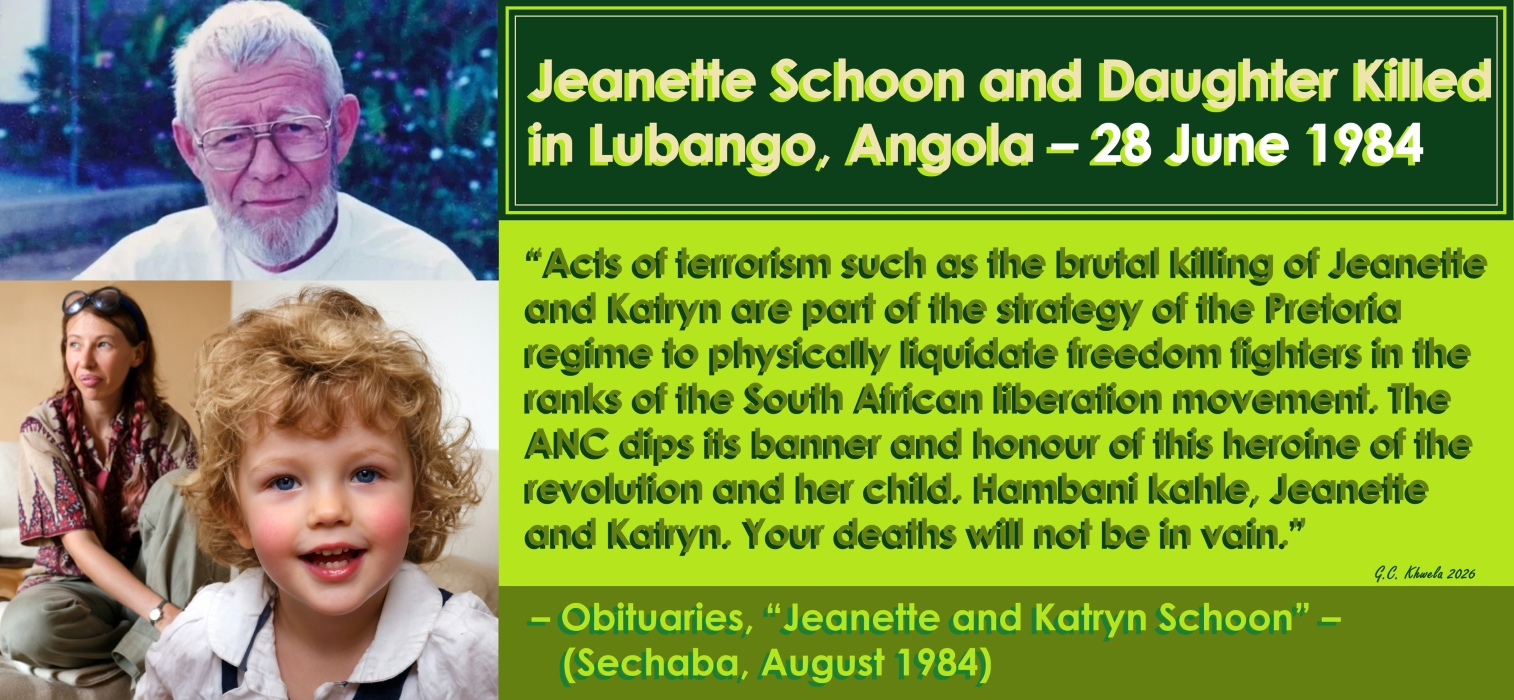
Jeanette Schoon and Daughter Killed in Lubango, Angola
On this day 28 June, in 1984, Jeanette Schoon, who was former member of South African Congress of Trade Unions (SACTU), and her six-year-old daughter, Katryn, were killed by a letter bomb at their Lubango house, in northern Angola. The explosion occurred in Schoon’s kitchen, while Jeannette’s three-year-old son, Fritz, was also in the kitchen at the time, but he was not hurt.
The African National Congress’ (ANC) anti-apartheid revolutionary, Marius Schoon, Jeanette’s husband, was the target of the bombing because of his involvement in the revolutionary struggle. Marius was banned in South Africa and had initially taken his family into exile in Botswana, but they moved to Angola because they thought it would be safer there. The explosion was facilitated by Craig Williamson, a spy for the apartheid Security Branch police who pretended to be a family friend.
South African political activist and teacher Marius Schoon became a member of the South African Congress of Democrats (COD) in association with the African National Congress (ANC) at the University of Witwatersrand in Johannesburg while undergoing his postgraduate studies. In September 1964, Marius Schoon plotted to bomb the Hospital Hill Police Station in Johannesburg. His Umkhonto we Sizwe (MK) Unit included Mike Ngubeni (the Unit Commander), Sholto Cross and Raymond Thoms. An undercover police agent provocateur infiltrated Schoon’s Unit and supplied them with a fake bomb with a view to entrapment. Schoon was arrested and sentenced to 12 years in Pretoria Local Prison. Schoon’s first wife Diana committed suicide while Schoon was in prison.
As an Afrikaner himself, Schoon was more hated than other anti-apartheid revolutionaries by the Afrikaner National Party government which had instituted the apartheid system. Authorities prevented him from attending his late wife’s, Diana’s, funeral and from visiting their daughter Jane. While in prison, in 1974, Marius and Denis Goldberg, became concerned about Fischer’s health and suspecting that he would not receive the proper care he needed, they kept a detailed diary of Fischer’s medical care which was subsequently smuggled out of prison.
Authorities released Schoon from prison in 1976 having served his full term without remission, with requirements to restrict his movements. Authorities declared Schoon a banned person, which meant he was prohibited from leaving home between 18:00 and 06:00 and forbade him to teach or associate with other political activists.
In June 1977, Schoon married Jeanette Curtis, a banned student and trade union activist. Jeanette Curtis began active opposition to the injustice of apartheid in 1966, at the age of 18, and in the final year of school in Johannesburg, she took part in a campaign against the Sabotage Act. From 1967 to 1970 she was a student at the University of the Witwatersrand, where she played an active role in the National Union of South African Students (NUSAS), holding key positions in the organisation, and the office of vice-president in 1971. During those years she took part in many political campaigns, such as against forced resettlement of African people, segregation in education and for the rights of political prisoners.
From 1971 to 1975 she played an important part in the movement to build Black trade unions, and helped establish a trade union newspaper, “Isisebenzi”. In 1974, Jeanette’s passport was confiscated and was in 1975 detained for three months under Section 6 of the Terrorism Act. Shortly after her release, she was banned, together with a large number of fellow trade unionists. In 1977 she married Marius Schoon, a recently released political prisoner. The day after their marriage, which was illegal since both were banned and not allowed to meet, they skipped the border to Botswana.
The couple, fearing for their safety in South Africa, moved first to the capital of Botswana, Gaborone, then to Molepolole, teaching at Kgari Sechele Secondary School, and later back to Gaborone where they jointly worked for the International Volunteer Service, while at the same time serving within the Regional Internal Political Reconstruction Committee and later the Senior Organ of the ANC. Marius also took part as a Cultural Worker in Medu Arts Ensemble, as part of the photography team together with Baleka (Mbete) Kgosietsile, Patrick Fitzgerald and Thele Moema. They had two children: Katryn (1978) and Fritz (1981). There was also a report that in 1981, Dirk Coetzee of the Section C Vlakplaas Unit, was supplied with a revolver and ammunition by Brigadier Willem Schoon to kill Marius, in Molepolole, but the mission failed.
During this time, internally within the ANC, the Schoons broke Craig Williamson’s cover. Prior to Williamson’s ‘coming out’ as an apartheid police agent, he visited the Schoons in Botswana and stayed with them as a house guest on a number of occasions, using his friendship with Jeanette to gain access to their circle of friends and associates. Nobody suspected that he could have been operating as an agent for the state.
In 1975, while on the National Executive of the NUSAS, he met and befriended a fellow member of the Executive, Jeanette, and was later employed by NUSAS on a full-time basis and was perfectly positioned to carry out his spying role as his NUSAS job meant that he travelled to university campuses across the country to organise students on behalf of the student organisation.
Craig Williamson was one of the outstanding apartheid government spies, named later publicly and confirmed as a highly successful infiltrator of the liberation movements. This allowed the ANC leadership to attempt to manipulate Williamson covertly for the Movement’s ends for a time. After a fellow security policeman who had known Williamson since their days at Wits University defected from the police and threatened to expose him, Williamson emerged from his double role, to work overtly as a Major for the security police under Colonel Goosen.
Later, in 1983, following a warning from the United Kingdom’s High Commissioner (Ambassador) in Botswana that Marius was a target for assassination by the apartheid government security forces, the ANC redeployed the Schoon family the pair to Lusaka. In the short time they were in Zambia they felt threatened and frequently vacated their accommodation for fear of South African security force raids. In December 1983, at the behest of the ANC, they moved to Lubango, in Angola, to teach English at the university there.
Both Marius and Jeanette Schoon began working as university lecturers with the ANC in Lubango, Angola, in 1984. On 28 June 1984, while Marius was away in Luanda, Jeanette Schoon collected – either from their personal post-box or from the University mail office – and carried home a parcel that contained a bomb, which exploded immediately on opening. The explosion killed her and their daughter Katryn instantly. Their son Fritz, a toddler at the time, survived and was found wandering around the house. He never fully recovered from the trauma of seeing his mother and sister murdered before his eyes and developed epilepsy as a direct consequence.
According to Marius Schoon, the organisation had not informed them about the situation in Angola before they arrived. The murder of Jeanette and Kathryn Schoon took place as the rest of the region was locked into the aftermath of the mutinies. It was a sad reminder that the ANC Security Department did not function as it ought to. Instead of guarding the security of ANC members in Angola, it was caught up in internal matters. The Angolan Interior Minister, Rodrigues Kito, advised the ANC to downplay the killing of Jeanette and Katryn Schoon so as to avoid having everybody up in arms.
The perpetrators Craig Michael Williamson and Roger Howard Leslie “Jerry” Raven, who manufactured the bomb, appeared before the Truth and Reconciliation Commission (TRC) to apply for amnesty in the 1990s. Apartheid spy Craig Williamson told the TRC that Ruth Slovo (née First) and the Schoons had been targeted because of a perception that existed amongst security forces that the ANC and SACP could not function properly “without white brains”. Williamson maintained that “It was a basic fundamental belief that… if it weren’t for the ‘blanke kommuniste’ (white communists) then we wouldn’t actually have this problem we’ve got.”
Williamson, said he believed she and her husband, ANC revolutionary activist Marius Schoon, had been teaching English to Cuban soldiers in Angola. According to Williamson, this could have been useful to the Cubans in their manning of air defence installations in the Lubango area of Angola, where the Schoons lived. Williamson explained that although he had been friends with the Schoons while at the University of the Witwatersrand in the early 1970s, he still viewed them as the enemy because of their involvement with the ANC.
Roger Raven, applied for amnesty for the death of South African Communist Party (SACP) stalwart, ANC activist and Joe Slovo’s wife Ruth First, as well as ANC activist Marius Schoon’s wife Jeanette and daughter Katryn. Raven denied that he knew for whom the bombs were intended when he was ordered by his commander, Williamson, to insert explosives into intercepted letters. He only found out later when Williamson congratulated him for successfully detonating the bombs, resulting in the deaths of First in 1982 and the Schoons in 1984.
In the First incident, Raven said Williamson gave him an official envelope containing a letter which had been intercepted en route from Lesotho. He said he inserted layers of sheet explosives that had the appearance of blotting paper and an electrical circuit into the envelope. When the envelope was opened from either end the circuit would be closed, triggering the device. Referring to the attack on the Schoons, he said the bomb had been assembled in the same way and that he did not know the identity of the recipient at the time.
The TRC granted amnesty to the applicants. However, following the granting of amnesty to both applicants, the Schoon and Slovo families launched review proceedings against the granting of amnesty. The Committee did not oppose the application and chose to abide by the judgment of the High Court. The grounds for review were that the Amnesty Committee had failed to properly consider the evidence relating to the applicants’ knowledge of the Schoons’ domestic arrangements abroad.
Secondly, the Schoon and Slovo families argued that the Amnesty Committee had failed to properly consider the requirements of proportionality in the killing of a six-year-old child. Furthermore, that the Committee should have refused amnesty on the grounds that the statement that “it had served the Schoons right that their daughter had been killed because they had used her as their bomb disposal expert” indicated personal malice or spite. Thirdly, that the Amnesty Committee had misdirected itself in finding that the Schoons were still engaged in political work, thereby justifying its conclusion that the bomb was sent bona fide with the object of countering or resisting the struggle.
The fourth ground for review was that the sending of a letter bomb to kill the Schoons had not been an act associated with a political objective, as the Security Branch police had already succeeded in driving the Schoons out of South Africa. And finally, that there had been failure to make full disclosure in respect of a wide range of evidence given by Williamson and Raven. This related to the identification of the targets to whom the bombs were sent, the manner in which the bombs were packaged, the construction of the device itself, the involvement of General Petrus Johannes Coetzee and the precise role played by each of the applicants. Coetzee was believed to had devised and managed the assassinations and bombings that killed Ruth First, Jeanette Schoon and her daughter Katryn, and maimed Albie Sachs, despite disclaimers recorded during the TRC hearings where he later sought amnesty.
After the bombing, Marius Schoon and son moved several times, first to Tanzania, then to Zambia and eventually to Ireland. In 1986, Schoon married Sherry Mclean and returned to South Africa in 1990 after the ban on anti-apartheid parties was lifted. He died on 7 February 1999 from lung cancer, aged 61.
According to newspaper reports, in November 2007, the twenty-six-year-old son of Marius and Jeanette Schoon, Fritz Schoon, moved to sequestrate Craig Williamson after the latter failed to honour a deal with the Schoon and the Slovo families to pay towards their legal and other costs. In his affidavit, Fritz Schoon argued that Williamson was evading the payment of his indebtedness by either failing to disclose or concealing property and assets that he owned. On 27 May 2008 the judge ordered the sequestration of Williamson’s estate.
In the obituary section of Sechaba, its official journal, the ANC declared the following, “Acts of terrorism such as the brutal killing of Jeanette and Katryn are part of the strategy of the Pretoria regime to physically liquidate freedom fighters in the ranks of the South African liberation movement. The ANC dips its banner and honour of this heroine of the revolution and her child. Hambani kahle, Jeanette and Katryn. Your deaths will not be in vain.” Marius Schoon died without forgiving Williamson for the attack and spurned an offer by the former spy’s lawyer to attempt a reconciliation between the two men. During his testimony Schoon said the only time he ever wished to see Williamson again was “across the sights of an AK47 rifle”.
Sources:
Wikipedia.
South African History Online (SAHO).
African National Congress, “Further Submissions and Responses by the African National Congress to Questions Raised by the Commission for Truth and Reconciliation”, 12 May 1997.
Jacques Pauw, “Into the Heart of Darkness: Confessions of Apartheid’s Assassins”, Jonathan Ball, 1997.
SAPA, “London Bombers Were Stopped by Police on Way to ANC: TRC Hears”, South African Press Association, 23 September 1998.
SAPA, “Ruth First Killed in Frustration as Slovo Eluded Assassination”, South African Press Association, 17 September 1998.
Patrick Ricketts, “Routes to Freedom ‘The Pipeline to Freedom’: Botswana & the Liberation Struggles in Southern Africa – People, Places & Events”, 2008.
Maren Saeboe, “State of Exile: The ANC and Umkhonto we Sizwe in Angola, 1976 – 1989”, Master of Arts Dissertation, University of Natal, December 2002.
Gregory Houston, “Chapter 15: The Post-Rivonia ANC and SACP underground”, The Road to Democracy in South Africa, Vol. 1, Zebra, 2004.
Obituaries, “Jeanette and Katryn Schoon”, Sechaba, August 1984.
Truth and Reconciliation Commission, “Truth and Reconciliation Commission of South Africa Report”, Vol. 6, 21 March 2003.
Truth and Reconciliation Commission, “Truth and Reconciliation Commission of South Africa Report”, Vol. 2, 29 October 1998.
Robin Binckes, “Vlakplaas: Apartheid Death Squads, 1979 – 1994”, Pen and Sword, 2018.
John R. Schlapobersky, “When They Came for Me: The Hidden Diary of an Apartheid Prisoner”, Berghahn, 2021.
Castro Khwela
Good evening fellow Compatriots!🙏🏾✊🏾👊🏾
Discover more from CASTRO KHWELA
Subscribe to get the latest posts sent to your email.