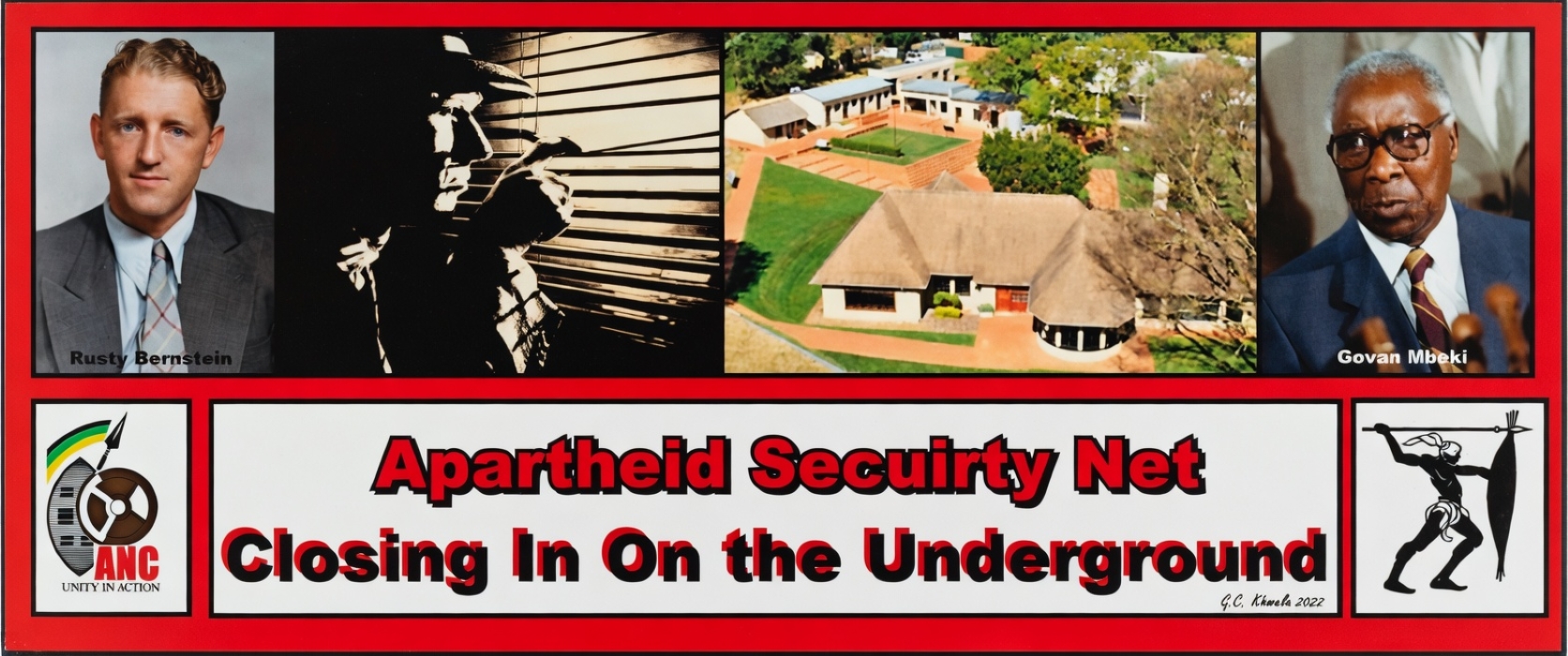
Apartheid Security Net Closing In On the Underground
On Saturday, 6 July 1963, at approximately 02:00 in the morning, Umkhonto we Sizwe (MK) Natal Regional Command member, Billy Nair, was arrested in his Durban home. The news spread like wildfire among the underground activists throughout the country, and as a result, when MK High Command member Ian David Kitson arrived for a meeting at Liliesleaf Farm on the same day, he commented that he was surprised to see his comrades being there, as he thought everyone was moving base following Billy Nair’s arrest.
Responding to Kitson, the Political Commissar of the National Command, Walter Sisulu, mentioned that it was the last time that they were meeting at the Farm. The meeting was called to finalise the discussion on the guerrilla warfare plan, which Lionel “Rusty” Bernstein had made adjustments to. Bernstein had placed an alternative proposal centred on limited attacks on isolated border outposts, after which guerrillas were expected to retreat into bases in the British protectorates.
This was anticipated to lead to an international incident that would precipitate strikes and a serious political crisis. According to Bernstein, the only alternative to the proposal was a protracted guerrilla war, which wouldn’t succeed given the might of the apartheid South African state and its allies. The apartheid state had thrown overboard every possibility of democratic rule and for that reason there was little, if any, room for change besides revolutionary mass action and armed resistance leading to victory by military means. This was held to be possible despite the alliance between the southern African racist settler states.
The first person to respond to the proposal was Govan Mbeki, who argued that an armed invasion and a guerrilla war were the only ways the regime could be removed. Mbeki was basing himself on the plan and direction that they had developed as part of the Umkhonto we Sizwe (MK) High Command, which considered four types of violent activities: sabotage, guerrilla warfare, terrorism and open revolution.
The consideration was that for a small and fledgling army, open revolution was inconceivable, while terrorism unavoidably reflected poorly on those who employed it, as it often undermined public support that it could otherwise mobilise. The only possibility was guerrilla warfare, but since the African National Congress (ANC) had been reluctant to embrace violence at all, it made sense to start with the form of violence that would inflict the least harm against individuals, which was sabotage.
Since it did not involve the loss of life, sabotage offered the best hope for reconciliation among the races afterwards, as the intention was not to initiate a bloody war between whites and blacks. The consequences of a bloody war could be long-lasting, as could be seen with the animosity between the Afrikaner and the English, which still remained acute fifty years after the Anglo-Boer war had ended.
If a civil war between white and black were to be provoked, it would be detrimental to cordial race relations. Moreover, sabotage had an added advantage that it required less manpower than other forms of violence. Therefore, the strategy was to make selective raids against military installations, power plants, telephone lines and transportation links, which were targets that would hamper the military effectiveness of the state, in addition to frightening supporters of the National Party, scare away foreign investors, thus weakening the apartheid economy.
The expectation was that due to the impact of these activities the apartheid regime would be forced to the negotiating table. However, if sabotage failed to produce the desired results, then MK would consider the next phases, which were guerrilla warfare and terrorism. According to Mbeki, the approach they were supposed to adopt was that only mass struggle with an armed component could hope to make a real impact and rejuvenate mass involvement. In order to draw in the masses of the population, the political wing should arouse the people to participate in the struggles that were designed to create an upheaval throughout the country. Since the enemy was well organised as a well-armed state supported by the bulk of the white population, efforts would have to be undertaken through international campaigns to isolate the country, which will eventually result in victory.
After Mbeki’s input, the meeting ran out of time, as Bernstein had to leave. However, Denis Goldberg insisted that the meeting could not end without an agreement on an alternative venue for the follow-up meeting, as it was going to be difficult to get people back together again. When Bob Hepple suggested returning to Liliesleaf Farm on 11 July 1963, Bernstein jumped up and shouted, “Never again!” When Hepple insisted that it should just be for once, “The very last time!” Bernstein stood up as it was getting dark outside and repeated, “But definitely never again!” and ran to his car.
Indeed, Bernstein was correct, as the apartheid Security Branch team under Lieutenant van Wyk was consistently surveying Rivonia to identify the exact spot where the underground meetings were taking place. Naturally, the apartheid Security Branch Commander, General van den Bergh, wanted the Umkhonto Headquarters found as soon as yesterday. Eventually a huge number of vehicles were deployed to patrol all the roads leading to small farms in the Morningside, Rivonia and Witkoppen areas.
Historical and intelligence evidence confirms that Apartheid Security Branch Commander General Hendrik van den Bergh and his combined intelligence agencies were already aware of the underground uMkhonto we Sizwe (MK) networks operating in the area well before the raid. The heavily coordinated deployment of police vehicles to patrol and cordon off the roads around Morningside, Rivonia, and Witkoppen on 6 July 1963 was not a random exercise; it was part of a targeted, long-term intelligence operation.
For decades, apartheid propaganda maintained that the eventual raid on Liliesleaf Farm on 11 July 1963 was a sudden stroke of luck resulting from a vague, last-minute tip-off by an informant. However, declassified records and research by historians like Garth Benneyworth prove otherwise. The operation was the culmination of a massive surveillance effort initiated in 1962 involving the apartheid Security Branch, Republican Intelligence (RI), the South African Defence Force (SADF) and specialised radio direction-finding units.
Following Nelson Mandela’s arrest in August 1962, information extracted from his personal diary and other seized materials gave the Security Branch early leads to focus heavily on the smallholdings in Johannesburg’s northern agricultural areas. The intensive road patrols and vehicle deployments five days prior to the raid were used to actively narrow down the precise location of the high command, map out escape routes, and monitor the movement of suspected vehicles – such as Arthur Goldreich’s distinct Citroën. Rather than bumbling into the area, Van den Bergh’s operatives utilised local informants (including carefully positioned neighbours and children) to visually confirm who was entering and exiting the properties.
By the time the Security Branch drove onto Liliesleaf Farm in a disguised laundry van on 11 July 1963, they were executing a highly planned interdiction, effectively closing a trap they had spent weeks tightening around Rivonia. Rather than relying on a single tip-off, General van den Bergh’s Security Branch cross-referenced data from several specific informants to map out the high command. The primary informants and sources identified by historians and archival records included Gerard Ludi (Agent Q-018) who was s deep-cover Security Branch spy who successfully infiltrated the South African Communist Party (SACP) and underground liberation structures. Gerard Ludi provided regular intelligence on the movements of senior leaders. He leaked critical operational details that helped the Security Branch understand that the MK High Command was operating out of the semi-rural northern suburbs of Johannesburg.
Another critical informant was George Mellis who was a local resident living at the nearby Rivonia Caravan Park. Mellis noticed an unusual and highly suspicious amount of traffic – particularly luxury vehicles driven by white drivers and carrying Black passengers – frequently entering and exiting the secluded farm area. He reported these details to his family, who passed the information directly to the police. Local property owners and domestic workers in the immediate Morningside and Rivonia area were also weaponised by the state. Local civilian assets – including children and domestic staff from adjacent smallholdings – were used to look over fences, keep visual logs of vehicles (like Arthur Goldreich’s Citroën), and confirm the presence of high-profile fugitives like Walter Sisulu.
Lower-level MK operatives and activists arrested in late 1962 and early 1963 confirmed what the apartheid Security Branch was looking for. Following the implementation of the 90-day detention law, the General Laws Amendment Act of May 1963, the Security Branch used intense psychological and physical torture to extract fragments of data. This law stripped activists of all legal protection, allowing the Security Branch’s newly formed “Sabotage Squad” (led by brutal interrogators like Theunis “Rooi Rus” Swanepoel) to use physical and psychological torture systematically.
While many did not know the exact address of Liliesleaf, they provided descriptive landmarks, such as “a gabled house on a smallholding in Rivonia”, which Lieutenant van Wyk and his handlers used to physically pinpoint the gate just days before the raid. The primary MK operatives, recruiters, and couriers whose extraction of information – intentionally or under extreme duress – compromised the northern Johannesburg networks included several individuals. Prominent among them was Bartholomew Moru Hlapane, who was remembered as one of the most devastating high-level turncoats in the history of the South African liberation struggle.
Unlike low-level couriers who broke under torture to reveal geographical landmarks, Hlapane was a member of both the ANC’s National Executive Committee (NEC) and the Central Committee of the South African Communist Party (SACP). His betrayal directly enabled the Security Branch to dismantle the National High Command of Umkhonto we Sizwe (MK), leading directly to the Rivonia raid on 11 July 1963, where leaders like Walter Sisulu, Govan Mbeki, and Raymond Mhlaba were captured.
Hlapane was detained under the 90-day detention law in 1963. While in solitary confinement, the Security Branch successfully broke him. Rather than merely giving up a few names to secure his release, Hlapane completely switched sides, becoming a deep-cover asset and a “professional” state witness for the apartheid regime. Because Hlapane retained his high-level political standing, he knew the identities, methods, and communication lines of the survivors who were trying to reconstitute MK.
Hlapane had joined the ANC in 1948. Over the next decade, he became a prominent organiser, featuring as a defendant in the massive 1956 Treason Trial alongside Nelson Mandela. By the early 1960s, as the ANC was banned and forced underground, Hlapane was elevated to the National Executive Committee’s National Secretariat, wherein he helped coordinate national policy, underground logistics, and communications between regional structures. He was one of the few officials with a bird’s-eye view of the ANC’s entire operational footprint.
In 1955 Hlapane was recruited into the underground SACP by Joe Slovo. Following the state-declared state of emergency, he was co-opted onto the elite Central Committee in late 1962. The SACP Central Committee was the core intellectual and financial engine driving the armed struggle. Hlapane was directly privy to secret funding routes, ideological directives originating from Moscow, and the overlap of personnel between the SACP and Umkhonto we Sizwe (MK).
Following his detention under the 90-day detention law in 1963, Hlapane’s deep organisational access was systematically weaponised by Apartheid Security Branch Commander General Hendrik van den Bergh. General van den Bergh did not want to expose him as a State Witness at the Rivonia Trial, as Bruno Mtolo’s evidence was considered sufficient to convict the Rivonia Trialists. Van den Bergh wanted to use Hlapane’s memory of the SACP and ANC NEC structures to act as the ultimate weapon for the apartheid state. Hence, he became the main tool in the destruction of the underground structures of the ANC, the SACP and Umkhonto we Sizwe in the following years after the Rivonia Trial.
“TRAITORS TO THE REVOLUTION!”
Sources:
A. Lerumo, “Forms and Methods of Struggle the South African Democratic Revolution”, The African Communist, No. 9, April/May 1962.
Nelson Mandela, “Long Walk to Freedom”, Abacus, 1994.
Gerard Ludi, “The Communisation of the ANC”, Galago, 2011.
Stephen Ellis, “External Mission: The ANC in Exile, 1960–1990”, Jonathan Ball, 2013.
Thula Simpson, “Umkhonto we Sizwe: The ANC’s Armed Struggle”, Penguin, 2016.
Garth Conan Benneyworth, “Trojan Horses: Liliesleaf, Rivonia (August 1962 -11 July 1963)”, Historia, Vol. 62, No.2, November,2017.
Garth Conan Benneyworth, “Reconstructing the Raid”, The Thinker, Vol. 80, 2019.
Paul S. Landau, “Spear: Mandela and the Revolutionaries”, Jacana, 2022.
Castro Khwela
Good evening fellow Compatriots!🙏🏾✊🏾👊🏾
Discover more from CASTRO KHWELA
Subscribe to get the latest posts sent to your email.