Joe Mamasela Uncovered Apartheid Agent
Forty-five years ago, on 28 July 1981, Joe Mamasela and his adopted brother, Chief Montampede (aka “Monde”), were driven between Selibe-Phikwe and Gaborone in a convoy of two cars containing African National Congress (ANC) personnel. In Gaborone, Mamasela and Monde were split up, with Mamasela being taken to Okavango Flats and his brother to Gaborone’s Broadhurst suburb. Towards the evening, Mamasela began insisting on being taken to see Monde, as he was supposed to get back to South Africa, and needed money for transport.
Mamasela was then taken by Elias Masinga to house number 404 in Broadhurst, where he found “Iotola”, whom he knew to be an Umkhonto we Sizwe (MK) cadre, and Monde, who seemed to be dazed. He appeared to be wearing clothes that were too large for him, which were different from the ones he was wearing in Selibe-Phikwe. When getting closer to Monde, Mamasela noticed signs of panic on his face. Apparently then, Monde was being held on suspicion of being an apartheid informer.
The following day, Mamasela was driven from Gaborone to Selibe-Phikwe to fetch his clothes and money, where he met his girlfriend, Priscilla. He then informed Priscilla that they, with Monde, had been kidnapped. Priscilla then promised him that she will phone the police, which she did, as the police came to raid the property at the Okavango Flats and arrested all the residents there, including Mamasela.
Under interrogation at the police station, Mamasela was told by one of the policemen that a corpse matching the description of his brother was picked up at Lobatse, and his remains were in the government mortuary. At the mortuary, Monde’s body was so charred that Mamasela could only identify him by a ring on his finger. Close to midnight, Mamasela was released by the Botswana police, and he managed to get a bakkie to carry him and his brother’s corpse to South Africa. Arriving at the border, which was then closed, he was allowed in, but at the South African side he was arrested by the apartheid police.
According to Mamasela, members of the apartheid Security Branch arrived the following day, and began working on him, trying to convert him to work for them. One of them told him to look at what the ANC was doing, when they were supposed to liberate him, they instead were killing people, burning them alive.
Despite all these events and different versions being told, the history of how Mamasela came to be an apartheid agent and an askari at Vlakplaas remained contentious. His version was that he became a student activist in his earlier years due to his interest in South African politics. He was later promoted to the position of Secretary-General of the South African Student Movement (SASM) at his school.
However, Mamasela further claimed that he joined the ANC in Botswana in 1977, after having been recruited by Snuki Zikalala, but was later arrested by security police. Mamasela’s account follows that he was tortured by the security police until he broke, giving information and agreeing to become an askari for the apartheid security forces. This implied that when he went to Botswana in July 1981, he was already operating as an apartheid agent, and the ANC was already aware of that fact.
An alternative account provided by journalist Jacques Pauw and another anonymous source stated that Mamasela became a police informant in 1979 after he had been arrested for housebreaking and theft. Pauw suggested that while Mamasela claimed his arrest was the result of his political activities, “there is evidence to suggest that he was involved in common crime and that was the real reason for his detention and interrogation. A charge of armed robbery had been opened against him in Randfontein … but according to police reports, charges were withdrawn.”
He then infiltrated the ANC in Botswana and underwent intelligence training. After his cover was blown, Mamasela escaped with his brother’s corpse in a bakkie and became part the vicious apartheid unit at Vlakplaas. Subsequently, Mamasela was involved in the murders of at least 40 anti-apartheid activists during his 12 years as an askari, many of them committed while he was based at the notorious Vlakplaas and later as part of a death squad that operated out of the Northern Transvaal Security Branch.
Joe Mamasela became one of South Africa’s most notorious askaris – a term used during apartheid to describe former liberation fighters or student activists who turned into informants and deadly operatives for the apartheid regime’s security forces. Operating primarily out of the infamous Vlakplaas counter-insurgency unit under commanders like Dirk Coetzee and Eugene de Kock, Mamasela was transformed into a ruthless executioner. He confessed to participating in the abduction, torture and murder of anti-apartheid activists during the 1980s and early 1990s.
Mamasela earned a reputation for being an exceptionally cold and willing killer. His former Vlakplaas commander, Dirk Coetzee, later described him as “ruthless and had the killer instinct”, and that he was “a born killer”. He was notoriously effective because he used his background as a former activist to gain the trust of young freedom fighters. He would pose as a taxi driver or an Umkhonto we Sizwe (MK) recruiter, luring unsuspecting youths into deadly ambushes.
Some of his most notorious operations included the Mamelodi 10, in 1986. Mamasela drove a minibus filled with 10 young activists, promising to smuggle them into Botswana for military training. Instead, he drove them straight into a police ambush where they were drugged, placed back into the vehicle, and burned alive. With the COSAS 4, in 1982, acting as a fake taxi driver, Mamasela lured four student activists into an abandoned pumphouse under the guise of weapon training. The Security Branch then detonated explosives rigged to the building, killing three of them. Mamasela was also directly involved in the brutal 1981 stabbing and bludgeoning of Durban human rights lawyer Griffiths Mxenge, as well as the 1985 abduction and killing of the PEBCO Three activists in Port Elizabeth (now Gqeberha).
For decades, Mamasela managed to evade prosecution by cooperating as a state witness and providing information during the Truth and Reconciliation Commission (TRC) era. However, the state eventually pursued accountability for these decades-old atrocities. In June 2026, Mamasela, who was then 71, was formally charged with multiple counts of murder, kidnapping, and crimes against humanity relating to his apartheid-era actions. He was granted medical bail, and his trial is scheduled to begin in the Pretoria High Court.
Within the Vlakplaas C-10 counter-insurgency unit, Joe Mamasela was considered one of the most effective, lethal and relied-upon operatives. While many askaris were treated with deep suspicion by their white handlers or limited to minor intelligence-gathering roles, Mamasela became a primary instrument for high-profile assassinations and complex infiltration operations. However, his relationship with his peers and commanders was deeply complicated, resulting in a stark contrast in how he was rated by different Vlakplaas leaders.
Mamasela was highly effective because he possessed a rare combination of physical fitness, total sobriety and deep familiarity with liberation movement structures. Unlike many Vlakplaas operatives who relied heavily on alcohol to cope with the psychological toll of their work, Mamasela remained disciplined, calculated and intensely focused. He was exceptional at exploiting his background to pose as an ANC recruiter, single-handedly orchestrating traps that neutralised entire cells of anti-apartheid activists, such as the Mamelodi 10 and the COSAS 4. Among the dozens of askaris stationed at Vlakplaas, Mamasela stood out – not as a popular teammate, but as a uniquely ruthless asset. His standing within the unit is best understood through the contrasting viewpoints of its two most famous commanders.
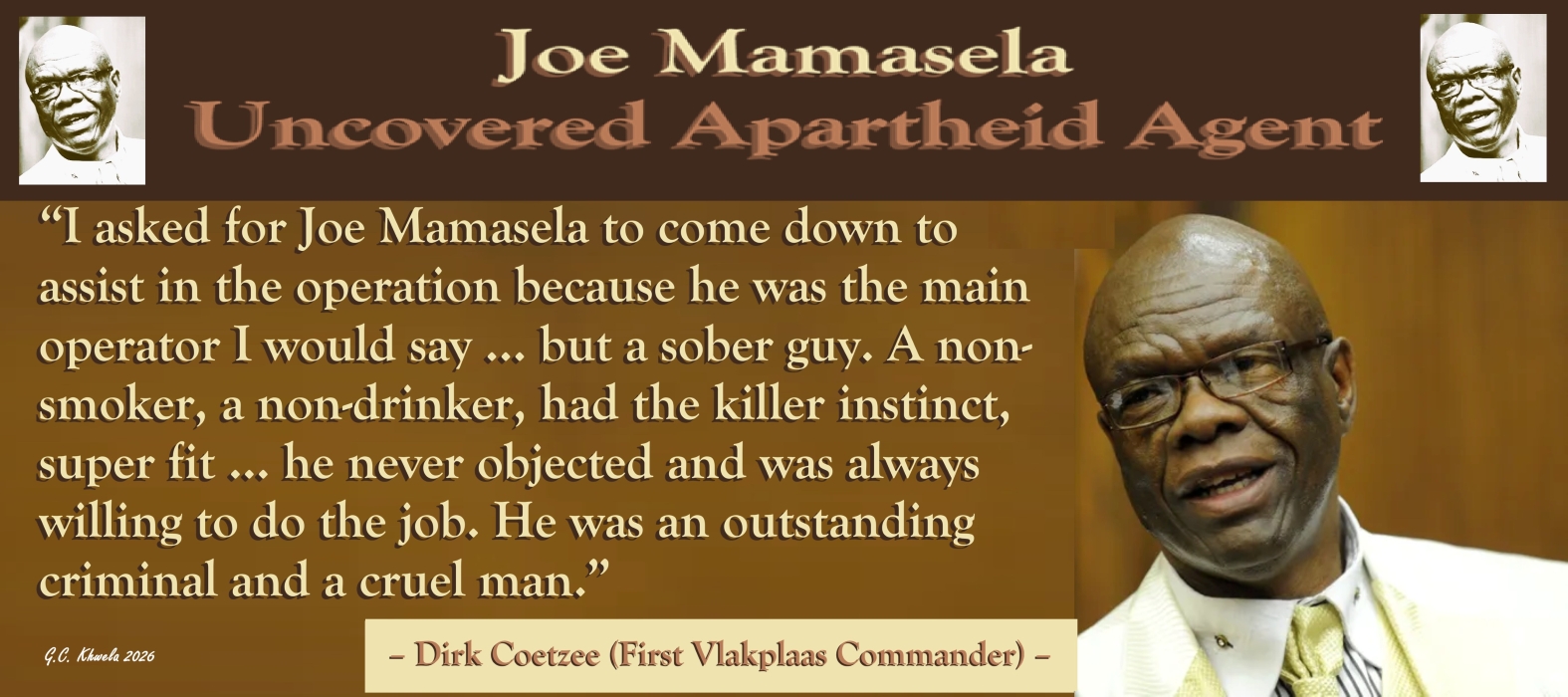
Vlakplaas founder and first commander Dirk Coetzee rated Mamasela extraordinarily highly for operational deployment. When Coetzee needed to execute the high-profile assassination of Durban human rights lawyer Griffiths Mxenge in 1981, he specifically requested Mamasela to be brought in from another region. Coetzee later explained his high rating of Mamasela to the TRC, “I asked for Joe Mamasela to come down to assist in the operation because he was the main operator I would say, with Almond Nofomela of course, but a sober guy. A non-smoker, a non-drinker, had the killer instinct, super fit.” Coetzee further noted that while Mamasela was forced into the role initially, “he never objected and was always willing to do the job. He was an outstanding criminal and a cruel man.”
When Eugene de Kock (dubbed “Prime Evil”) took over at Vlakplaas, the dynamic changed drastically. De Kock openly disliked Mamasela and rated him poorly as a team player, viewing him as arrogant, unmanageable and unnecessarily cruel to his fellow turned fighters. During his TRC amnesty hearings, De Kock stated, “I personally, and it’s my personal opinion, did not like Mr Mamasela, he usually followed his own head. He was not a person who could work in a team… At times he was mean with specifically the askaris”. Despite this personal animosity, De Kock still utilised Mamasela for major operations because of his undeniable, lethal efficiency.
Compared to other askaris – some of whom, like Brian Ngqulunga, suffered immense psychological distress, drank heavily or even contemplated turning back to the ANC – Mamasela adjusted to his role with terrifying ease. While other askaris were constantly monitored out of fear that they would re-defect, Mamasela was given a long leash by senior white leadership, such as Brigadier Willem Schoon and Brigadier Jack Cronjé. He was deeply resented and feared by other black askaris because of his mean streak and his habit of currying favour directly with the white officers, bypassing the unit’s internal hierarchy.
Within the black townships and communities he operated in on a daily basis during the 1980s, Joe Mamasela was perceived as a charismatic, deeply trusted figure – a calculated facade that made his ultimate betrayal devastatingly effective. Because the community did not know he was an askari, he weaponised their trust to embed himself in their daily lives. When the truth finally emerged during the 1990s Truth and Reconciliation Commission (TRC) era, that perception instantly transformed into profound hatred, terror and a lasting legacy of community paranoia.
On a daily basis, Mamasela did not look or act like an apartheid policeman. He carefully constructed a persona designed to blend seamlessly into the social fabric of black townships like Soweto, Mamelodi and the East Rand. Mamasela frequently operated as a minibus taxi driver in South African townships, where taxi drivers were central community figures who overheard local gossip, transported activists and moved freely without arousing police suspicion. He was highly intelligent, sober, and exceptionally articulate and would engage daily with township youths, quoting heavily from the ANC’s Freedom Charter, Karl Marx and Malcolm X. This intellectual framing convinced young activists that he was a senior, deeply committed underground liberation fighter.
He went as far as entering into romantic relationships with women embedded in student politics. Most tragically, he dated East Rand student activist Maki Skhosana while posing as an MK operative named “Mike”. Mamasela’s ability to manipulate daily community spaces didn’t just lead to the deaths of the activists he directly captured; it actively ripped the social fabric of the townships apart by triggering internal paranoia.
A prime example occurred in July 1985, after Mamasela, acting as “Mike”, supplied booby-trapped hand grenades to young activists in Operation Zero Zero, causing them to accidentally blow themselves up. Because the community did not know “Mike” was actually a Vlakplaas askari, suspicion fell entirely on his girlfriend, Maki Skhosana. Believing she was the police informant, an enraged township crowd brutally murdered and “necklaced” Skhosana at a victim’s funeral – an atrocity broadcast globally. Mamasela successfully redirected the community’s daily rage onto an innocent member of their own collective, leaving families shattered and neighbours distrusting one another.
When apartheid ended and Mamasela’s identity as the notorious “Sergeant X” was made public, the daily perception of him shifted from a respected figure to South Africa’s ultimate symbol of betrayal. He became arguably the most hated man in South Africa’s black communities. He could no longer walk freely in places like Soweto without heavy security. In 1997, for instance, gunmen pumped bullets into his car while he was traveling to visit his parents in Soweto, forcing the state to move him to a high-security safe house.
In the township lexicon, an “impimpi” (informant/traitor) was viewed with greater disgust than the white apartheid officials themselves, as they were seen as selling out their own blood for blood money. Even decades later, Mamasela’s presence in any community sparked outrage. When he was granted bail in June 2026 for his historical crimes, it reignited deep-seated trauma for the families and communities who remembered him not just as a state killer, but as the friendly man who once drove them in his taxi.
Sources:
Wikipedia.
Jacques Pauw, “Into the Heart of Darkness: Confessions of Apartheid’s Assassins”, Jonathan Ball, 1997.
SAPA, “Mamasela Moved to Safe House After Attempt on His Life: Report”, South African Press Association, 13 April 1997.
Truth and Reconciliation Commission, “Truth and Reconciliation Commission of South Africa Report, Vol. 3”, Truth and Reconciliation Commission, 29 October 1998.
SAPA, “Police Askari Did Not Know Grenades Were Booby-Trapped”, South African Press Association, 4 August 1999.
Alette Smeulers, “Eroding the Myth of Pure Evil: When Victims Become Perpetrators”, in R. M. Letschert et al. (Eds.), “Victimological approaches to international crimes: Africa”, Intersentia, 2011.
Jacob Dlamini, “Askari: A Story of Collaboration and Betrayal in the Anti-Apartheid Struggle”, Jacana, 2014.
Thula Simpson, “Umkhonto we Sizwe: The ANC’s Armed Struggle”, Penguin, 2016.
Karyn Maughan, “Joe Mamasela, Apartheid Askari and Remorseless Killer”, Mail & Guardian, 21 April 2016.
Robin Binckes, “Vlakplaas Apartheid Death Squads 1979–1994”, Pen and Sword Books, 2018.
Tymon Smith, “The Officers Who Allegedly Killed Ernest Dipale”, The Ahmed Timol Project, 10 March 2021.
No author, “Justice for the COSAS 4 Families”, Press Release by the Foundation for Human Rights and Webber Wentzel, 24 August 2021.
Thato Gololo, “Infamous Askari Joe Mamasela, Charged with Apartheid-Era Crimes, Gets Bail”, News24, 25 June 2026.
Castro Khwela
Good morning fellow Compatriots!🙏🏾✊🏾👊🏾
Discover more from CASTRO KHWELA
Subscribe to get the latest posts sent to your email.