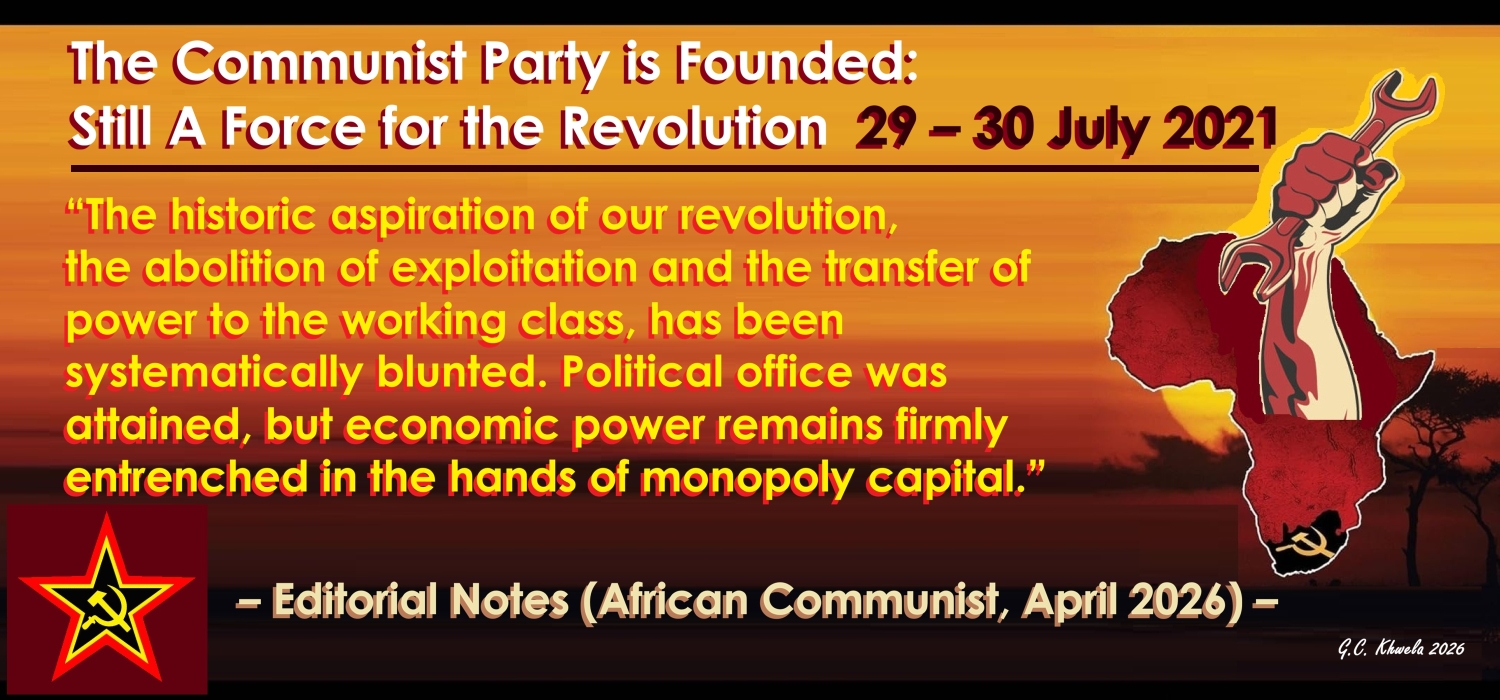
The Communist Party is Founded: Still A Force for the Revolution
On 29 – 30 July 1921, 105 years ago, the Communist Party of South Africa (CPSA) was founded in Cape Town. However, the founding conference of the Party took place from 30 July to 1 August 1921, mainly initiated by radical White workers and socialists who had experienced workers’ struggles in Europe and were inspired by the first workers’ state which was founded in 1917 in Russia after the Bolshevik Revolution. However, the non-racial Party as we know it today is attempting a difficult balancing act by trying to remain an influential voice inside the halls of government while building an independent, grassroots socialist movement capable of pressuring its historic liberation ally at the ballot box.
Going back to history a bit, the founding conference was preceded by a public meeting in Cape Town attended by over two thousand, mainly so-called Coloured, workers and it was addressed by William H (Bill) Andrews, who announced the establishment, aims and character of the new Party. The conference that formally established the CPSA, which was then a South African Section of the Communist International, elected an executive with its headquarters in Johannesburg. The executive consisted of Bill Andrews as secretary-editor, C.B. Tyler as chairman, and S.P. Bunting as treasurer. While the Party did begin with a predominantly white membership, it underwent a profound transformation over the decades to become a cornerstone of the non-racial liberation struggle.
Historically, being established in Cape Town, the Party initially drew support from white trade unionists and European immigrants who had largely moved to the burgeoning city. However, in the mid- to late 1920s the Party refocused its efforts toward the African majority, leading to a rapidly growing Black membership. Banned by the apartheid regime under the Suppression of Communism Act in 1950, in 1953 it reconstituted secretly as the South African Communist Party (SACP) to emphasise its local roots. During that period, it forged a lasting revolutionary alliance with the African National Congress (ANC), the South African Indian Congress (SAIC), the South African Coloured People’s Organisation (SACPO), and the South African Congress of Trade Unions (SACTU).
The transition of the Communist Party from a white-led, labour-focused group into an inclusive, non-racial cornerstone of the liberation struggle was driven by pivotal leaders who bridged racial and ideological divides. Among the key historical figures driving the shift was Moses Kotane. Appointed General Secretary in 1939, Kotane was arguably the most crucial architect of “Africanising” the Party. He famously argued that Marxism must be adapted to the specific realities of African colonial oppression rather than applied as a rigid European formula. His leadership successfully embedded the party within mass-based African communities.
The shift toward a non-racial, African-centred communist party profoundly shaped the direction of South Africa’s liberation. The SACP introduced the concept of “Colonialism of a Special Type”, which argued that white South African colonialism occupied the same geographic space as the colonised Black majority. To address this, the SACP formulated the Two-Stage Revolutionary theory, which posited that the immediate goal must be the liberation of Black people in general and Africans in particular towards the achievement of a non-racial national democratic society. This was to be attained through the National Democratic Revolution, which would lay the groundwork for a future socialist transition. This ideological framework allowed communists to work seamlessly toward the ANC’s democratic goals.
SACP intellectuals and revolutionary workers brought rigorous organisational and drafting skills to the broader liberation movement. Party members played an indispensable, foundational role in writing the Freedom Charter of 1955. The document’s famous opening line, “South Africa belongs to all who live in it, black and white,” reflected the SACP’s deeply ingrained commitment to non-racialism. When peaceful protests were met with state violence, SACP and ANC leaders jointly concluded that non-violence was no longer viable. Together, they formed Umkhonto we Sizwe (MK) in 1961. SACP members like Joe Slovo and Ahmed Kathrada worked directly alongside Nelson Mandela and Walter Sisulu to command the early sabotage campaigns.
During the long decades of exile, the ANC required weapons, funding, and diplomatic support to sustain a global armed liberation movement. The SACP utilised its ideological networks to secure vital military hardware, intelligence training and educational scholarships from the Soviet Union and the Eastern Bloc, keeping the anti-apartheid struggle alive externally. Following the attainment of a democratic South Africa, the Party currently operates in a complex political space, transitioning from a silent national liberation movement and government partner into an increasingly independent political entity. While it historically struggled and governed entirely in tandem with the ANC, deep policy disagreements have triggered a historic shift in how the party exercises its power.
Since the dawn of democracy in 1994, the SACP has not contested national elections under its own name. Instead, it has ruled through the Tripartite Alliance alongside the ANC and the Congress of South African Trade Unions (COSATU). SACP members run for public office on the ANC’s electoral lists. High-ranking SACP leaders routinely hold prominent positions within the national cabinet. For instance, key figures like Science and Technology Minister Blade Nzimande have historically held dual membership across both organisations.
The SACP is currently undergoing its most significant structural shift since 1994. Frustrated by what it views as the ANC-led government’s shift toward “neoliberal” economic policies, rising corruption, and a failure to protect the working class, the party resolved to independently contest local government elections. This decision has fractured the traditional alliance and sparked a major political standoff. The ANC issued a strict directive stating that while dual membership is permitted, the ANC constitution strictly forbids its members from campaigning for a rival party. The ANC gave members holding dual cards an ultimatum to declare their allegiance.
Led by General Secretary Solly Mapaila, the SACP completely rejected the ANC’s demands. Mapaila maintains that the SACP is exercising its democratic right to offer a clear socialist alternative to voters without acting as a hostile “opposition” to the ANC. To strengthen its independent political footing outside of the ANC’s machinery, the SACP launched a permanent “Council of the Left”.
This broad coalition brings together various left-leaning political parties, socialist organisations, civil society groups and powerful public and private sector trade unions. Major labour unions, including the National Education, Health and Allied Workers’ Union (NEHAWU) and the National Union of Mineworkers (NUM), formally broke ranks with the ANC’s election machine to back and campaign for the SACP.
In day-to-day governance and public discourse, the SACP functions as a left-wing pressure group, challenging the state from within. Its primary focuses include strongly fighting against cuts to public spending and aggressively opposing proposed increases to Value-Added Tax (VAT), as well as mobilising communities against the soaring cost of basic food, electricity and utilities. The Party is also pushing back against the privatisation of state-owned enterprises, such as Eskom and Transnet, advocating instead for state-led industrial investment.
To realise the vision of the Freedom Charter – where “The Land Shall Be Shared Among Those Who Work It” and “The People Shall Share in the Country’s Wealth” – the SACP maintains that political freedom is hollow without complete economic emancipation. The SACP believes it can drive the transformation process toward a fully non-racial democratic society by executing a strategy focused on electoral independence, policy radicalisation and mass mobilisation. For three decades, the SACP acted as a junior partner in the Tripartite Alliance, relying on the ANC to execute the National Democratic Revolution. However, with the ANC openly admitting that wealth and land redistribution are still stalled “works in progress”, the SACP is shifting its strategy.
By contesting elections independently, the SACP aims to enter government under its own banner to directly accelerate the pace of economic and land redistribution. General Secretary Solly Mapaila has fiercely opposed the ANC’s recent governing compromises, positioning the SACP as a vital left-wing counterweight against privatisation and pro-capitalist policies. The SACP argues that the historical injustice of colonial and apartheid dispossession cannot be solved through slow, market-based mechanisms.
To enforce the Freedom Charter’s land mandate, the party is pushing for a “National Land Referendum”. Frustrated by legislative delays, the SACP has partnered with traditional leaders to advocate for a national referendum on land ownership transformation. This aims to place the mandate for rapid land restitution directly in the hands of the people, bypassing legislative gridlock. The Party advocates for shifting land out of the hands of monopoly capital and repurposing it for comprehensive urban development, food security and worker-led agrarian cooperatives.
To fulfil the Charter’s demand that mineral wealth, banks and monopoly industries be transferred to the ownership of the people, the SACP focuses on breaking corporate dominance. The SACP actively fights what it defines as “stealth privatisation” of critical state-owned infrastructure like Eskom, Transnet and the water supply. The Party argues that these assets must remain under democratic public control to serve social needs rather than private profit. It’s official roadmap calls for the nationalisation and socialisation of monopoly industries, such as Sasol and Mittal Steel, restructuring them to answer directly to popular community and worker planning.
The position that the Party holds is that non-racial democracy cannot exist while deep economic inequality falls along racial lines. It therefore aims to bridge these systemic divisions by uniting a fractured society around shared working-class interests. Through the new coalition, the “Council of the Left”, the SACP is uniting progressive civil society, traditional leaders and major public sector unions into a formidable political bloc.
By organising factory and community units, the SACP seeks to shift power from short-term, profit-maximising shareholders back to ordinary workers, ensuring that corporate wealth is fundamentally socialised. Ultimately, the SACP’s role is to transition from an advisory ally into an active political force that utilises both the ballot box and mass street mobilisation to force a material, structural break with capitalism – ensuring the country’s immense wealth is finally shared by all who live in this country.
The current trajectory of the South African Communist Party (SACP) – specifically its historic decision to independently contest the 4 November 2026 local government elections – presents a high-stakes gamble. The success of this strategy, and whether the masses will understand it, depends on how the party handles immense political pressure, voter confusion and its own historical baggage. The SACP’s trajectory has a mixed outlook, balanced between historic organisational challenges and a unique opportunity to reshape South African politics.
By organising the “Conference of the Left” with left-leaning political parties and movements, progressive civil society, and massive unions, Mapaila is successfully positioning the SACP as the central hub for fractured socialist forces. Decades of systemic unemployment, poverty and municipal failure have left a massive vacuum for an anti-austerity party. If the SACP can capture even a modest percentage of votes in key municipal districts, it could become a vital coalition kingmaker, forcing the ANC or other parties leftward. Historically, the SACP’s independent runs in municipal by-elections have yielded mixed results – averaging roughly 3.5% of the vote, with isolated highs of 12% in parts of the Eastern Cape. Replicating this on a national municipal scale requires immense financial and logistical machinery.
Reaction from the ANC has been aggressive in protecting its turf, barring SACP members from participating in ANC structures or candidate lists. The ANC’s ultimatum forcing dual-card members to “choose a side” is already causing internal purges, intimidation and resignations at the local branch level, threatening to starve the SACP of seasoned activists. The greatest hurdle for the SACP nonetheless is not just winning votes but clearly communicating its complex message to an exhausted electorate. The SACP insists that it is contesting the elections independently, yet it claims it is not leaving the Tripartite Alliance. For the average voter, this is incredibly confusing.
People may struggle to understand how a Party can fiercely campaign against the ANC at the municipal ballot box while remaining comfortably in a governing alliance with them at the national cabinet level. Because high-ranking SACP figures have occupied powerful government ministries for 32 years, many voters view the SACP as co-authors of the country’s current economic woes. Convincing the masses that the SACP is suddenly a “fresh, radical alternative” to the very system it helped manage is a major public relations challenge.
Where the masses will easily understand the SACP is through its localised, pocketbook campaigns. The party’s fierce opposition to Value-Added Tax (VAT) increases, its fight against the privatisation of Eskom and Transnet, and its calls for a national referendum on land redistribution speak directly to the lived realities of township and rural communities. The Party’s long-standing, vocal track record of fighting corruption within the liberation movement gives the SACP an aura of moral authority that the ANC has largely lost.
One may conclude that the SACP’s current strategy is highly precarious. The masses deeply understand and crave the objectives of the Freedom Charter – wealth sharing and land redistribution. However, they may remain sceptical of the SACP’s tactical position. If the SACP behaves like a timid, hesitant ally, it risks becoming irrelevant. But if it aggressively utilises its alliances with trade unions and the left-leaning parties and movements to champion local community struggles, it could successfully build a formidable, independent socialist bloc in a democratic South Africa.
The Party must adhere to what the Central Committee had declared, that “the original aspiration of the revolution, therefore, is not abstract idealism but a tangible material and historical project to abolish exploitation, end capitalist class domination, and place political and economic power in the hands of the working class and the oppressed – the majority in society.”
Sources:
Wikipedia.
South African History Online (SAHO).
A. Lerumo, “50 Years of the Communist Party – 3: From ‘Fusion’ to Fascism”, The African Communist, No. 46, Third Quarter 1971.
Mazibuko K. Jara, “Freedom Charter Anniversary: Build a People’s Economy”, South African Communist Party (SACP), 25 June 2001.
South African Communist Party, “Chapter 9: The SACP’s Programme of Action to Advance the Goals of ‘The South African Road to Socialism’”, in South African Communist Party (SACP), “The South African Road to Socialism: SACP Political Programme”, SACP, 2007.
Mthembi Phillip, “Repositioning of the South African Communist Party (SACP) in the Politics of Post-Apartheid South Africa: A Critical Study of SACP from 1990 – 2010”, Master of Arts: University of Limpopo, 2014.
Alex Mohubetswane Mashilo, “The National and Property Question in South Africa: Land Reform and Expropriation”, Umsebenzi Online, Vol. 17, No. 2, 9 March 2018.
Sphamandla Siyabonga Gumede, “The Role of the South African Communist Party (SACP) in the Struggle for Liberation in South Africa, C.1921-2015”, University of Zululand, 2021.
Thabiso Goba, “SACP Wants Referendum on Land Expropriation Without Compensation”, Eyewitness News (EWN), 12 December 2024.
Solly Mapaila, “SACP Central Committee Statement”, South African Communist Party (SACP), 6 April 2025.
Alex Mohubetswane Mashilo, “SACP Moves Forward to Participating Independently in the 2026 Local Government Elections – Resolution of the 5th SNC, Extract from the April 2025 CC Statement”, Umsebenzi Online, Vol. 24, No. 1, 21 May 2025.
Ntebo Mokobo, “ANC Claims 80% of Freedom Charter Fulfilled, Land Reform Lags Behind”, SABC News, 24 June 2025.
Johnathan Paoli, “Mapaila: SACP Will Not Play Junior Partner in Alliance”, Inside Politics, 31 August 2025.
Yamkeleka Manjeya, “‘This is Not What the Revolution Was About’: Mapaila Slams ANC’s ‘Economic Betrayal’”, City Press, 2 September 2025.
Thabiso Goba, “SACP Says It Wants to Enter Govt to Help ANC Accelerate Land and Economic Redistribution”, Eyewitness News (EWN), 10 January 2026.
Mbulelo Mandlana, “Circular to All Members, Cadres, and Structures”, South African Communist Party (SACP), 23 April 2026.
Thabiso Shomolekae, “ANC Says SACP Will Not Participate in Party’s Election Activities”, Polity, 23 April 2026.
Zara Groenewald, “SACP Confirms It Will Contest Local Elections Independently”, SABC News, 23 April 2026.
Simon Majadibodu, “SACP’s Solly Mapaila Rejects ANC’s ‘Ultimatum’ Ahead of 2026 Elections”, Cape Times, 24 April 2026.
Central Committee, “The NDR Must Win on Two Fronts: Working-Class Hegemony and Anti-Imperialist Solidarity”, The African Communist, Issue 216, 1st Quarter 2026.
Solly Mapaila, “Conference of the Left: A Decisive Turn from Fragmentation to Coordination”, News24, 5 June 2026.
Gunnett Kaaf and Mazibuko Kanyiso Jara, “No Shortcuts”, Africa Is A Country, 3 July 2026.
Castro Khwela
Good morning fellow Compatriots!🙏🏾✊🏾👊🏾
Discover more from CASTRO KHWELA
Subscribe to get the latest posts sent to your email.