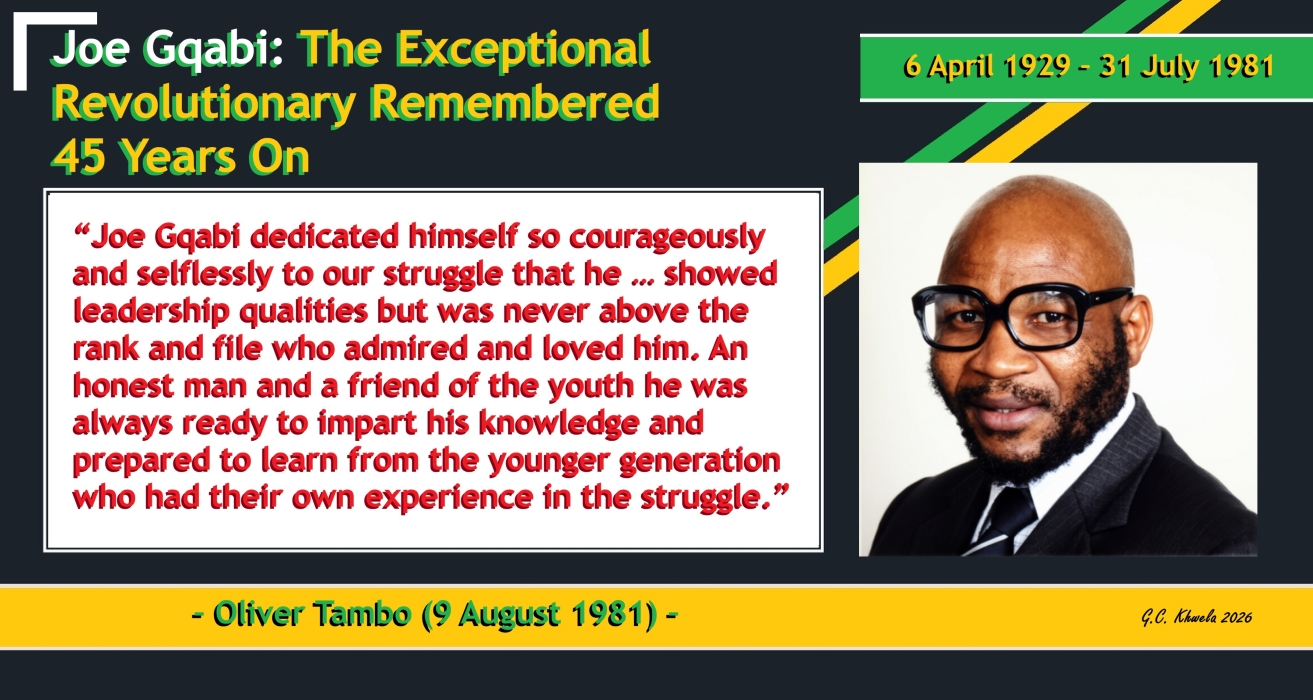
Joe Gqabi: The Exceptional Revolutionary Remembered 45 Years On
45 years ago, on the evening of 31 July 1981, while driving out of his residence in Eves Crescent, which was in Salisbury’s (now Harare) Ashdown Park suburb, in Zimbabwe, the African National Congress’s (ANC) Chief Representative to Zimbabwe, Joe Gqabi was shot dead by allegedly three assailants. The assailants opened fire at close range into the head and body of Gqabi who died immediately.
This was an early action by D40, the ex-Rhodesian outfit that was a direct forerunner to the apartheid Special Forces Death Squad, the Civil Cooperation Bureau (CCB). The murderer was Graham “Gray” Branfield, a former Deputy Inspector of Police with Bulawayo’s Special Branch. Reconnaissance for the murder was done by a local spy ring recruited on behalf of the apartheid government by two ex-Rhodesians, one of whom worked for South Africa’s intelligence services, the other for the Special Forces. When Joe Gqabi’s Secretary arrived at the house the following morning, at 00:15, there were eighteen spent cartridges on the driveway and a .22-calibre Beretta pistol, fitted with a silencer, was near his body in the car.
“Gray” Branfield, the secret agent who gunned down Gqabi was allegedly part of the planning of “Operation Lebanta”, the 1982 attack on ANC targets in Maseru that were designed to kill Chris Hani. Years later, Branfield was alleged to have been connected to the apartheid South African Defence Force (SADF) raid in Gaborone in 1985. He later died in Iraq, where he was working as a security contractor. The first attempt on Joe Gqabi’s life was early 1981, when enemy agents planted seven kilograms of dynamite under his car which were discovered in time before they could harm him.
Born in Aliwal North (now Maletswai) in the Eastern Cape, on 6 April 1929, Joe Gqabi joined the African National Congress (ANC) in the middle of the 1950’s. He was a veteran of several ANC campaigns. At about the same time, he joined the staff of the “New Age”, the militant newspaper in Johannesburg, as both photographer and reporter. This job gave him considerable experience in investigative journalism, particularly in exposing the hidden crimes of apartheid. Following the Sharpeville Massacre and the declaration of the State of Emergency in 1960, Joe was amongst the 2 000 political detainees. It was during this period that he showed his courage and dedication.
In 1961, Joe Gqabi was amongst the first to answer the call of Umkhonto we Sizwe (MK), leaving the country for military training in the People’s Republic of China. He was captured and sentenced to two years imprisonment for having left the country illegally. At the end of the two year term, he was re-arrested in the Fort and charged under the Sabotage Act and sentenced to ten years imprisonment on Robben Island, where he served his sentence together with some of the top leaders of the Movement – Nelson Mandela, Walter Sisulu, Govan Mbeki, Ahmed Kathrada and others.
Released in 1975, severe restrictions were placed on him. But this did not deter him from re-organising the ANC apparatus. Gqabi was definitely involved – in one way or another – in guiding and advising the students and youth during the Soweto uprisings in 1976. It was immediately after or during these uprisings that he again shot into prominence as the principal defendant in the lengthy trial of “The Pretoria 12”, which caught the attention of the country and the world. He was the No. 1 accused in the Pretoria 12 Trial, he became one of the 6 acquitted – the others got from 6 to 18 years imprisonment. He left the country shortly after acquittal in 1978 and found his way in the ranks of his comrades in the External Mission of the ANC. Soon after Zimbabwe’s independence, Gqabi was appointed to represent the ANC there.
Gqabi’s death was a heavy blow for the ANC, but nonetheless, it had the impact of improving relations between the ANC and the ZANU-PF (Zimbabwe African National Union-Patriotic Front) government. The appointment of Joe Gqabi as one of the most experienced and astute operatives to be the first official representative in Harare, was a prudent move by the ANC. In the presence of the ANC leadership at the official funeral of Joe Gqabi, which included President Oliver Tambo, Zimbabwean Prime Minister Robert Mugabe declared that Zimbabwe and the people of South Africa were united by the death of Gqabi in their just common cause and would remain united until final victory.
When Mugabe spoke to mourners at the funeral on Sunday, 9 August 1981, he said Gqabi’s death provided conclusive proof that “the enemy is in our midst”. He also called for vigilance against what he described as further acts of enemy aggression against leading nationalist figures. Mugabe then spoke directly to Tambo, saying, “Have no fear, therefore, Comrade President Tambo, that this act might deter the people of Zimbabwe from their noble duty to render assistance to the people of South Africa”.
Following Mugabe’s speech at the funeral, Oliver Tambo maintained that since Zimbabwe treated Gqabi’s death in the way that they did, it conveyed a message that the ANC was not going to be frightened off from the struggle for liberation. According to Tambo: “On the contrary, the more the enemy strikes at Zimbabwe, the greater will be the determination with which Zimbabwe responds. The people of the region, correctly reflecting the positions of the African continent, have stood firm in defence of their commitment to the total liberation of our continent…”
The ANC issued a statement following his assassination, which said, “Joe Gqabi dedicated himself so courageously and selflessly to our struggle that he was elected Member of the National Executive Committee of the ANC. He showed leadership qualities but was never above the rank and file who admired and loved him. An honest man and a friend of the youth he was always ready to impart his knowledge and prepared to learn from the younger generation who had their own experience in the struggle. As a fearless journalist, freedom fighter, leader and man of the masses, he will be remembered by thousands of all oppressed who are proud of having produced such a gallant son.”
Joe Nzingo Gqabi was revered as an exceptional leader because he was a complete revolutionary who bridged intellectual, military and grassroots resistance, creating an underground network so resilient that the apartheid regime viewed his total elimination as a strategic necessity. The apartheid state feared him deeply because he was not merely an ideologue; he possessed a rare combination of tactical brilliance, cross-generational appeal and strategic positioning right on South Africa’s borders. Working for the militant newspaper ‘New Age’, Gqabi was an investigative powerhouse. His dangerous work uncovering the “potato farms scandal” in Bethal – where dead labourers were used as fertilizer – exposed the raw monstrosity of apartheid to the international community.
Following the 1960 Sharpeville Massacre, he was among the first cohorts sent to China for guerrilla warfare training to establish the ANC’s armed wing, Umkhonto we Sizwe (MK). He served a gruelling 12-year sentence on Robben Island alongside giants like Nelson Mandela and Walter Sisulu. Crucially, prison failed to break his resolve; the moment he was released in 1975, he instantly dove straight back into high-risk underground operations. Alongside Martin Ramokgadi, Gqabi ran the “Main Machinery” – the clandestine ANC underground command in Johannesburg. He served as the vital, secret intermediary between the exiled ANC leadership and the student bodies driving the 1976 Soweto Uprisings.
As ANC President Oliver Tambo noted at his funeral, Gqabi was uniquely revered for his ability to connect effortlessly across political, ideological, racial and age divides. He could organise rural peasants in the Transkei Pondo Revolt, unionise construction workers and mentor radical youth simultaneously. The Pretoria regime realised that imprisonment, bans and torture could not stop Gqabi. By 1980, he had skipped South Africa to become the ANC’s Chief Representative in newly independent Zimbabwe. This specific role made him the regime’s public enemy number one for several lethal reasons.
Operating out of Harare, Gqabi was perfectly positioned to build a corridor for weapons, intelligence and MK guerrillas to flood directly across the Limpopo River into South Africa. He built an incredibly close, sophisticated rapport with Robert Mugabe’s new government. This threatened to turn Zimbabwe into an official, heavily armed springboard for the liberation movement. The regime attempted to lock him away permanently during the high-profile Pretoria Twelve Trial in 1977. When he managed to beat the charges and get acquitted due to lack of evidence, the state realised their judicial system could no longer contain him.
Recognising his exceptional revolutionary qualities, the ANC statement continued to say, “If the racist regime thought by cowardly murdering Joe Gqabi it was going to intimidate the front line states and demoralise the ANC, it had blundered. These acts of international terrorism can only steel our resolve to advance the struggle for which Comrade Joe lived and sacrificed his life, to new and higher levels … We dip our revolutionary banner in honour of his hero who symbolises the indomitable forces of resistance to racism, oppression and exploitation. We hold up our clenched fists and say: The Struggle Continues, Victory is Certain! Hamba kahle Qhawe lamaQhawe!”
Sources:
Wikipedia.
South African History Online (SAHO).
Obituary, “Joe Nzingo Gqabi”, Sechaba, September 1981.
Jacques Pauw, “Into the Heart of Darkness: Confessions of Apartheid’s Assassins”, Jonathan Ball, 1997.
Truth and Reconciliation Commission, “Truth and Reconciliation Commission of South Africa Report”, Vol. 2, TRC, 29 October 1998.
Truth and Reconciliation Commission, “Truth and Reconciliation Commission of South Africa Report”, Vol. 3, TRC, 29 October 1998.
Luli Callinicos, “Oliver Tambo: Beyond the Engeli Mountains”, David Philip, 2004.
Vladimir Shubin, “ANC: A View from Moscow”, Jacana, 2008.
Janet Smith and Beauregard Tromp, “Hani: A Life Too Short”, Jonathan Ball, 2009.
Thula Simpson, “Military Combat Work: The Reconstitution of the ANC’s Armed Underground, 1971-1976”, African Studies, Vol. 70, Issue 1, 2011.
Stephen Ellis, “External Mission: The ANC in Exile, 1960–1990”, Oxford University, 2013.
Vladimir Shubin with Marina Traikova, “‘There is No Threat from the Eastern Bloc’”, The Road to Democracy in South Africa, Volume 3, International Solidarity, Part II, South Africa Democracy Education Trust (SADET), 2015.
Thula Simpson, “Umkhonto we Sizwe: The ANC’s Armed Struggle”, Penguin, 2016.
Tshwarelo eseng Mogakane, “Hawks Captain Tells Inquiry Zim Authorities Stalled ANC Veteran’s Murder Probe”, Sunday World, 16 July 2026.
Castro Khwela
Good evening fellow Compatriots!🙏🏾✊🏾👊🏾
Discover more from CASTRO KHWELA
Subscribe to get the latest posts sent to your email.