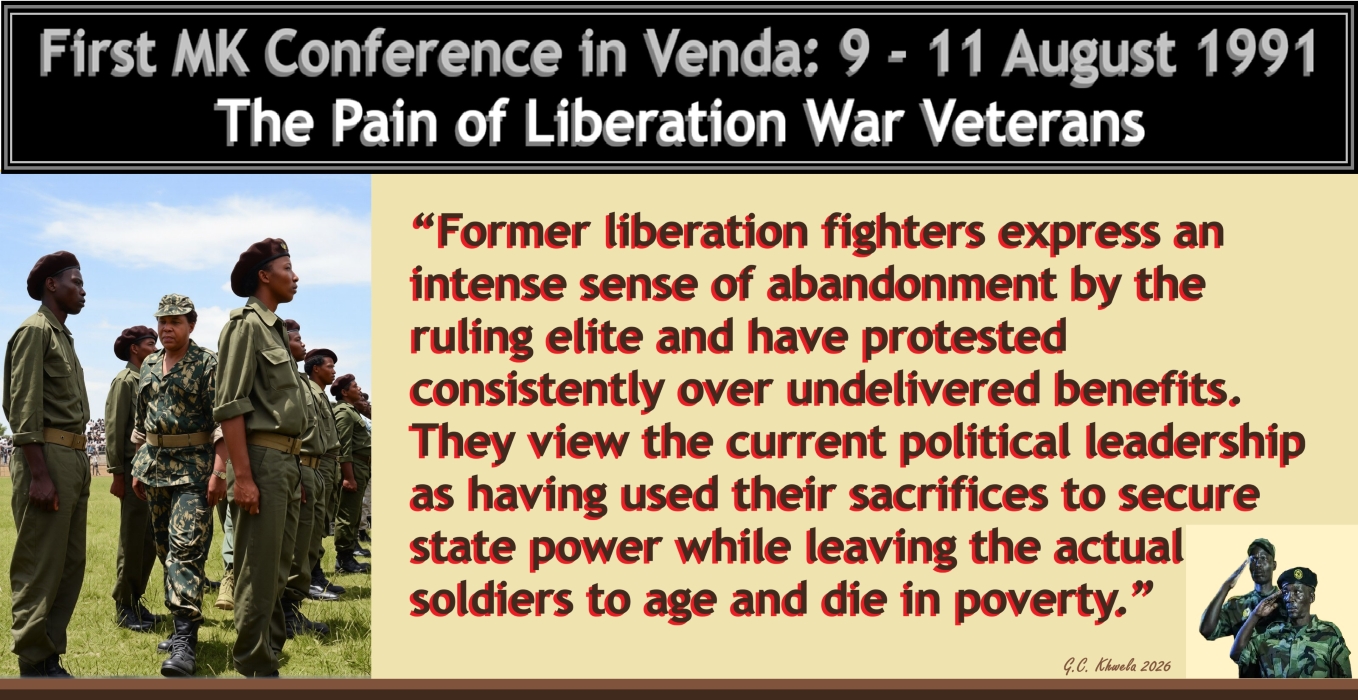
First MK Conference in Venda and the Pain of Liberation War Veterans
On 9 – 11 August 1991, Umkhonto we Sizwe (MK) held its first conference at the University of Venda, in Thohoyandou, following African National Congress (ANC) President Nelson Mandela’s instruction to the ANC Conference in Durban in July the same year that he must set-up a conference to address the concerns of MK Cadres. Hopes for a peaceful transfer of power from the minority to the majority were dashed as the transition progressed, mainly as a result of state-sponsored “Third Force” violence that led to devastating community wars, as well as the systemic neglect of returning cadres that disrupted expectations for a smooth transition to a democratic dispensation.
At the Durban Conference, held on 4 – 7 July 1991, after he was elected ANC President, Mandela in his closing address said, “On Friday I attended a session of the MK commission. It became very clear to me after listening to the speakers that the problems of MK cannot be properly addressed in a one-day commission. A separate conference of MK cadres attended by leading members of the NEC is necessary if justice is to be done to their complaints.”
In his opening address to the MK Conference on 9 August 1991, Mandela mentioned that he wanted to see MK restructured in a way that would enable its cadres to join the armed forces of a democratic South Africa. He also referred to the disclosures of clandestine government funding to political groups, which he considered as demonstrating “in the clearest possible terms the pressing need for an interim government of national unity to preside over the entire transition from apartheid to democracy”.
On the same day, MK Chief of Staff, Chris Hani, delivered a behind-closed-doors address to the conferences, in which he discussed the state of the People’s Army abroad following the relocation from Angola to Tanzania and Uganda in 1989. According to Hani, MK encountered serious logistics, accommodation and transport problems when it moved to Uganda and Tanzania, as most of the vehicles were left behind in Angola and those that could be shipped out were not very serviceable. From the very beginning, MK confronted these problems, including the shortage of spare parts, as well as the challenges of medical supplies and drugs.
In Tanzania for example, MK had to adjust to a process where the running of a camp and its security was handled by the Tanzanian People’s Defence Force, and this affected the morale of MK soldiers. Most of the camps were located near to populated villages and this increased the number of AWOLS (absenteeism without leave) and these were also followed by growing desertions to Mazimbu, Dakawa, and even to Zambia and South Africa.
Many of the cadres were under-deployed, and the feeling of idleness contributed to the general decline of morale. In contrast, the situation in Uganda was generally favourable and was improving. However, in Zambia, the morale of the army was declining, as MK cadres were waiting for deployment long before the legalisation of the ANC. Some of the cadres had retreated to Zambia from the Forward Areas or from inside the country and their non-deployment was impacting on their low morale. Most cases in the Forward Areas were amicably resolved, since most of them were not that serious.
With regard to the talks with the apartheid government, Hani observed that short of a major disaster in the negotiation process, “the transition is very likely to be relatively peaceful and … lead to a peaceful transfer of power from the minority to the majority, it would have definite implications in the way we organise our new army”. For Hani that would mean they had to inherit a fully-fledged SA Defence Force (SADF), with the defence forces of the Transkei, Venda, Bophuthatswana and Ciskei Bantustans.
The conference reflected optimism within the ANC that there was going to be a peaceful transition to majority rule. MK Army Commander, Joe Modise, expanded on the need to prepare for inclusion in the new national armed forces, by emphasising on the steps that had to be taken to train MK cadres in ground, air and naval capabilities. This implied that the conversion of the guerrilla detachments had to be prioritised if the liberation movement was to be present in the future defence apparatus. Modise further indicated that Tanzania and Uganda were already training MK cadres for integration into a modern military structure, and agreements were to be finalised with three other countries.
However, Chris Hani’s early optimism during the conference that “the transition is very likely to be relatively peaceful and … lead to a peaceful transfer of power from the minority to the majority”, was shattered as the transition went on. This was largely due to a state-sponsored “Third Force” violence, escalating township wars, and systemic neglect of returning exiles, which derailed hopes for a seamless democratic transition. The historical reality of this period highlighted how the transition became one of South Africa’s bloodiest eras. Elements within the apartheid intelligence and security forces covertly funded and armed proxy groups to destabilise the peace process.
The state fuelled bloody clashes between the Inkatha Freedom Party (IFP) and ANC alignment networks, specifically targeting rural communities and townships in KwaZulu-Natal and Gauteng (then PWV area). Brutal, anonymous attacks on commuters and communities weaponised civilian spaces to force a political deadlock.
At the same time, returning cadres faced severe economic hardships, lack of housing and extreme psychological trauma upon arrival. The complex political process left many MK soldiers in a state of limbo before formal integration into the new South African National Defence Force (SANDF) in 1994. Many veterans felt abandoned by the political leadership, as they had no means to assist their families and were left to fend for themselves under difficult economic conditions.
The conditions of returning exiles, political prisoners and liberation war veterans – primarily from Umkhonto we Sizwe (MK), the Azanian People’s Liberation Army (APLA) and the Azanian National Liberation Army (AZANLA) – have been defined by systemic marginalisation, bureaucratic failures, and a deep-seated sense of political betrayal both before and after the 1994 transition. Returning exiles and released political prisoners faced sudden, unassisted reintegration, as many returned to find broken families, zero employment prospects, and severe psychological trauma without state-sponsored counselling.
Liberation fighters were initially excluded from official demographic records. Thousands of cadres were left in administrative limbo at holding bases like Wallmansthal during the integration process. The impact of the struggle wars post-1994 within South Africa, suffering from poor living conditions, substandard food and delayed processing. While formal armies had clear legal frameworks, the demobilisation or absorption of “non-statutory” guerrilla forces lacked coherent structural planning, treating freedom fighters as a security threat rather than heroes. Instead of designing a completely new military framework, guerrilla forces were absorbed into the pre-existing structure of the apartheid-era South African Defence Force (SADF).
The conventional ranking metrics heavily favoured former SADF members, as highly experienced liberation commanders were routinely assigned lower ranks and lesser pay grades due to a lack of “formal, conventional” military certificates. The institutional culture remained overwhelmingly Eurocentric and hostile to liberation histories. Many integrated veterans faced disciplinary purges, leading to mass SANDF soldiers’ strike and subsequent discharges without adequate retirement packages. The Department of Military Veterans (DMV), established to provide critical lifelines under the Military Veterans Act of 2011, had collapsed into near-total operational failure. Reports to Parliament’s Portfolio Committee on Defence and Military Veterans exposed rampant corruption, continuous procurement scandals and an inability to process applications.
Three decades later, elderly veterans are still forced to protest outside political offices just to secure physical veteran certificates. Without these documents, they are locked out of legally promised state housing, healthcare and educational support for their children, as well as basic military pensions. Military veterans continue to protest over undelivered benefits. Veterans regularly have to take the state to high court to force the payout of their pensions, with the government actively fumbling or delaying court-ordered restitution, as military veterans are still waiting for pension four years after court had ordered the payouts.
Former liberation fighters express an intense sense of abandonment by the ruling elite and have protested consistently over undelivered benefits. They view the current political leadership as having used their sacrifices to secure state power while leaving the actual soldiers to age and die in poverty. It is a painful sight to see once vibrant cadres dying as destitute vagrants.
To ease the deep pain, poverty and sense of abandonment felt by liberation war veterans, the South African government and political leadership must pivot from empty political rhetoric to decisive structural and economic interventions. Several actionable steps can be taken to directly address their immediate hardships and restore their dignity. Clean up the systemic mismanagement and financial waste within the DMV through restructuring, independent forensic audits and strict criminal prosecution of corrupt officials. This includes electronically cleaning and urgently digitising the military veterans’ database to fast-track verification, eliminating the bureaucratic red tape that keeps aging veterans waiting years for their legal status.
The government must urgently establish mobile and regional offices in rural provinces and townships so elderly or infirm veterans do not have to travel long distances to major cities just to access help. Ensure the seamless, automatic rollout of the military veterans’ pension to all verified cadres without administrative delays or court interventions. Set aside a fixed quota of high-quality state-subsidised housing specifically for veterans and their families, moving them out of informal settlements. Fully fund and automate the educational bursaries promised to the children of veterans to break the cycle of generational poverty caused by their sacrifice.
Moreover, the government must grant all verified liberation veterans and their immediate dependents free, lifelong access to South African Military Health Service (SAMHS) facilities. Launch specialised, culturally sensitive mental health programmes to address decades of untreated post-traumatic stress disorder (PTSD) stemming from exile, torture, imprisonment and guerrilla warfare. Ensure that every veteran receives a fully state-funded, dignified military burial to honour their contribution, lifting the financial burden of funerals from grieving and impoverished families.
Besides the welfare benefits that are instantly due to liberation war veterans the government must provide tailored business, agricultural or technical training programmes specifically designed for aging or retired veterans who want to sustain themselves. Enforce state procurement policies that mandate government departments to source a percentage of goods and services from verified veteran-owned enterprises. Officially elevate the historical status of MK, APLA and AZANLA within the official heritage landscape, ensuring their legacy matches that of statutory forces. Political leaders must move away from defensive posturing, directly engage with veteran associations in good faith and publicly acknowledge the state’s failures in handling their welfare since 1994.
AZILUNGE IZINTO ZAMA COMMANDER!
Sources:
Wikipedia.
South African History Online (SAHO).
Guy Lamb, “Reintegration into Civilian Life: The Case of former MK and APLA Combatants from Military to Civilian Life; The Case of Retired Special Forces Operators”, Track Two, Vol. 12, Nos. 1 and 2, September 2003.
Lephophotho Mashike and Mafole Mokalobe, “Reintegration into Civilian Life: The Case of Former MK and APLA Combatants”, Track Two, Vol. 12, Nos. 1 and 2, September 2003.
Sandy Africa, “The Transformation of the South African Security Sector: Lessons and Challenges”, Geneva Centre for the Democratic Control of Armed Forces (DCAF) Policy Paper – No. 33, March 2011.
Thula Simpson, “Umkhonto we Sizwe: ANC’ Armed Struggle”, Penguin, 2016.
Mpho Khalo, “The Impact of the Struggle Wars Post 1994 Within the South African Army”, DITSONG: National Museum of Military History, 28 September 2021.
Paul Mashatile, “Chris Hani Remembered as a Martyr Whose Sacrifice Shaped South African Democracy”, Government Communications (GCIS), 11 April 2025.
Carl Niehaus, “The Department of Military Veterans Has Collapsed: A Betrayal of Those Who Fought for Freedom”, Independent Online (IOL), 3 June 2026.
Carl Niehaus, “Opinion: Collapse of SA Defence and Military Veterans Departments a Betrayal”, DefenceWeb, 26 June 2026.
Tania Broughton, “Military Veteran Still Waiting for Pension Four Years After Court Victory”, DefenceWeb, 20 July 2026.
Asemahle Vumsindo, “ANC Military Veterans Protest Over Undelivered Benefits”, Grocott’s Mail, 24 July 2026.
Padraig O’Malley, “Situation Affecting Integration of Umkhonto We Sizwe into New SANDF”, Nelson Mandela Foundation, https://omalley.nelsonmandela.org/index.php/site/q/03lv02424/04lv02730/05lv02918/06lv02970.htm
Castro Khwela
Good evening fellow Compatriots!🙏🏾✊🏾👊🏾
Discover more from CASTRO KHWELA
Subscribe to get the latest posts sent to your email.