Fidel Castro Resigns
On 24 February 2008, the Cuban National Assembly of People’s Power unanimously voted Raúl Castro Ruz, Fidel Castro’s brother, as President and Commander-in-Chief of the Cuban Revolutionary Armed Forces. In a 19 February 2008 letter, Cuban leader Fidel Alejandro Castro Ruz announced that he would not accept the positions of President and Commander-in-Chief at that month’s National Assembly meetings.
Fidel was a Cuban revolutionary and political leader who served as Prime Minister of Cuba from 1959 to 1976 and President from 1976 to 2008. Ideologically a Marxist-Leninist and Cuban anti-imperialist nationalist, he also served as the First Secretary of the Communist Party of Cuba from 1961 until 2011. Under Fidel, Cuba became a one-party socialist state, and people-based revolutionary initiatives were implemented throughout society.
Born on 13 August 1926 in Birán, Oriente, Cuba, son of a wealthy Spanish farmer, Castro adopted leftist and anti-imperialist ideas while studying law at the University of Havana. He planned the overthrow of Cuban President Fulgencio Batista, launching a failed attack on the Moncada Barracks in 1953. After a year’s imprisonment, Castro travelled to Mexico where he formed a revolutionary group, the “26th of July Movement”, with his brother Raúl and Ernesto “Che” Guevara. Returning to Cuba, Castro took a key role in the Cuban Revolution by leading the Movement in a guerrilla war against Batista’s forces from the Sierra Maestra mountains.
After Batista’s overthrow in 1959, Castro assumed military and political power as Cuba’s Prime Minister. The United States came to oppose Castro’s government and unsuccessfully attempted to remove him by assassination, economic blockade, and counter-revolution, including the Bay of Pigs Invasion of 1961. Countering these threats, Castro aligned with the Soviet Union and allowed the Soviets to place nuclear weapons in Cuba, resulting in the Cuban Missile Crisis – a defining incident of the Cold War – in 1962.
Adopting a Marxist-Leninist model of development, Castro converted Cuba into a one-party, socialist state, under Communist Party rule, the first in the Western Hemisphere. Policies introducing central economic planning and expanding healthcare and education were accompanied by state control of the press and the suppression of internal dissent.
Following the revolution, Cuban goods were embargoed from United States’ soil for nearly the entire time, first under a partial embargo signed by President Dwight D. Eisenhower in 1960, then under a nearly complete embargo by executive order of President John F. Kennedy in 1962. The Helms-Burton Act of 1996, also known as the Cuban Liberty and Democratic Solidarity Act, strengthened the U.S. embargo against Cuba and allowed Congress to override a presidential cancellation of the embargo. It also included a provision that prohibited recognition of a transitional government in Cuba that included Fidel or Raúl Castro.
Abroad, Castro supported anti-imperialist revolutionary groups, backing the establishment of Marxist governments in Chile, Nicaragua, and Grenada, as well as sending troops to aid allies in the Yom Kippur, the Ogaden, and the Angolan Wars. He also offered educational programmes as well as military and health training to national liberation forces in Africa, particularly the Southern African region, in countries which were under Portuguese colonial, Smith and apartheid racist rule.
These actions, coupled with his leadership of the Non-Aligned Movement from 1979 to 1983 and Cuba’s medical internationalism, increased Cuba’s profile on the world stage. Following the Soviet Union’s dissolution in 1991, Castro led Cuba through the economic downturn of the “Special Period”, embracing environmentalist and anti-globalisation ideas. In the 2000s, Castro forged alliances in Latin America with Hugo Chávez’s Venezuela and signed Cuba up to the Bolivarian Alliance for the Americas. In 2006, Castro transferred his responsibilities to Vice President Raúl Castro, who was elected to the presidency by the National Assembly in 2008.
The longest-serving head of state in the 20th and 21st centuries, outlasting nine US presidents and spending longer in power than any leader who was not a monarch, Castro polarised opinion throughout the world. Critics called him a dictator whose administration oversaw human rights abuses, the exodus of many Cubans, and the impoverishment of the country’s economy. Nevertheless, Castro was decorated with various international awards and significantly influenced different individuals and groups across the world.
His supporters viewed him as a champion of socialism and anti-imperialism whose revolutionary regime advanced economic and social justice while securing Cuba’s independence from U.S. hegemony. Moreover, his supporters praised his ability to provide high levels of healthcare and education for Cuban citizens, while keeping the country fully independent of the United States.
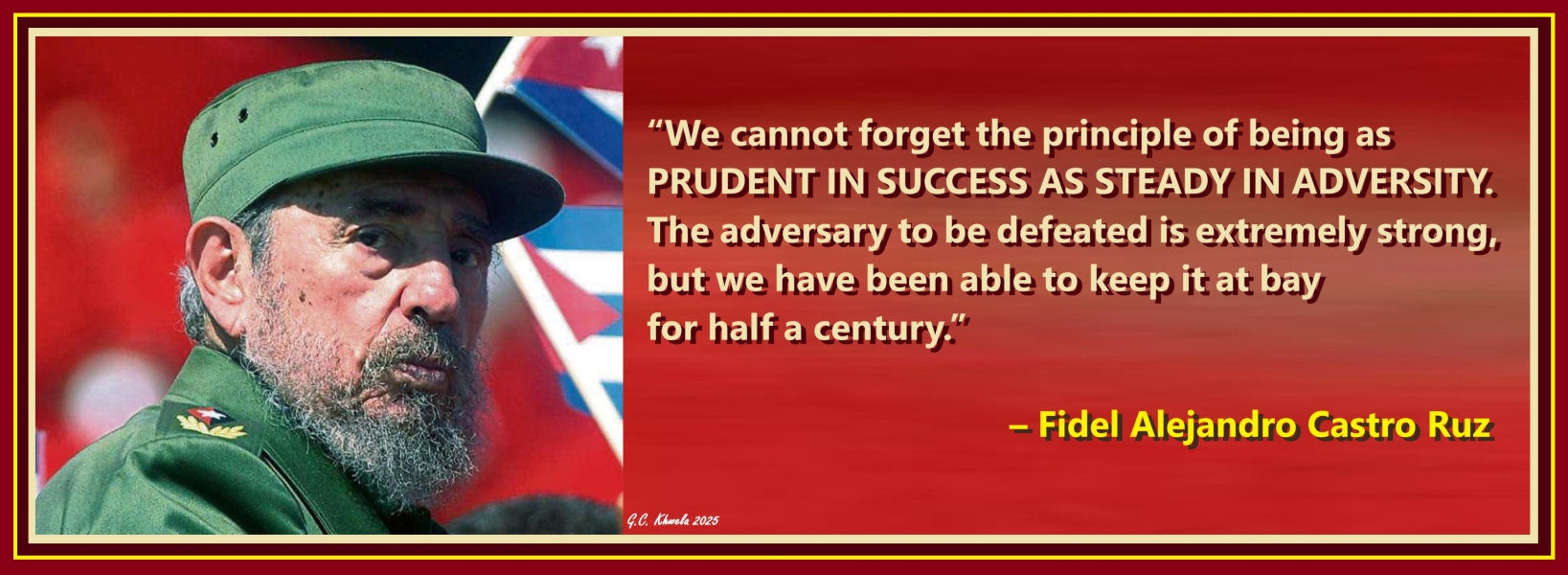
In his letter of resignation, Castro wrote, “My elemental duty is not to cling to positions, much less to stand in the way of younger persons, but rather to contribute experience and ideas whose modest value comes from the exceptional era in which I lived … We cannot forget the principle of being as prudent in success as steady in adversity. The adversary to be defeated is extremely strong, but we have been able to keep it at bay for half a century. This is not my farewell to you. My only wish is to fight as a soldier in the battle of ideas. I shall continue to write under the title: ‘Reflections of Comrade Fidel’. It will be another weapon you can count on. Perhaps my voice will be heard. I shall be careful” (Al Jazeera).
Following his recovery from intestinal bleeding, United States’ President George W. Bush said: “One day the good Lord will take Fidel Castro away”. The atheist Castro replied: “Now I understand why I survived Bush’s plans and the plans of other presidents who ordered my assassination: the good Lord protected me” (Wikipedia).
Sources:
Wikipedia
Al Jazeera, “Castro resignation: Full text”, 19 February 2008.
Angela Balakrishnan and Mark Tran, “Castro resigns as Cuban president”, The Guardian, 19 February 2008.
NPR, “Castro Resigns as Cuba’s President”, National Public Radio, Washington, D.C., 19 February 2008.
PBS, “Cuba’s Castro Resigns After 49-year Reign”, Public Broadcasting Service, Arlington, Virginia, 19 February 2008.
Anthony Boadle, “Cuba’s Fidel Castro steps down after half a century”, Reuters, 20 February 2008.
Latin America, “Fidel Castro Announces Resignation”, LATIN AMERICA WORKING GROUP, 19 February 2008.
Independent, “Fidel Castro resigns as president”, INDEPENDENT, 19 February 2008.
David Savona, “Fidel Castro Resigns Cuban Presidency”, Cigar Aficionado, 19 February 2008.
France 24, “Fidel Castro Steps Down”, FRANCE 24, 19 February 2008.
Castro Khwela
Good morning fellow Compatriots!
Discover more from CASTRO KHWELA
Subscribe to get the latest posts sent to your email.