Afrikaner Right-Wing Organisations Stormed CODESA Negotiations
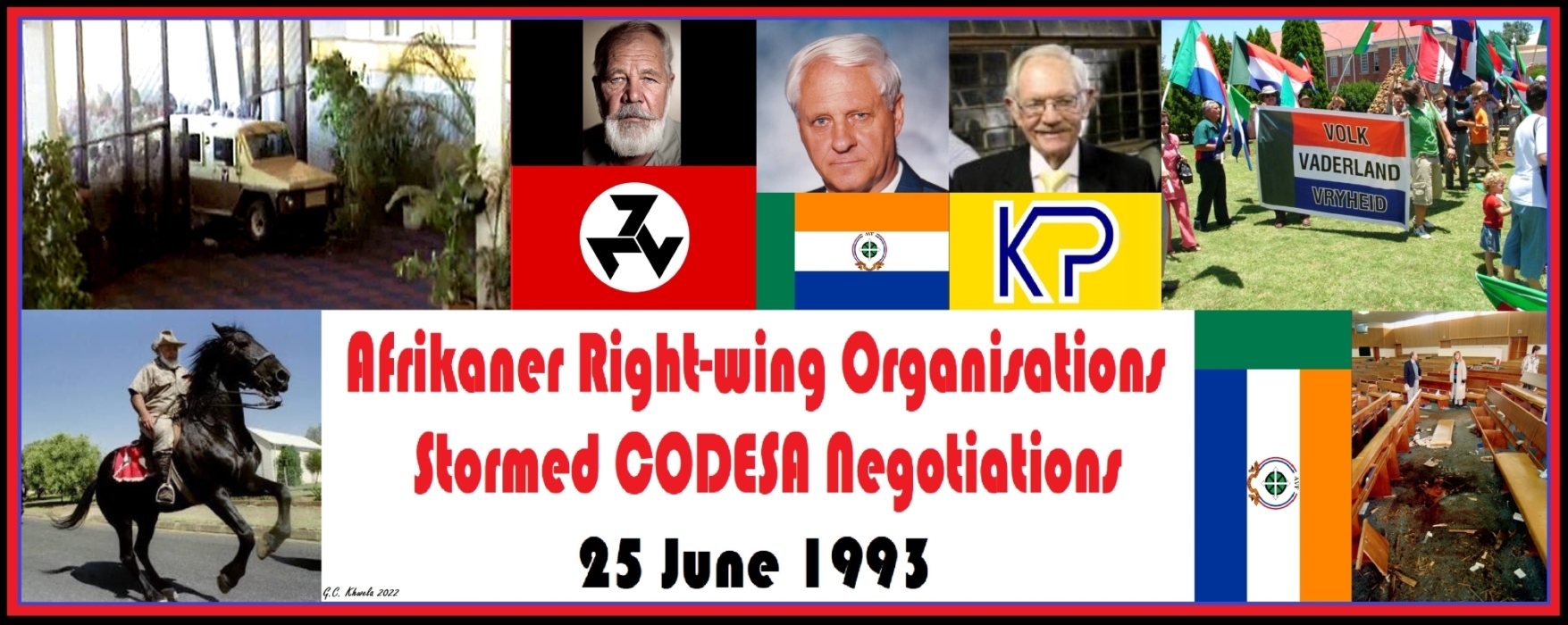
On 23 June 1993, leaders of the Afrikaner right-wing organisations held a secret meeting in an undisclosed venue near Pretoria. They included Eugéne Terre’Blanche, leader of the Afrikaner Weerstandsbeweging (AWB), Constand Viljoen, the retired Chief of the apartheid SADF and leader of the Afrikaner Volksfront (AFV), and Ferdi Hartzenberg, leader of the Conservative Party (KP). The meeting was around planning to halt the negotiations that were taking place at the World Trade Centre in Kempton Park. These negotiations were strongly opposed by right-wing white groups in South Africa.
The “White Right-Wing” consisted of all white groups and individuals who organised themselves to campaign for self-determination and who mobilised against the democratic changes sweeping South Africa in the early 1990s. Most of these groups and individuals emerged from conservative Afrikaner circles in the country. The movement away from apartheid by the National Party government during the early 1990s was regarded by some white Afrikaners as a treasonous capitulation to black political demands, which would result in the country being handed over to “communists”. In response to this perceived threat, the “White Right-Wing” began organising itself with a view to creating structures that would ensure the safety of its members and the protection of their property. Neighbourhood watches and surveillance groups (referred to as “Verkenningsgroepe”) were formed in various areas.
As the political situation progressively deteriorated from the Right-Wing perspective, radical talk and an inclination towards violence increased exponentially within its ranks. Right-wing groups showed phenomenal growth and came to accommodate a wide range of racist conservative sentiments, which also included elements from the apartheid military who joined in, bringing with them their own professional skills, such as the manufacture of explosives. At the start of the 1990s, the “White Right-Wing” embodied a large number of groups, some operating underground to avoid detection and infiltration by the security forces.
Many of the groups were characterised by splintering and leadership struggles. However, once the negotiating parties had agreed on a formula and date for democratic elections, right-wing forces began uniting to mobilise for their struggle for self-determination. From February 1990, right-wing violence took on a more organised and orchestrated form. Isolated racist attacks on individuals were replaced by mass demonstrations and orchestrated bombing and sabotage campaigns. The most dramatic of these mass actions was the 25 June 1993 occupation by members of the AWB and other right-wing groups of the World Trade Centre at Kempton Park.
From an affidavit of Hermanus Frederick Vercuiel to the Goldstone Commission, which was appointed in July 1993 to investigate the events of 25 June 1993, it appears that on 8 June 1993 Vercuiel was appointed by the Executive Committee of the AVF to arrange the protest meeting at the World Trade Centre on 25 June 1993. On 22 June 1993 a meeting took place between the AVF, the apartheid South African Police (SAP), the apartheid South African Defence Force (SADF) and the Kempton Park Traffic Department.
At the meeting it was agreed that: The participants would park their cars on a rugby field of the South African Airways which is the vicinity of the World Trade Centre; they would hand over their firearms for safe keeping at a mobile police station (two caravans) in the vicinity of the World Trade Centre; Officials of the AVF would actively assist in ensuring that the participants in possession of firearms would hand them over to the SAP.
During a telephone conversation on 23 June 1993, it appeared that it was not practical for all the firearms to be handed in at mobile police stations. According to the SAP it was agreed that weapons would be left by the participants in their motor vehicles, which would be kept under constant surveillance by members of the SAP. It had previously been agreed between General Constand Viljoen and General J van der Merwe, the Commissioner of Police, that bodyguards of AVF leaders, clearly identified by armbands, would be in open possession of firearms. According to the statement of Vercuiel, it was agreed with the SAP that no other participants would be allowed openly to carry firearms, but they could do so if they were concealed.
The SAP maintained that it was never agreed that participants would be allowed to carry concealed firearms. It was reiterated and again agreed at a meeting held on 24 June 1993 that, apart from twelve clearly identifiable bodyguards, no participant would be in possession of a firearm. Whatever the precise terms of the agreement between the AVF and the SAP, it was an unambiguous condition of the local authority’s permission for the meeting to be held that there would be no firearms allowed at the meeting; The leaders of the AVF, including Mr Terre’Blanche were aware that in terms of the law the carrying of arms in the area was unlawful. It is not in dispute that the AVF leaders gave solemn under-takings to the SAP that the gathering would be peaceful and that property would not be damaged.
On 24 June 1993, Vercuiel was informed by some of the prospective participants that the area allocated for the meeting outside the gate of the World Trade Centre was too small. Adv T Langley, a member of the Conservative Party’s negotiating team at the Multi-Party Negotiations, was approached by Vercuiel and requested to seek permission for the meeting to be held on a grassed area inside the premises of the World Trade Centre. Until then such permission had been refused. Mr Langley was unsuccessful in obtaining such permission from the Planning Committee at the World Trade Centre.
Again, on 24 June 1993, the Negotiating Council published the “Revised Proposed Guidelines for Demonstrations”, and a copy was handed to the SAP on 24 June 1993. On the basis of its initial intelligence, the SAP decided to make available 200 policemen at the World Trade Centre. However, by 23 June 1993, the SAP received information that as many as 10 000 to 15 000 people might attend the meeting. Although they believed this was an exaggerated figure, the number of policemen was increased from 200 to 700. Following the meeting which was held at approximately 07:00 in the morning of 25 June 1993, and in the light of a belligerent attitude displayed by Mr Terre’Blanche, the SAP decided to engage Unit 19 of the Internal Stability Division. However, it only arrived at 11:00 after the incidents had taken place at the World Trade Centre.
On 25 June, while talks between the National Party (NP), the African National Congress (ANC) and other negotiators were taking place, a cry was heard at approximately 08:00 from the AWB members who were positioned outside the perimeter fence. According to reports, a protest led by the AVF was scheduled for 25 June outside the negotiation venue. At 08:00 protesters began arriving, and began harassing delegates to the negotiations. The mood had begun as a festive one, with AWB supporters bringing their families, as well as barbecuing equipment and other provisions, associations one would normally make with a peaceful sit-in or protest.
However, the mood changed for the worse when members of Terre’Blanche’s personal bodyguard wing, the Ystergarde (Iron Guard), began rocking cars; many were armed, paramilitary members of various right-wing organisations, carrying firearms and other weapons. Some 2 000 of them then surged forward, led by their leader Eugéne Terre’Blanche. The police manning the gate stepped aside for the AWB men, who after entering the compound, went across 200 metres of the open field to the main building.
At approximately 09:00, Terre’Blanche ordered one of the AWB’s armoured vehicles, a ‘Viper’ armoured vehicle, to crash through the glass windows of the World Trade Centre, thus allowing supporters, carrying firearms and chanting “AWB”, to invade the premises. Police attempted to form a cordon to prevent the invasion but were ineffective. A police captain who tried to prevent the vehicle from breaking through was assaulted and suffered internal bleeding.
Once inside, the right-wingers, in black and khaki uniforms, were effectively left in control of the building while the multi-party negotiation delegates took cover by hiding in meeting rooms. Among them were Joe Slovo, Roelf Meyer and Cyril Ramaphosa. The policemen standing guard at the door were telling them to lie on the floor if they happen to hear any shots.
Terre’Blanche, Viljoen and Hartzenberg then walked through the breach opened up by the armoured vehicles and strode up to speak to government officials. The protesters painted slogans on the walls, urinated over furniture, and harassed delegates. Damage was estimated at more than R700 000. The protesters also held a prayer meeting in the main negotiating chamber. Before leaving, negotiations with the police were held in which it was agreed that none of the members would be arrested that day. The departure was peaceful compared to the entrance. General Constand Viljoen later denied that the invasion was planned by the Afrikaner Volksfront (AFV) as part of their protest and criticised the AWB members who had “got out of hand”.
The Goldstone Commission, headed by Justice Richard Goldstone, which was tasked with investigating the protest, found that the South African Police Force protecting the negotiations had been completely ineffective; that the AWB members had acted as hooligans. It made recommendations to further restrict public carrying of weapons, paramilitary uniforms and face covering during demonstrations. A report published in the Christian Science Monitor the following Monday, 28 June 1993, observed that if the storming of the World Trade Centre was aimed at halting the momentum of the talks, it failed.
Following this ghastly incident at the World Trade Centre in Kempton Park, the Umkhonto we Sizwe (MK) commanding structure and the apartheid SADF generals struck a deal on the formation of a neutral peacekeeping force, which was to consist of between 7 000 and 12 000 men. The peacekeeping force was envisaged to be composed of the apartheid SADF, the SAP, MK and members of the other liberation movements, as well as members of the Bantustan forces.
Sources:
Wikipedia.
South African History Online (SAHO).
South African History Archives (SAHA).
R.J. Goldstone, “Goldstone Commission on AWB invasion of Multi-Party Negotiations at WTC”, Goldstone Commission of Inquiry, 13 July 1993.
Thula Simpson, “Umkhonto we Sizwe: The ANC’s Armed Struggle”, Penguin, 2016.
Castro Khwela
Good evening fellow Compatriots!
Discover more from CASTRO KHWELA
Subscribe to get the latest posts sent to your email.