Umkhonto Penetrating Mozambique Alongside FRELIMO Forces
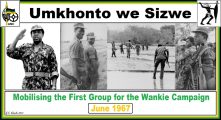
On 20 June 1967, the African National Congress (ANC) leadership decided that infiltration through Mozambique was impracticable. Umkhonto we Sizwe (MK) soldiers would have had to cross hundreds of kilometres of territory controlled by the Portuguese forces, and their inability to speak the local language would have vastly added to the possibility of discovery. The original idea was for MK team to infiltrate South Africa in the northeastern part, to go and create bases, mobilise people and fight there.
This decision followed a report on an attempt in May 1967, when a group of MK cadres led by Josiah Jele was sent to northern Mozambique to investigate potential infiltration routes into South Africa. The ANC leadership was facing mounting pressure from the MK cadres at the MK Kongwa Camp, near Dodoma, in Tanzania, to explore every possibility for sending guerrillas back to South Africa. This included finding a route through South West Africa, even though the South West Africa People’s Organisation (SWAPO) considered that impossible in the light of escalating armed conflict in the region. The unit that was led by Josiah Jele was to seek a passage via Mozambique to the northeastern corner of South Africa.
In early May 1967, Sandi Sijake, Spy Motsela and Duncan Khoza were collected from Kongwa by ANC Secretary General Duma Nokwe to Morogoro, where they found Tennyson Makiwane, Josiah Jele, George Tau, Linda and Kalamas waiting for them. Thereafter they all drove to Dar es Salaam, and the following day to a house wherein they were welcomed by the ANC Deputy President Oliver Tambo, the Treasurer General Moses Kotane and the MK Army Commander Joe Modise. Deputy President Tambo then informed the seven combatants that they were being sent to Mozambique to find out if they could reach South Africa through the liberated areas under the control of the Mozambican Liberation Front (FRELIMO).
The seven of them were then issued with AK-47 assault rifles, ammunition, camouflage uniform, green army caps, rucksacks and water bottles. They were then informed by Joe Modise that their Commander would be Josiah Jele, his Commissar being George Tau and Duncan Khoza was to be the communications officer. Just after they were issued their military packages, one of the leaders of FRELIMO, Joachim Chissano, arrived at the same house. Chissano then informed them that FRELIMO had liberated two northern provinces of Mozambique’s eleven provinces, Cabo Delgado and Niassa, and that the team was to be briefed and assisted by other FRELIMO commanders regarding their mission.
After being driven on a long journey in a truck and a Land Rover by FRELIMO combatants, they arrived in southern Tanzania, in a FRELIMO camp called Netzingwe, at the border which demarcates Mozambique from Tanzania. They were then placed in the company of Samora Machel, who was then the Commander-in-Chief of the FRELIMO armed forces, the People’s Forces for the Liberation of Mozambique (FPLM). Samora Machel, whom they knew from Kongwa since the time when FRELIMO began the armed struggle in 1964, had replaced Filipe Samuel Magaia, who was assassinated by a Portuguese agent on 10 October 1966.
Although FRELIMO had liberated two of Mozambique’s provinces, Machel was doubtful that the MK team would be able to reach South Africa, since FRELIMO had not then been able to advance, penetrate and create structures in southern Mozambique, which they were supposed to pass in order to reach their destination. Utilising both Cabo Delgado and Niassa provinces as liberated zones, FRELIMO was extending its operations into Nampula, Zambezi and the eastern part of the Tete province. In the evening, the MK team was joined by twenty FRELIMO combatants as they drove into Mozambique’s Niassa province, after crossing the Ruvuma River.
At Niassa province, the MK team was welcomed by Armando Pangwene, who was the overall Commander of the FPLM guerrilla operations in Mozambique. Commander Pangwene then handed over the MK team to Commander Abuda, who was to take over the command, and Adelino Sithole, who spoke good English, and the two were to take them to the FRELIMO main base in northern Mozambique. It became a five-day walk through the bush to the main base, and on the way, a Portuguese spotter aircraft flew over them, and this was followed by another one that dropped two bombs, but none of the FRELIMO or MK cadres were wounded.
Ultimately the group reached the main base where they were inducted into the activities of the base personnel. After a few days’ rest at the main base, the MK team informed their Commander, Josiah Jele, that they were ready to move further south to investigate the possibilities of getting into South Africa. Commander Abuda then took the group to the front, which was said to be at the edge of the Tete province, where guerrilla operations against the Portuguese had commenced. The MK team was informed that the southern provinces, which bordered on South Africa, had not yet been liberated. Furthermore, that the Mozambicans in the south were not sufficiently politicised to offer the logistical support MK cadres would need in order to survive.
According to the FRELIMO cadres that operated in the frontline of the Tete province, the MK team had to walk through parts of the Tete and Zambezi provinces, and the length of the Manica into Gaza province to reach the Kruger National Park in South Africa. The entire area they had to go through was hostile territory where FRELIMO had no presence. It soon became clear that MK would not be able to reach South Africa through Mozambique, and instead Jele and his comrades used their time in Mozambique very well in observing the organisation and strategy of FRELIMO and gaining permission to take part in some operations in order to gain field experience.
During their six-week stay, they visited several FRELIMO bases, some located deep inside those parts of Mozambique in which the Portuguese forces held sway. For Josiah Jele, they gained a lot of experience, as the MK team, which was then used to train some of those who were infiltrated into Southern Rhodesia. Some of the MK cadres who were part of the MK team also went into Wankie to fight there in order to impart their experiences. Unfortunately, after six weeks, Commander Abuda informed the team that the FRELIMO and ANC leadership had ordered their return to Tanzania, and that they would be escorted to the base on the Ruvuma border.
Late that evening they began their march to the Ruvuma River, and in the morning when they reached a large patch of tall grass sparsely dotted with shrubs, they experienced gunfire approximately 200 metres ahead of their positions. They then took cover and returned fire, thus allowing the advance party to retreat and join the group. When they withdrew to the nearby bush, trying to locate the rear section, they realised that twelve of the entire group was missing, including the MK Commander Josiah Jele. They began discussing the possibilities of attacking the enemy, which was turned down on the basis that it wasn’t the best option, as it was not a freedom fighter’s culture to fight on enemy’s terms.
The argument put forward by Commander Abuda was that they had no information about the enemy’s position, weaponry or deployment. The main focus was to locate the missing section, which had been approximately 200 metres behind the main group. However, Commander Abuda emphasised that they should move on before the enemy support helicopters and bombers arrived, and they all agreed considering the possibilities of being caught in battle against Portuguese ground and air forces. With Josiah Jele missing, it fell upon George Tau to command the MK team. What followed was a hazardous journey back to Tanzania, during which Jele was separated from his Commanders and spent 10 days alone with a Frelimo soldier.
Jele also described how the MK unit and Frelimo forces were ambushed while making their way back to Tanzania. The 10 days he and his Frelimo comrade spent marching towards Tanzania was one of his most difficult experiences. They had lost their compasses, had very little food and no water, and were faced with a communication problem because they did not speak the same language. Indeed, the ANC struggled during these years in its major objective to open a trail back into the country, which provided important lessons to the Movement at the 1969 Morogoro Conference.
Sources:
Rendani Moses Ralinala, Jabulani Sithole, Gregory Houston and Bernard Magubane, “Chapter 12: The Wankie and Sipolilo Campaigns”, The Road to Democracy in South Africa, Vol. 1, 1960-1970, South African Democracy Education Trust (SADET), 2015.
Thula Simpson, “Umkhonto we Sizwe: The ANC’s Armed Struggle”, Penguin, 2016.
Sandi Sijake, “Fighting for My Country: The Testimony of a Freedom Fighter”, Jacana, 2024.
Castro Khwela
Good evening fellow Compatriots!
Discover more from CASTRO KHWELA
Subscribe to get the latest posts sent to your email.