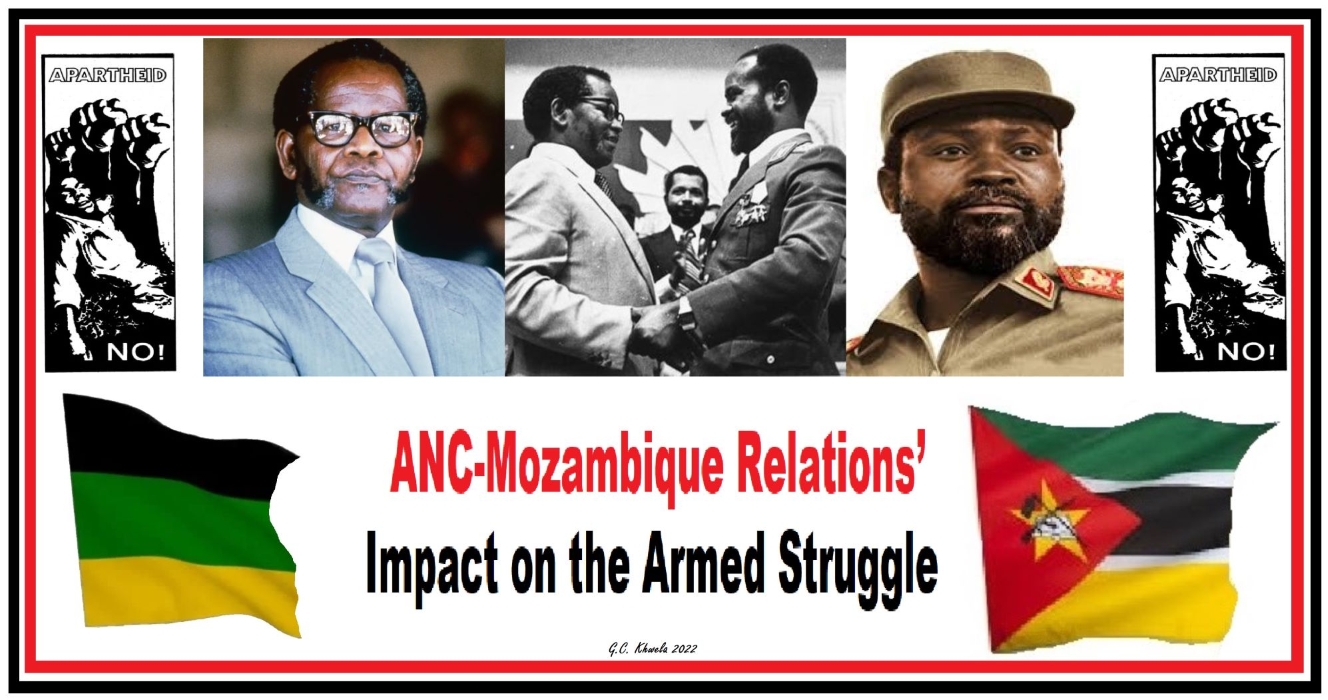
ANC-Mozambique Relations’ Impact on the Armed Struggle
On 30 May 1983, a New York Times newspaper article maintained that “Mozambique could be ruined by South Africa, and that appears to be the reason that its leaders have sought to disperse concentrations of African National Congress (ANC) personnel in its capital and have moved some of them to the northern province of Nampula”.
This article was followed by a report that arrived on 14 June 1983 at the headquarters of the apartheid South African Defence Force’s Special Forces at Voortrekkerhoogte, which was alleging that the ANC was developing a base in Mozambique’s Nampula province. According to the report, the camp was located 12 kilometres north-west of a small centre called Mecuburi, which in turn was located north-west of the town of Nampula. The camp was an old farm called Impirima, which was previously owned by a Portuguese rancher, and it was started in June 1982, without special fencing around, except for a normal cattle fence covering 600 hectares of land.
The camp was in reality a product of tensions that were evolving between the ANC and the Mozambican authorities, which were mainly prompted by pressure from the racist South African government over increasing armed activities, conducted by Umkhonto we Sizwe (MK) within South Africa. Actually, the South African authorities had set themselves the goal of eliminating the ANC presence in the neighbouring states. They applied a carrot-and-stick policy to secure their neighbours’ co-operation. These methods were applied intensively to Mozambique.
In March 1983, at a meeting between ANC representatives and the Mozambican authorities, the Mozambicans for the first time reported on the contacts they had had with the apartheid South African government. It was at this meeting that the Mozambicans insisted on the withdrawal of about 150 MK cadres from Maputo to the camp in Nampula, also insisting that they would not be allowed to have armaments for self-defence, despite the fact that RENAMO, the rebel Mozambican Resistance Movement, that was supported by Pretoria, was already active in area.
Meanwhile, on 5 May 1983, South African Foreign Minister Pik Botha met with Mozambique’s Joachim Chissano in Komatipoort, wherein Pretoria expressed its preparedness to cease its support for RENAMO “in exchange for the transfer of black nationalist guerrillas of the ANC from their sanctuaries in Maputo to northern Mozambique”.
During a debate on foreign affairs in the House of Assembly on 11 May 1983, apartheid Foreign Minister Botha threatened war against the neighbouring states if they continued to “harbour guerrillas”, and was supported by the spokesperson of the New Republic Party (NRP), Brian Page, who maintained that “if any of our neighbours harbour enemies of this state who are committed to the overthrow of the legitimate regime, then they must accept the consequences, which will include pre-emptive strikes, hot pursuit and the rest. This is unavoidable and in our opinion does not constitute destabilisation.”
Later that month, during the debate on defence-related matters, Harry Schwarz of the opposition Progressive Federal Party (PFP), called on the apartheid government to increase spending on military hardware to enable the military to carry out its task. His complaint was that there was a lack of understanding in South Africa of the nature of the threat facing the country.
Following the Pretoria, Church Street bombing, on 20 May 1983, the apartheid South African Air Force (SAAF) undertook a revenge raid against ANC targets in Maputo on 23 May. A month later, on 6 June 1983, General Constand Viljoen, the Chief of the apartheid South African Defence Force (SADF), in an interview with the New York Times newspaper, asserted that South Africa was determined to deny the ANC “bases in all our neighbouring states, either through the cooperation of the states themselves, or by means of military action against the bases”.
Prior to these threats, at the Seventh Summit Conference of the Non-Aligned Movement (NAM), which took place in New Delhi, India, from March 7 to 12, 1983, Mozambique President Samora Machel declared that “We are faced with a racist, colonial, bellicose regime. South Africa is the Nazism of our time.” He accused the Botha regime of recruiting “drug addicts, bandits, criminals and subversives” to destabilise the independent states of Africa opposed to Pretoria’s policies. However, following apartheid’s retaliation to the Pretoria, Church Street bombing, on 23 May 1983, by sending the SAAF aircraft to bomb the capital, Maputo, the Mozambican authorities reacted negatively towards the ANC, by imposing restrictions on its cadres’ movements and confiscating weapons from houses that belonged to its members.
The ANC leadership decided to rescue the situation and decided to send President Oliver Tambo and Secretary-General Alfred Nzo to Mozambique on 9 January 1984 to meet with Mozambican President Samora Machel and the Minister of Security, Mariano Matsinhe. President Machel received them in the Island of Bilem, wherein he described the difficulties Mozambique was facing and the reasons for signing a treaty with Pretoria. However, he avoided discussing the position of the ANC in his country; instead he offered advice on the ANC ceasing to be a liberation movement, and instead fighting for political, democratic and human rights. He also mention that the ANC should not try to pose as a communist party, especially with the close links it had with the South African Communist Party (SACP), as it made the ANC to appear to be a tool of the Soviet Union.
On 14 January 1984, a follow-up meeting was undertaken between Mozambique’s security minister, Matsinhe, and an ANC delegation led by Oliver Tambo. Matsinhe informed them that the implication of the talks with South Africa was that the ANC would not be allowed to engage in any form of underground activity against South Africa from Mozambican soil. Secondly, the ANC presence in the country would be reduced to a diplomatic mission. Finally, MK Chief of Staff, Joe Slovo, would have to leave Mozambique. Tambo then proposed that the ANC delegation should be allowed to return to Mozambique shortly with the response of its National Executive Committee (NEC), to which Matsinhe agreed.
On 25 January 1984, the NEC of the ANC, held a joint meeting with the Politico-Military Committee, wherein they drew up a document titled “Decisions and Suggestions from the NEC/PMC Meeting of 25th Jan 1984”, which consisted of a list of numbered points. It began by recommending that the ANC should consult with regional countries like Tanzania, Zambia, Zimbabwe, Lesotho and Botswana, to understand their thinking on the then evolving situation. The document further recommended that a new delegation, led by Tambo, should convey to Samora Machel and his ministers the view that the ANC regarded these developments as the most serious blow to the movement since its banning in 1960.
The betrayal of the ANC would mean the betrayal of the revolutionary gains in Mozambique and in southern Africa as a whole. The ANC had started its struggle long before the independence of Mozambique and would continue it. Furthermore, the document emphasised that the ANC could not rescind its decision to engage on the armed struggle, and that the decision by the Mozambican authorities was tantamount to saying it must stop the armed struggle.
Moreover, the document urged the leadership to uncover from the Mozambican government the implications of only allowing the ANC to have a diplomatic presence in Mozambique. Without the armed struggle, the document continued, the struggle for liberation in South Africa would be dead, and accordingly the ANC would not be party to its own self-destruction. Therefore, it concluded that the ANC should be angry and aggressive, as well as provide Mozambique the benefit of its own overall analysis of the situation, primarily show that if the trend Mozambique was pursuing continued, it would represent capitulation to imperialism.
At the 19th Summit of the Heads of State and Government held in Ethiopia on 6 – 12 June 1983, the Organisation of African Unity (OAU) adopted a resolution that strongly condemned the “apartheid regime for the stepped-up internal repression, assassination of ANC members and leaders as well as the criminal acts of terrorism and massacres repeatedly carried out by the Pretoria regime against innocent South African refugees and nationals of the neighbouring countries”. The OAU further declared the “Pretoria regime’s continued system of apartheid and acts of internal repression and terrorism as well as act of destabilisation and aggression against the Southern African independent states constitutes a threat to world peace and international security”.
The OAU reiterated its “full and unswerving support for the struggle against the apartheid regime in all forms especially the armed struggle for the seizure of power by the people of South Africa”. Furthermore, it commended the “Front Line States and Lesotho for the courageous sacrifice they are making in resisting the policies of blackmail and intimidation pursued by the apartheid regime in order to coerce them to abandon their traditional position of giving moral and political support to the Liberation Movement of South Africa including the grating of political asylum to refugees.” The ANC was also commended by the OAU as “the vanguard of the National Liberation Movement of South Africa, for the continued intensification of the armed struggle”, and it saluted “the combatants of Umkhonto we Sizwe (MK) who continue to register victories”.
Speaking in Maputo, at the Fourth Congress of the Mozambique Liberation Front (FRELIMO), in April 1983, ANC President OR Tambo asserted that “Our bases are in South Africa itself, our bases are among the people of our country, in the cities, in the mountains … The regime cannot find these bases. Therefore, it invents mythical bases in neighbouring territories. For it is easier to massacre refugees in their beds or to send bandits to murder teachers and health workers in Juham than it is to stop the revolutionary process inside South Africa itself. That is why we have war in Southern Africa, and why we will never have peace in our zone as long as apartheid exists.”
“And this is the greatest pledge we can make to the people of Mozambique,” Tambo continued, “as represented at this Congress: We will spare no effort to increase our blows against the apartheid system, to unite the broadest sections of the South African people in concerted action against it, and to destroy once and for all the most direct and pressing source of oppression and war in our zone.”
A Luta Continua! A Vitória é Certa!
Sources:
Editorial Notes, “Hands Off the Frontline States!”, The African Communist, no. 95, Fourth Quarter 1983.
ANC President OR Tambo, “The Unity of Our Peoples”, Sechaba, July 1983.
Sechaba Reporter, “OAU Resolution on South Africa”, Sechaba, September 1983.
Thula Simpson, “Umkhonto we Sizwe: The ANC’s Armed Struggle”, Penguin, 2016.
Vladimir Shubin, “ANC: A View From Moscow”, Jacana, 2008.
Castro Khwela
Good day fellow Compatriots!
Discover more from CASTRO KHWELA
Subscribe to get the latest posts sent to your email.