De Klerk Addresses Parliament as New National Party Leader
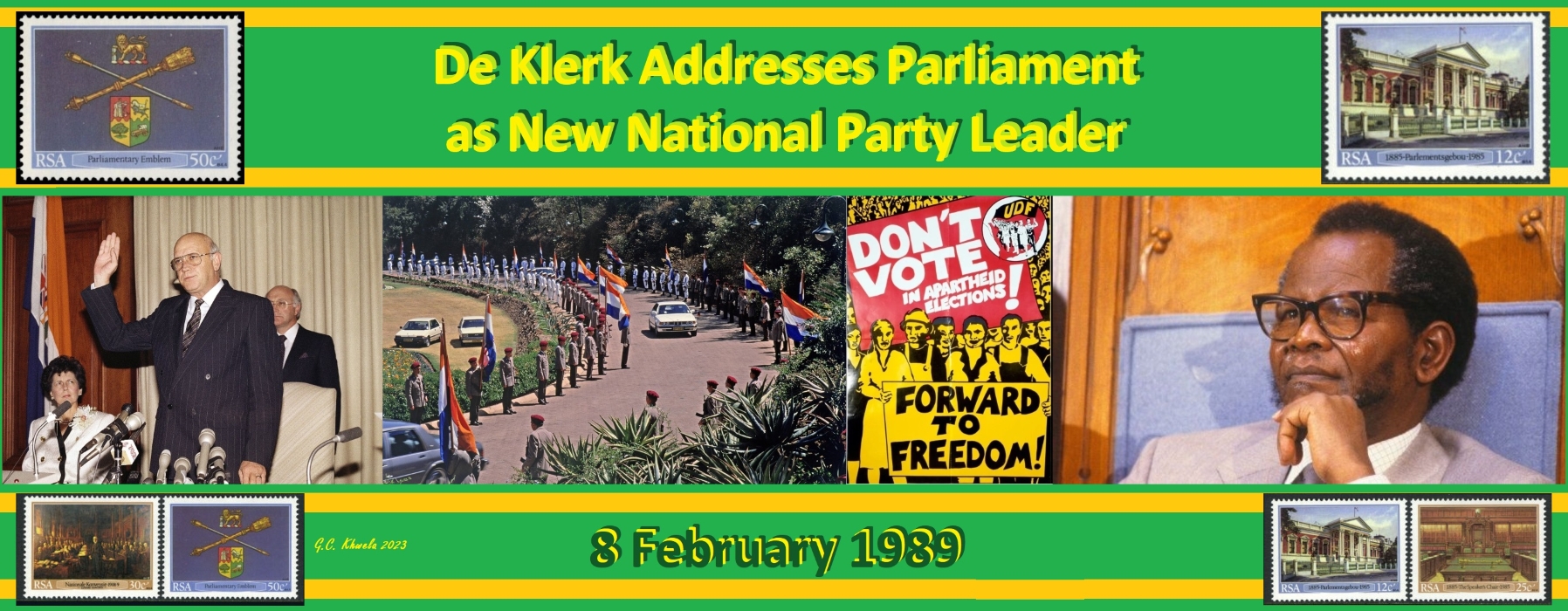
On 8 February 1989, F.W. de Klerk made his first major statement as National Party leader, when addressing the Tri-cameral Parliament, after being elected on 3 February when P.W. Botha unexpectedly resigned his leadership position as party leader. In his speech De Klerk said, “I want to state unequivocally that the National Party is against domination of any one group by others. White domination, in so far as it still exists, must go”.
According to De Klerk, this was based on a firm commitment to “group rights, alongside individual rights, is based on the reality of South Africa and not on an ideological obsession or racial prejudice” (Associated Press, 8 February 1989). Furthermore, De Klerk maintained, that “all the people of South Africa, whether they be black, white, Indian or coloured, must have a vote, must elect their leaders, and must, through their leaders, become part of all decisions affecting their lives. They must therefore become involved at all levels of government in such a way that no one group will be able to dominate the other” (The Times, 19 May 1989).
While De Klerk was more willing to compromise with the government’s opponents than was the case with autocratic Botha, it was becoming apparent that he still intended to focus his attention on protecting the interests of the white minority. He said he envisioned a system of government in which decisions were made by consensus and disputes settled by “a fair referee”.
For example, during a press conference in Cape Town, on the evening of 8 February 1989, De Klerk emphasised his belief that a “typical one-man-one-vote leads to majority rule, which would be catastrophic for South Africa” (Independent, 9 February 1989). For De Klerk (The Times, 19 May 1989), support for a one-person, one-vote system “would inevitably lead to majority rule and (black) domination … and is therefore totally unacceptable”. He called on those demanding such a system as pursuing “an unattainable non-racial Utopia”.
Under De Klerk, the entire State apparatus was channelled toward ensuring the successful completion of the negotiation process, a battle for steering the narrative. De Klerk knew he had to move quickly and in time before the government’s hand could be weakened. He had to act from a position of strength in order to succeed in the political negotiation while appeasing his detractors, the business community and moderates. He had to project control over the liberation process, commanding and constructing the national narrative. While De Klerk thought “Botha was a good administrator”, he critiqued “the negative aspects of P.W. Botha’s managerial style”, vowing to himself to “change all this if I ever became president” (Independent, 9 February 1989).
Meanwhile, the President of the African National Congress (ANC), Oliver Tambo, responded to the address on 9 February 1989, saying “De Klerk’s reform does not mean anything”. Tambo’s comment was primarily based on De Klerk’s reaffirmation of the pledge made by P.W. Botha before to reject the system of one-person-one-vote. Tambo contended that “we are back to square one, because if you do not accept the system, then, white domination stays in place” (Xinhua, 9 February 1989).
In its Editorial, the ANC official journal “Sechaba” (Vol. 23 No. 4, April 1989), maintained that “The apartheid regime is in disarray, and pulling in different directions. The racists don’t want to relinquish their privileges, but can’t agree on how to cling to them. The followers don’t know what leader to follow, with PW Botha refusing to go, and (Chris) Heunis, De Klerk and others taking their turn to talk of ‘reforms’ … When they speak to their followers, it seems that not Botha, not De Klerk, not Heunis, dare address the real problems looming behind their ‘leadership crisis’ and their confusion.”
The Editorial concluded that “There is no confusion here; only political clarity, planning, discipline, and a determination to be free. It is the democratic forces that hold in their hand the future of our country; and that is the racists’ most serious problem of all.”
Speaking to the Ordinary Congress of the Socialist International in Stockholm, Sweden, on 20 June 1989, ANC President Oliver Tambo maintained that “Our commitment to a non-racial society cannot encompass any division by law of the South African people along lines of race or ethnicity, nor the exercise of political rights through separate institutions of government defined in similar terms. The rights of all South African citizens can and will be guaranteed in a Bill of Rights” (Sechaba, Vol. 23 No. 8, August 1989).
According to Tambo, “Our democratic system must provide for the equal participation of all South Africans in decision-making. There can be no doubt that the franchise at all levels must be for common political institutions on the basis of one person, one vote, one constituency. … The reforms that have been promoted by the Pretoria regime are not a translation into policy of these aspirations of the majority. These changes that have been made do no arise from any desire to dismantle apartheid, but are an expression of the ideas of the ruling group acting in the interests of the White minority in order to deflect domestic and international pressure.”
“Central to all the reforms made and proposed is the concept of group rights. We reject”, Tambo stressed, “both the concept and the premise upon which it is based: namely that South African society is composed of mutually incompatible peoples, whose survival and freedom is dependent on political and geographic segregation. … The concept of group rights, which provides a minority with a veto over the wishes of the majority, carries with it the seeds of continued division and conflict, and hence cannot provide lasting peace or security for either the minority or the majority, whereas a non-racial and democratic system provides a basis for building an enduring security for all South Africans” (Sechaba, Vol. 23 No. 8, August 1989).
Sources:
“New Party leader pledges Black rights, White segregation”, Associated Press, 8 February 1989.
“De Klerk sticks to Botha line”, Independent, 9 February 1989.
“Botha Heir Apparent Vows Drastic S Africa Changes”, The Times, 13 May 1989.
“ANC leader dismisses South Africa’s reform pledge”, Xinhua, 9 February 1989.
“Editorial”, Sechaba, Vol. 23 No. 4, April 1989.
“President Tambo on Negotiations”, Sechaba, Vol. 23 No. 8, August 1989.
Castro Khwela
Good day fellow Compatriots!
Discover more from CASTRO KHWELA
Subscribe to get the latest posts sent to your email.