Apartheid Minister Kobie Coetsee on the Mandela-Botha Meeting
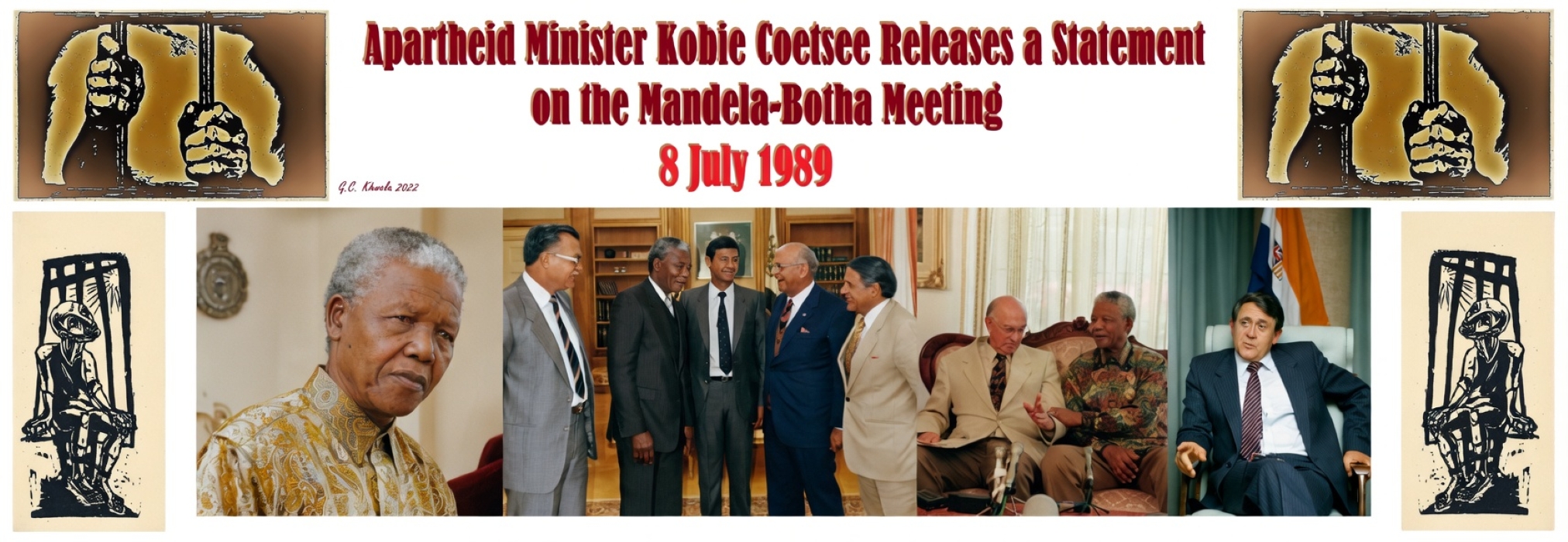
On 8 July 1989, three days after the meeting between apartheid President P.W. Botha and Nelson Mandela, Kobie Coetsee, the apartheid Minister of Justice, issued a statement, with Mandela’s permission, about the meeting. The statement was interestingly compiled by Mike Louw, Deputy Director-General of the National Intelligence Service (NIS), which explained that no policy matters were discussed and that no negotiations took place. However, both Mandela and Botha confirmed their support for “peaceful development in South Africa”.
Subsequently, the news bothered the African National Congress (ANC) and its revolutionary allies, as they were unaware of the developments happening between Mandela and the apartheid government. In Orlando, Soweto, at a news conference held at the Mandela house, Winnie Mandela and the General-Secretary of the South African Council of Churches (SACC), Reverend Frank Chikane, dismissed the meeting as a political ploy to mislead the masses and the international community.
In addition, the Spokesperson of the ANC in Lusaka, Tom Sebina, maintained that the meeting was not to be regarded as the beginning of the negotiation process, but a mere gimmick by the Botha regime to gain an upper hand on the then pending white elections. The ANC office in London also did not believe the news, and accordingly issued a statement declaring that Mandela was outmanoeuvred by the racist regime and was selling the Movement down the river. It was possible that this was an exercise by P.W. Botha to polish his ego in order to cover up his stroke. The South African Communist Party (SACP) was also dismayed by the news, as it viewed the meeting as a concerning eagerness for power, which could probably lead to a strongly repressive state.
On 10 July 1989, Winnie Mandela visited her husband at Victor Verster Prison to confirm the veracity of Coetsee’s statement. Mandela instead reprimanded her for casting suspicions on the talks with the apartheid government. Following confirmation that indeed the meeting did take place between Mandela and P.W. Botha, Bishop Desmond Tutu reacted positively to the news and saw the process as an attempt, after a long time, to listen to the calls for negotiations. However, he regretted the fact that the meeting was held unexpectedly and without prior information. Also, on behalf of the South African Council of Churches (SACC), Reverend Chikane thanked Mandela and praised him for the effort.
The engagement with Botha did not happen spontaneously, as a result of Mandela being outmanoeuvred by the racist regime, or without prior knowledge of his comrades, including ANC President Oliver Tambo. When the regime began engaging Mandela through Kobie Coetsee in 1987 and proposed to discuss serious proposals through a Special Committee, headed by Coetsee himself, Mandela made it clear to them that he wanted to meet with his comrades first before he could proceed with such engagements.
Secondly, he mentioned that it was critical that he should communicate with Oliver Tambo in Lusaka about what was taking place. And lastly, he intended to draft a memorandum to P.W. Botha, which laid out the views of the ANC on the vital issues affecting the country that would create talking points for any future engagements.
Mandela met and discussed the matter with his Comrades and even received a note from Oliver Tambo who was showing concerns about reports that Mandela was meeting with the racist regime. Mandela responded to Tambo’s note in a concise letter, telling him that yes he was talking to the government “about one thing and one thing only: a meeting between the National Executive of the ANC and the South African government”. Before Mandela submitted the memorandum he drafted to P.W. Botha, he made sure that Tambo got it first, in order to allay his fears and that of the National Executive of the ANC that he had not veered off the road with engaging the racist regime.
There was nothing sinister about Kobie Coetsee, the apartheid Minister of Justice, issuing a statement about the meeting between Nelson Mandela and apartheid President P.W. Botha, as this was done with Mandela’s permission. The challenge, however, was that the meeting was held in secret and the arrangements were not communicated to the general public as well as to some in the leadership of the ANC and the SACP. Hence mixed reactions were received regarding the meeting, which was nonetheless later clarified by Mandela himself, by the ANC President Oliver Tambo and by the South African Council of Churches (SACC).
Kobie Coetsee, whose original motive was to neutralise Mandela by offering him freedom in exchange for a public renunciation of violence, was among the first Afrikaner nationalist politicians to grasp the truth that white minority rule really was doomed. However, for those in the military establishment who still harboured intentions to neutralise the “Mandela figure” in South African and international circles, the news came down as a huge shock. It was accepted with a sense of disbelief that, under their noses and without their knowledge, the “Groot Krokodil” (Great Crocodile) had shaken hands with the world’s most famous living “terrorist” (Barnard).
The strategic release of the photograph of the 5 July 1989 meeting between Nelson Mandela and State President P.W. Botha at Tuynhuys was a carefully calculated psychological and political operation, which was orchestrated by Niël Barnard, head of the National Intelligence Service (NIS) and Minister of Justice Kobie Coetsee, to condition the public and manipulate the political landscape. Their core intentions behind leaking and releasing the image focused on several key outcomes.
For over three decades, the apartheid regime had demonised Mandela and the ANC as “communist terrorists” with whom negotiation was impossible. The NIS intended to use the visual medium to break this psychological barrier. By showing a smiling, smartly dressed Mandela standing alongside the fiercely hardline P.W. Botha, the image shattered decades of state propaganda. It physically accustomed the white South African electorate to the reality that the government was talking to its primary adversary. At the time, the apartheid government faced severe fragmentation, with far-right factions, like the Conservative Party and the Afrikaner Weerstandbeweging (AWB) viewing any dialogue with the ANC as absolute treason.
By keeping the meeting informal – framed explicitly by Coetsee as a “courtesy visit” over tea rather than formal constitutional negotiations – the NIS could test the waters of public opinion. The image allowed the state to gauge the severity of right-wing backlash while providing a “soft introduction” to the inevitability of a negotiated settlement. By July 1989, P.W. Botha’s political career was collapsing following a stroke, and F.W. de Klerk was poised to take over the leadership of the National Party. Barnard and Coetsee had been running highly sensitive, secret talks with Mandela since 1985. They wanted to anchor and institutionalise the secret negotiation process so that it could not be derailed or reversed by the incoming De Klerk administration or conservative elements within the military and police (the “Securocrats”).
Making the meeting public knowledge effectively locked the state into the path of dialogue. Rumours of the historic secret summit had already begun to leak to the domestic and international press, threatening to spiral out of the state’s control. Rather than allowing investigative journalists or anti-apartheid groups to control the narrative, the NIS moved pre-emptively to announce the meeting having taken place. By releasing the photograph alongside a highly sanitised, carefully worded statement by Kobie Coetsee on 8 July 1989, the state ensured it dictated the context, spin and scope of the public conversation. South Africa was facing crippling international economic sanctions, disinvestment, and total diplomatic isolation. The photograph thus served as a powerful diplomatic signal to Western powers, such as the United States and the United Kingdom, that the South African state was finally moving toward reform and peaceful settlement. It was used to temporarily relieve global pressure and project an image of a progressive, state-directed transition.
Viewing this from the perspective of the national liberation movement, the decision by ANC President Oliver Tambo to withhold immediate information from senior leaders in the Tripartite Alliance about Mandela’s 5 July 1989 meeting with P.W. Botha was driven by acute security, ideological and strategic imperatives. Rather than a breakdown in leadership, the silence was a calculated manoeuvre rooted in several critical factors. The primary objective of the apartheid National Intelligence Service (NIS) was to separate Mandela from the exiled leadership in Lusaka. They believed they could isolate, neutralise and compromise Mandela as a lone individual while keeping the broader ANC labelled as a “terrorist organisation”.
Tambo and Mandela intentionally created a dual-track strategy. Mandela acted as the “internal pioneer” testing the waters, while Tambo maintained absolute public revolutionary orthodoxy in exile. Keeping the communications tightly sealed prevented the regime from exploiting internal alliance debates to fracture the movement. The Tripartite Alliance at the time was not ideologically uniform, as staunch cadres within the SACP and militant trade unionists in the Congress of South African Trade Unions (COSATU) viewed any unilateral engagement with the apartheid state as dangerous collaboration, outright pacification or an abandonment of the armed struggle.
President Oliver Tambo knew that opening a democratic debate within the broader alliance executive before or immediately after the meeting would trigger explosive structural disagreements. Hardliners would have felt compelled to formally reject or condemn the meeting to protect the alliance’s revolutionary principles. By controlling the information flow, Tambo bypassed a premature veto that could have permanently derailed the peace process. In July 1989, the infrastructure for secret communication between Mandela (inside Victor Verster Prison) and Tambo (in Lusaka, Zambia) was highly constrained. It relied on encrypted, high-risk intelligence networks like Operation Vula, which smuggled micro-coded messages in hollowed-out book covers via courier.
Passing highly explosive information regarding a head-of-state summit to a wider circle of political executives in exile would exponentially increase the threat of operational leaks. The apartheid state’s electronic surveillance of Lusaka was total; the risk of the National Party intercepting alliance discussions and using them to weaponise political divisions was deemed too high to expand the distribution list. At the exact moment of the meeting, the ANC was actively campaigning globally for increased economic sanctions, total disinvestment, and the escalation of the armed struggle against Pretoria. If the broader alliance leadership had been immediately informed and a leak occurred, it would have suggested the ANC was secretly double-dealing behind the backs of its international allies and internal mass-movement structures.
Tambo kept the knowledge confined to a tiny, “need-to-know” inner circle to maintain absolute plausible deniability, preserving the ANC’s international leveraging power until formal, state-to-state terms could be collectively drafted, which manifested later that year in the Harare Declaration. The communication window was further compacted by immense personal crisis. Just weeks after this historic meeting, in August 1989, Oliver Tambo suffered a catastrophic, near-fatal stroke due to the exhaustion of leading the movement in exile. The resulting physical incapacitation severely disrupted his ability to manage the delicate internal diplomatic rollout of Mandela’s prison diplomacy to the wider alliance partners.
Sources:
Wikipedia.
South African History Online (SAHO).
Jack Reed, “Mandela meets with Botha”, United Press International (UPI), 8 July 1989.
Waldimar Pelser, “An Historic Meeting”, Beeld, 8 July 1989.
Christopher S. Wren, “Pretoria Leader and Mandela Meet in Hint of Release”, The New York Times, 9 July 1989.
We the People of SA, “Secret Talks Between Prisoner 46/664 and the Government”, https://ourconstitution.wethepeoplesa.org/south-african-constitution/negotiating-our-freedom/secret-talks-between-prisoner-46-664-and-the-government-1985-1989/
The Guardian Correspondent, “ANC in ‘Secret Talks’ with Government”, The Guardian, 24 December 1990.
Nelson Mandela, “Long Walk to Freedom”, Abacus, 1994.
Dan van der Vat, “Kobie Coetsee: Afrikaner Leader Who Foresaw the Collapse of Apartheid and Met Mandela in Jail”, BusinessTech (BST), 5 August 2000.
Niël Barnard, “Secret Revolution: Memoirs of a Spy Boss”, Tafelberg, 2015.
Thula Simpson, “Umkhonto we Sizwe: The ANC’s Armed Struggle”, Penguin, 2016.
The Reading List, “Mandela’s Secret Meetings Revealed in Breakthrough by Mac Maharaj and Z Pallo Jordan”, Daily Maverick, 20 September 2021.
Castro Khwela
Good morning fellow Compatriots!🙏🏾✊🏾👊🏾
Discover more from CASTRO KHWELA
Subscribe to get the latest posts sent to your email.