Apartheid Minister Kobie Coetsee on the Mandela-Botha Meeting
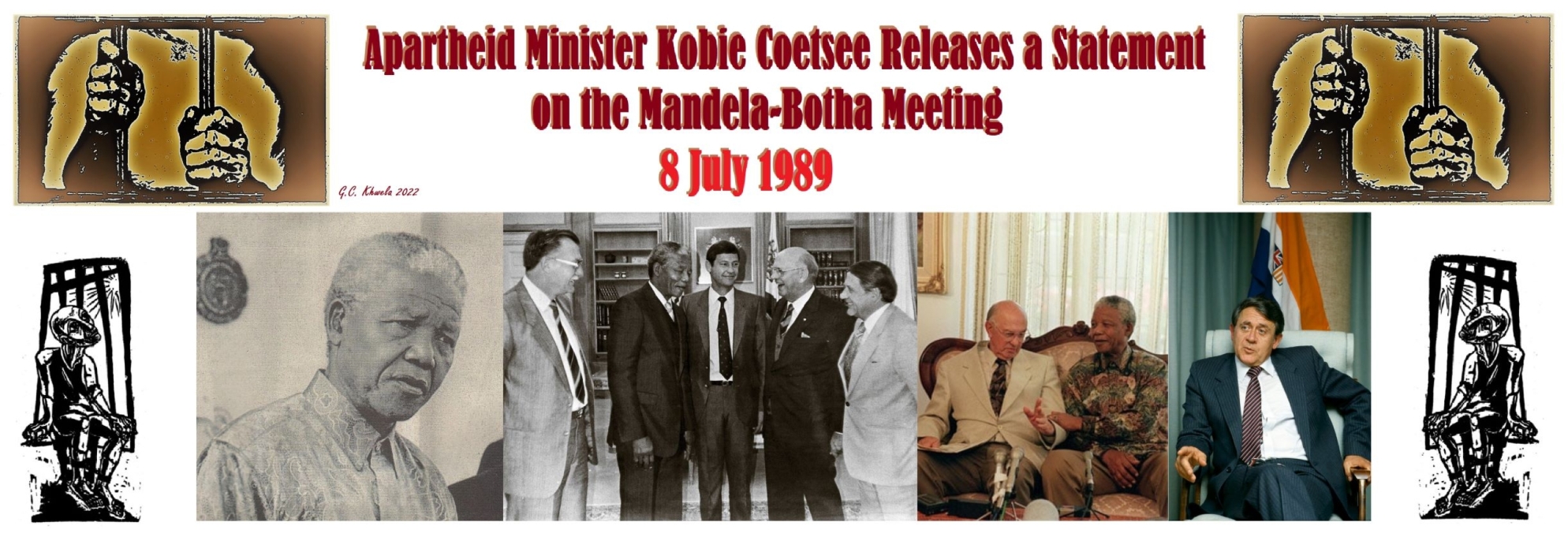
On 8 July 1989, three days after the meeting between apartheid President P.W. Botha and Nelson Mandela, Kobie Coetsee, the apartheid Minister of Justice, issued a statement, with Mandela’s permission, about the meeting. The statement was interestingly compiled by Mike Louw, Deputy Director-General of the National Intelligence Service (NIS), which explained that no policy matters were discussed and that no negotiations took place. However, both Mandela and Botha confirmed their support for “peaceful development in South Africa”.
Subsequently, the news bothered the African National Congress (ANC) and its revolutionary allies, as they were unaware of the developments happening between Mandela and the apartheid government. In Orlando, Soweto, at a news conference held at the Mandela house, Winnie Mandela and the General-Secretary of the South African Council of Churches (SACC), Reverend Frank Chikane, dismissed the meeting as a political ploy to mislead the masses and the international community.
In addition, the Spokesperson of the ANC in Lusaka, Tom Sebina, maintained that the meeting was not to be regarded as the beginning of the negotiation process, but a mere gimmick by the Botha regime to gain an upper hand on the then pending white elections. The ANC office in London also did not believe the news, and accordingly issued a statement declaring that Mandela was outmanoeuvred by the racist regime and was selling the Movement down the river. It was possible that this was an exercise by P.W. Botha to polish his ego in order to cover up his stroke. The South African Communist Party (SACP) was also dismayed by the news, as it viewed the meeting as a concerning eagerness for power, which could probably lead to a strongly repressive state.
On 10 July 1989, Winnie Mandela visited her husband at Victor Verster Prison to confirm the veracity of Coetsee’s statement. Mandela instead reprimanded her for casting suspicions on the talks with the apartheid government. Following confirmation that indeed the meeting did take place between Mandela and P.W. Botha, Bishop Desmond Tutu reacted positively to the news and saw the process as an attempt, after a long time, to listen to the calls for negotiations. However, he regretted the fact that the meeting was held unexpectedly and without prior information. Also, on behalf of the South African Council of Churches (SACC), Reverend Chikane thanked Mandela and praised him for the effort.
The engagement with Botha did not happen spontaneously, as a result of Mandela being outmanoeuvred by the racist regime, or without prior knowledge of his comrades, including ANC President Oliver Tambo. When the regime began engaging Mandela through Kobie Coetsee in 1987 and proposed to discuss serious proposals through a Special Committee, headed by Coetsee himself, Mandela made it clear to them that he wanted to meet with his comrades first before he could proceed with such engagements.
Secondly, he mentioned that it was critical that he should communicate with Oliver Tambo in Lusaka about what was taking place. And lastly, he intended to draft a memorandum to P.W. Botha, which laid out the views of the ANC on the vital issues affecting the country that would create talking points for any future engagements.
Mandela met and discussed the matter with his Comrades and even received a note from Oliver Tambo who was showing concerns about reports that Mandela was meeting with the racist regime. Mandela responded to Tambo’s note in a concise letter, telling him that yes he was talking to the government “about one thing and one thing only: a meeting between the National Executive of the ANC and the South African government”. Before Mandela submitted the memorandum he drafted to P.W. Botha, he made sure that Tambo got it first, in order to allay his fears and that of the National Executive of the ANC that he had not off the road with engaging the racist regime.
There was nothing sinister about Kobie Coetsee, the apartheid Minister of Justice, issuing a statement about the meeting between Nelson Mandela and apartheid President P.W. Botha, as this was done with Mandela’s permission. The challenge, however, was that the meeting was held in secret and its arrangement was not communicated to the general public as well as to some in the leadership of the ANC and the SACP. Hence mixed reactions were received regarding the meeting, which was nonetheless later clarified by Mandela himself, by the ANC President Oliver Tambo and by the South African Council of Churches (SACC).
Kobie Coetsee, whose original motive was to neutralise Mandela by offering him freedom in exchange for a public renunciation of violence, was among the first Afrikaner nationalist politicians to grasp the truth that white minority rule really was doomed. However, for those in the military establishment who still harboured intentions to neutralise the “Mandela figure” in South African and international circles, the news came down as a huge shock. It was accepted with a sense of disbelief that under their noses, and without their knowledge, the “Groot Krokodil” (Great Crocodile) had shaken hands with the world’s most famous living “terrorist” (Barnard).
Sources:
Wikipedia.
South African History Online (SAHO).
Dan van der Vat, “Kobie Coetsee: Afrikaner Leader Who Foresaw the Collapse of Apartheid and Met Mandela in Jail”, BusinessTech (BST), 5 August 2000.
Christopher S. Wren, “Pretoria Leader and Mandela Meet in Hint of Release”, The New York Times, 9 July 1989.
Jack Reed, “Mandela meets with Botha”, United Press International (UPI), 8 July 1989.
Waldimar Pelser, “An Historic Meeting”, Beeld, 8 July 1989.
Niël Barnard, “Secret Revolution: Memoirs of a Spy Boss”, Tafelberg, 2015.
Thula Simpson, “Umkhonto we Sizwe: The ANC’s Armed Struggle”, Penguin, 2016.
Nelson Mandela, “Long Walk to Freedom”, Abacus, 1994.
Castro Khwela
Good evening fellow Compatriots!
Discover more from CASTRO KHWELA
Subscribe to get the latest posts sent to your email.