Ashley Kriel Brutally Murdered – 9 July 1987
On the morning of 10 July 1987, Michelle Assure was alone at home when two Security Branch policemen, Warrant Officer Jeffrey Benzien and his colleague Strydom knocked on the door and demanded the whereabouts of her brother, Ashley Kriel. After denying knowing where he was, they then told her to go and identify his remains at the Salt River mortuary.
Actually, on 9 July 1987, 20-year-old Ashley Kriel was murdered by the apartheid police. On that day, apartheid Security Branch Captain William Liebenberg informed Warrant Officer Benzien and Sergeant Abels to go to 8 Albermarle Road in Athlone. Liebenberg told them to perform surveillance and determine if the trained African National Congress (ANC) “terrorist”, Ashley Kriel, was in the house or one of the adjacent properties. Benzien, told Abels to knock on the back door of the house. After a couple of minutes of Abels knocking, Ashley Kriel opened the door, carrying a towel and a jersey. Next thing Kriel was killed.
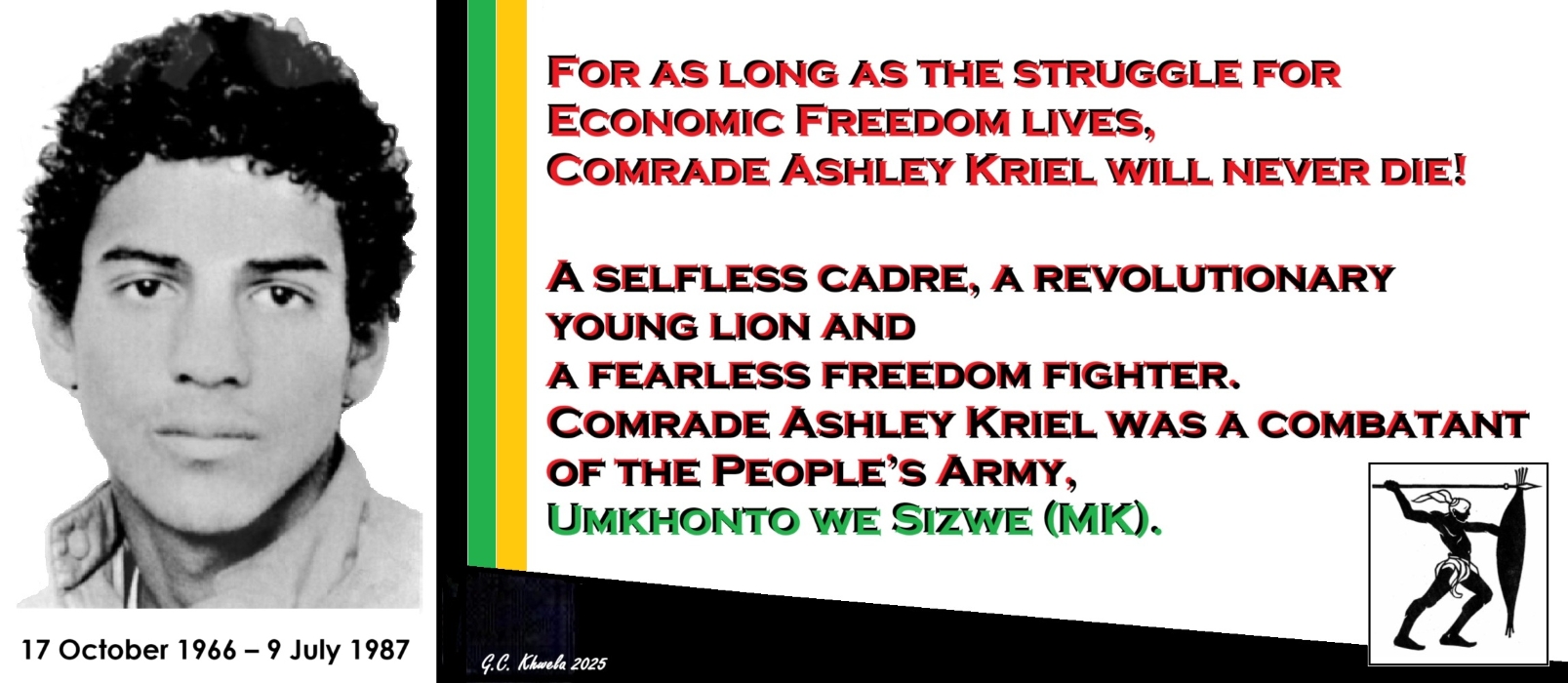
Ashley James Kriel was born on the 17 October 1966 to Ivy and Melvin Kriel. He grew up in Bonteheuwel, in Cape Town, which is a township on the Cape Flats and also went to school in Bonteheuwel. Despite a year at Athlone High School in 1982, he returned to Bonteheuwel High and finished his education there in 1985. As a result of his leadership skills, Kriel soon became an influential leader of the youth in Bonteheuwel.
Between the years 1981 and 1985 he was a founder member of Bonteheuwel Inter School Congress, became actively involved in the workers struggle and actively supported the United Democratic Front’s (UDF) anti-election campaign during the Tri-cameral Elections. Kriel was described by his family and friends as a natural born leader and very politically aware. As a result of these leadership skills, Kriel soon became an influential leader of the youth in Bonteheuwel, despite still being a teenager.
Along with close friend, Henriette Abrahams, Kriel organised the youth of Bonteheuwel into school boycotts, protests and other actions in line with the ANC’s call to make the country ‘ungovernable’ with plans that the inter-school Students’ Representative Council (SRC) named ‘Days of Action’. As a result of the unrests in Bonteheuwel, the apartheid Security Branch assigned a special unit to the area. Kriel was one of ‘The Five’ student leaders who were specifically targeted by this unit. They included Anton Fransch, Andrew ‘Gorrie’ November, Coline Williams and Gary Holtzman. Of the five, three were assassinated by 1990 with Coline Williams and Anton Fransch being killed in 1989.
Due to the intense attention by the apartheid Security Branch, Kriel had to go underground when he was only 18 years old. While he was underground, he became part of Umkhonto we Sizwe (MK), the armed wing of the ANC. Eventually, Kriel had to go into exile on 27 December 1985, finally ending up at an MK training camp, named Quibaxe, in north-eastern Angola. While at MK Quibaxe Camp, various acquaintances and friends state that Kriel grew into manhood. One of his comrades, Gary Holtzman, remarked in a documentary, titled “Action Kommandant”, that he was surprised to find that Kriel was now “proficient in Zulu”. He was trained in the use of various small firearms as well as in the use of homemade explosives and unarmed combat.
After completing his training, the decision was made to send him back to South Africa, as in 1987, Ashley Kriel re-entered the country via Lusaka and then Gaborone. Due to the nature of actions in which MK operatives were involved, they had to operate in secrecy. As such, Kriel was not able to contact his family or friends. He did, however, take up residence in the backroom of his old teacher’s house. From here, Kriel co-ordinated with his comrade, Nicklo Pedro, who was another MK operative.
On 9 July 1987, Kriel answered the door to his room, thinking that the men outside were municipal workers. The events that followed are disputed. The official police record states that Kriel was carrying a pistol under a towel. When he opened the door, the apartheid policemen pushed in, and in the ensuing scuffle to get him in handcuffs, Kriel’s pistol fired. This version of the events was outlined by Captain Jeffrey Benzien at the Truth and Reconciliation Commission (TRC) hearings.
However, an independent forensic investigator, Dr David Klatzow, refuted this version of events. He stated that the forensic evidence did not support Benzien’s testimony. Specifically, Klatzow pointed to the fact that the gunshot wounds on Kriel’s body were not close contact wounds but rather consistent with a shot fired from further away. Klatzow believed Kriel was shot from a distance while handcuffed. In spite of the doubts around Benzien’s testimony, he was granted amnesty by the Truth and Reconciliation Commission (TRC) for the killing of Kriel.
What is known as fact is that when the apartheid government finally found him, they cuffed and dragged him, beat him with a spade (on places like his forehead and throat), slit his throat and shot him in the back to make sure that he was truly dead because that is how much they feared him. His sister Michel returned to the house and found blood in numerous places, inside and outside, including on a spade, and believes he was tortured. The apartheid government held him responsible for all the unrests in Bonteheuwel in the early to mid-1980s and feared him because of it. They were so afraid of him, that they hunted him day and night, mercilessly harassing his family and anybody that was seen as being close to him. They were so afraid of him, that they could not let him live when they finally caught up with him in Athlone.
As Kriel’s family did not know he was in the country, his death came as a huge shock to them. His funeral was held on 20 July 1987 and became a site of contestation between the police and the people of Bonteheuwel. On the day of his funeral, the police surrounded his house with guns and Caspers, everywhere there were police, because that is how much they feared him. Kriel’s stature in the community was evidenced by the attendance of the likes of Archbishop Desmond Tutu, Dr Allan Boesak and Molena Faried Essack.
Chaos ensued after the funeral when the police tried to remove an ANC flag that was draped over Kriel’s coffin. Essack and Boesak threw themselves on the flag to stop the police from removing it. Kriel’s coffin was then borne by the crowds amid the flying teargas canisters. As the mourners left the church with his coffin, police started opening fire on those holding the coffin. The coffin bearers had to start running but they refused to let go of the coffin, even at one point, having to throw the coffin over the concrete wall so that they could get into the church. Police tried to storm the church but once again, they failed to get the body of Ashley Kriel. The police once again opened fire and even tried to shoot the hearse carrying his body off the road, as the driver fainted and Ashley’s sister had to quickly grab the wheel before they ended up in an accident.
Ashley Kriel was posthumously awarded the Joe Modise Commanding and Leadership Excellence Award, as well as the Stanza Bopape Young Martyr Memorial Award on 27 October 1996. On his release from prison in February 1990, the leader of the ANC and founder member of MK and its first Commander-in-Chief, Nelson Mandela, acknowledged Ashley Kriel’s sacrifice for the anti-apartheid struggle in his speech in Paarl. The Institute for Justice and Reconciliation and the University of the Western Cape (UWC) created the annual Ashley Kriel Memorial Youth Lecture in his memory, in order to highlight youth leadership challenges throughout the country.
At this funeral the following was said: “Ashley was indeed a great and feared leader, but despite all of this, he was still a son, a brother and a friend. He was described as an outstanding leader, hardworking, brilliant, fearless, but most importantly, he was described as kind and compassionate.”
“They knew the truth!”
Sources:
Wikipedia.
South African History Online (SAHO).
South African History Archives (SAHA).
Nathan Adams, “Justice for Ashley Kriel the Best Form of Commemoration”, Weekend Argus, 11 July 2021.
Okuhle Hlati, “We will get the truth on who ended Ashley Kriel’s life”, Cape Times, 17 November 2020.
Marelise van der Merwe, “Ashley Kriel: The struggle of Memory Against Forgetting”, Daily Maverick, 14 Jul 2016.
South Africa Move, “Ashley Kriel: The Story of a Leader”, South Africa Move, 7 June 2016.
Truth And Reconciliation Commission, “Nature of Violence: Shot and Killed by Police”, Truth and Reconciliation Commission Hearing, University of the Western Cape, 5 August 1996.
Thula Simpson, “Umkhonto we Sizwe: The ANC’s Armed Struggle”, Penguin, 2016.
Castro Khwela
Good evening fellow Compatriots!
Discover more from CASTRO KHWELA
Subscribe to get the latest posts sent to your email.